

New Delhi: The Earth’s climate is now more out of balance than at any point in recorded history, the World Meteorological Organization (WMO) has warned in its State of the Global Climate Report 2025 released on Monday. The report highlights how rising greenhouse gas concentrations are driving unprecedented warming of the atmosphere and oceans, along with widespread melting of ice, with consequences expected to last for hundreds or even thousands of years.
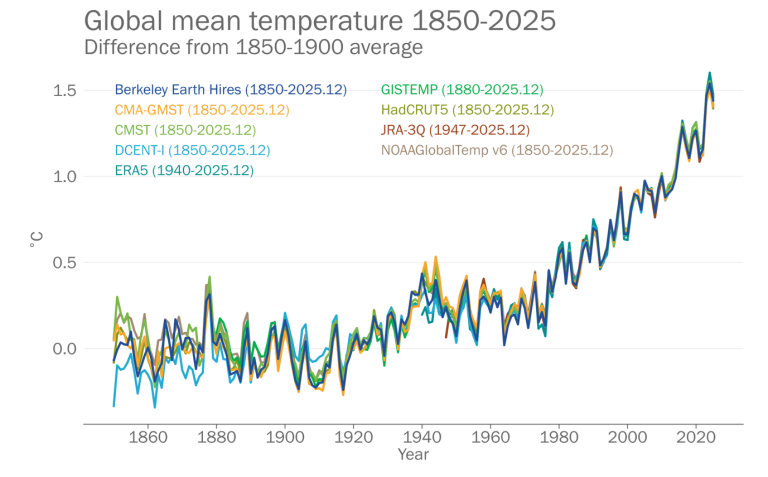
According to the report, the period from 2015 to 2025 marks the hottest 11-year stretch ever recorded, with 2025 ranking as the second or third warmest year, reaching approximately 1.43 °C above the 1850-1900 average. Extreme weather events, including heatwaves, heavy rainfall, and tropical cyclones, have caused widespread destruction, underscoring the vulnerability of interconnected global economies and societies.
The oceans, which play a critical role in regulating the planet’s temperature, continue to absorb vast amounts of heat and carbon dioxide. Over the past two decades, they have taken in energy equivalent to about 18 times the annual human energy consumption each year. Meanwhile, Arctic sea ice levels were at or near record lows in 2025, Antarctic sea ice reached its third lowest extent, and glaciers around the world continued to melt at alarming rates.
“Global climate is in a state of emergency. Planet Earth is being pushed beyond its limits. Every key climate indicator is flashing red,” said UN Secretary General António Guterres. “Humanity has just endured the 11 hottest years on record. When history repeats itself 11 times, it is no longer a coincidence. It is a call to act,” he added.
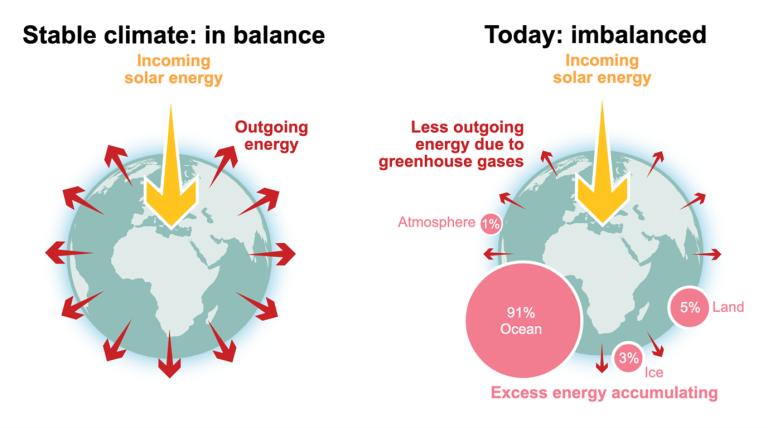
Released on World Meteorological Day (March 23), under the theme ‘Observing Today, Protecting Tomorrow’, the report introduces the Earth’s energy imbalance as a key climate indicator for the first time. This imbalance measures the difference between incoming solar energy and outgoing heat from the Earth system. While a stable climate requires these to be roughly equal, increasing levels of greenhouse gases such as carbon dioxide, methane and nitrous oxide — now at their highest in at least 800,000 years — have disrupted this balance.
The report notes that the Earth’s energy imbalance has been rising since measurements began in 1960, with a particularly sharp increase over the past 20 years, reaching a new peak in 2025.
“Scientific advances have improved our understanding of the Earth’s energy imbalance and of the reality facing our planet and our climate right now,” said WMO Secretary General Celeste Saulo. “Human activities are increasingly disrupting the natural equilibrium and we will live with these consequences for hundreds and thousands of years.”
She further emphasized the growing severity of daily weather conditions. “On a day-to-day basis, our weather has become more extreme. In 2025, heatwaves, wildfires, drought, tropical cyclones, storms and flooding caused thousands of deaths, impacted millions of people and caused billions in economic losses,” said Saulo.
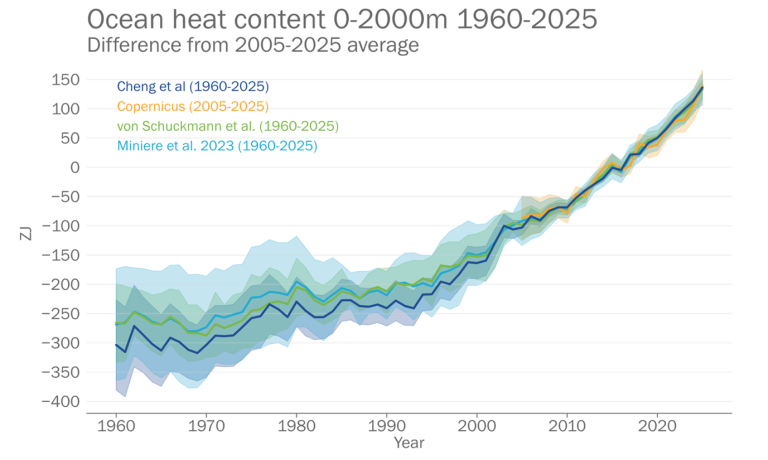
The report explains that only 1% of the excess heat is felt in the atmosphere near the Earth’s surface, while about 5% is stored in land masses. The vast majority (over 91%) is absorbed by the oceans, which act as a buffer against even greater temperature increases on land. Ocean heat content reached a record high in 2025, with its rate of warming more than doubling between 1960-2005 and 2005-2025.
An additional 3% of excess energy is contributing to the warming and melting of ice. Significant mass loss has been recorded in both Greenland and Antarctic ice sheets, while Arctic sea ice reached its lowest or second lowest annual extent in the satellite era. Notable glacier loss was also reported in Iceland and along the Pacific coast of North America.
These changes are accelerating global sea level rise, which has been increasing at a faster rate since satellite observations began in 1993. Scientists warn that ocean warming and rise of sea level will continue for centuries, with some impacts such as changes in deep ocean chemistry being irreversible on timescales of hundreds to thousands of years.
The report also examines the cascading impacts of extreme weather events, including food insecurity and displacement, as well as the growing link between climate change and health risks. Rising temperatures and shifting rainfall patterns are influencing the spread of diseases like dengue and increasing the severity of heat stress, particularly among vulnerable populations.
“And in this age of war, climate stress is also exposing another truth: our addiction to fossil fuels is destabilizing both the climate and global security. Today’s report should come with a warning label: climate chaos is accelerating and delay is deadly,” said Guterres.
(Cover Photo by Markus Spiske on Unsplash)