

New Delhi: The warning has been issued early, and it is unusually stark. As India enters the peak summer months, the Union Health Ministry has alerted states and Union Territories to brace for what could be an exceptionally harsh heatwave season in 2026. Drawing on projections from the India Meteorological Department, the advisory forecasts above-normal heatwave days between April and June across East, Central, and North-West India, alongside the South-East Peninsula. Coastal belts of Odisha, West Bengal, Tamil Nadu, Puducherry, and Andhra Pradesh are also expected to face severe conditions, with isolated pockets in Gujarat, Maharashtra, and Karnataka likely to be affected.
The response has begun in fragments. Delhi has already rolled out a heatwave action plan, mandating work breaks between 1 pm and 4 pm for outdoor labourers, distributing oral rehydration solutions to students, and setting up water points across the city. The Centre has instructed states to establish dedicated Heat Stroke Management Units, ensure fully staffed ambulance services, disseminate early warnings, and report heatstroke cases in real time through the Integrated Health Information Platform.
Yet, beneath these administrative measures lies a deeper and more unsettling reality: India’s cities are becoming the epicentres of a slow-burning public health crisis. The danger is not merely the heat itself, but the unequal ways in which it is experienced. The real question is no longer whether India can endure hotter summers, but whether its urban populations can survive them with dignity and equity.
Urban Heat Trap
The crisis unfolding across Indian cities is neither accidental nor evenly distributed. It is structural, layered, and deeply unequal. Though not conducted the Indian context, the study ‘Disentangling Urban Vulnerability to Rising Temperatures’, published online in The Lancet Planetary Health offers a critical lens to understand this phenomenon.
“Rising temperatures are already taking a severe toll on human health, contributing to an estimated average of 5,46, 000 heat-related annual deaths globally,” highlights the report. It further warns that “the temporary exceedance of 1·5°C above pre-industrial levels in 2024 shows that the world is rapidly approaching the planetary boundary for climate change, with escalating risks to lives, livelihoods, and health systems.”
These global warnings resonate with particular urgency in India’s urban landscape. More than half of the world’s population now lives in cities, and India is urbanising at a rapid pace. But cities, by their very design, intensify heat. Dense built environments, concrete surfaces, vehicular emissions, and shrinking green cover create what is known as the urban heat island effect, where temperatures in cities are significantly higher than in surrounding rural areas.
“Cities emerge as hot spots… with higher temperatures than their rural surroundings due to dense built environments, extensive impervious surfaces, and related human activities,” says the report published in The Lancet.
In India, this phenomenon is visible from Delhi’s concrete sprawl to Kolkata’s congested neighbourhoods and Mumbai’s high-rise clusters. Informal settlements, often built with thermal-retentive materials and lacking ventilation, become “heat traps”. The absence of tree cover, open spaces, and water bodies exacerbates the problem.
However, the report insists that heat alone does not define risk. Instead, it introduces a crucial framework: vulnerability is shaped by exposure, susceptibility, and adaptive capacity. This triad is key to understanding why heatwaves kill some and spare others.
Inequality in Heat
The most striking contribution of the report lies in its dissection of vulnerability. It challenges simplistic assumptions that certain demographic groups are uniformly at risk, and instead highlights how multiple factors intersect.
High temperatures do not affect all urban residents equally, says the report. Vulnerability varies widely and reflects the interaction of three factors: exposure (degree to which individuals encounter heat), susceptibility (extent to which individuals are adversely affected when exposed — as shaped by biological, social, and environmental factors), and adaptive capacity (the ability to anticipate, prepare for, respond to, and recover from heat-related impacts).
“Health risks or impacts are, therefore, understood as a function of the climate hazard itself (ie, temperature), interacting meteorological and environmental conditions (ie, air pollution and humidity), and the underlying vulnerability of the affected populations. Disparities in vulnerability are often rooted in intersecting systems of inequality, including economic injustice, social exclusion, and colonial legacies,” it notes.
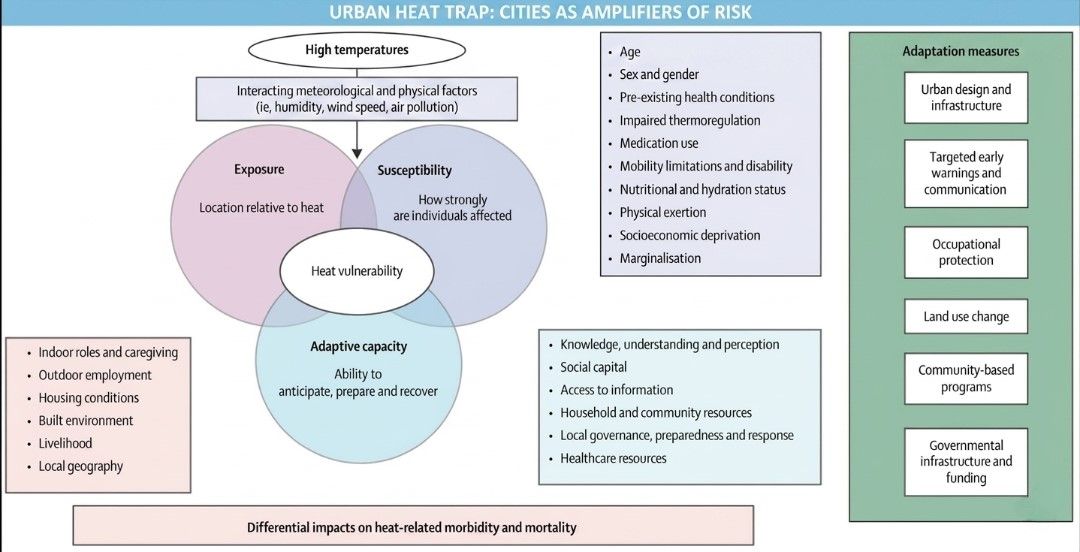
Source: The Lancet - Planetary Health
Recent studies on temperature-related impacts usually treat vulnerability as one single concept. They often focus on higher risks for certain groups based on factors like gender, age, or income level. However, they don’t look closely at how different aspects of vulnerability — such as how much people are exposed to heat, how sensitive they are to it, and how well they can cope — work together to create these risks. Understanding how these factors interact is important. It helps authorities design fair and effective solutions that better protect people who are most at risk and improve their ability to deal with extreme heat.
This is particularly relevant to India, where inequality is deeply embedded in urban life. Exposure refers to the degree to which individuals encounter heat. In Indian cities, this is often determined by occupation and location. Construction workers, street vendors, sanitation workers, and traffic police are directly exposed to extreme temperatures for prolonged hours. Similarly, residents of densely populated slums experience higher ambient temperatures due to poor housing and lack of ventilation.
Susceptibility, on the other hand, relates to how severely individuals are affected when exposed. Age, pre-existing health conditions, nutrition, and social isolation all play a role. While older adults are often considered highly vulnerable, the report offers a nuanced perspective: “Age-stratified analyses showed no significant differences in heat exposure across age groups… other factors, such as physiological susceptibility and adaptive capacity, may be more likely to drive heightened vulnerability.”
Perhaps the most critical dimension is adaptive capacity: the ability to cope with and recover from heat stress. This includes access to cooling, healthcare, information, and social support. In India, adaptive capacity is sharply divided along economic lines. Air conditioning, reliable electricity, access to healthcare, and even awareness of heat risks remain privileges rather than rights.
The report’s case study of Madrid reveals patterns that are uncannily similar to Indian cities. “Clear hot spots where high cooling ‘degree hours’ overlap with low income are primarily located in… districts with high population densities and low average income,” says the report. It further notes that “populations in the lowest income quartile experience, on average, 592 additional cooling degree hours per year than those in the highest quartile.”
Translated to the Indian context, this means that the urban poor not only face higher temperatures but endure them for longer durations, with fewer resources to cope. Heat, therefore, becomes not just an environmental hazard but a social injustice.
Rethinking Policy
India’s current approach to heatwaves remains largely reactive. Heat action plans, early warnings, and emergency responses are necessary but insufficient. The deeper challenge lies in addressing the structural drivers of vulnerability.
The report underscores the importance of tailoring interventions to the dominant drivers of vulnerability. “When exposure differences dominate, adaptation measures should focus on reducing direct contact with heat through urban design and environmental modification,” says the report published in The Lancet. “When susceptibility is the primary driver, interventions should focus on reducing physiological or social susceptibility… When low adaptive capacity mainly underlies vulnerability, strategies should prioritise strengthening resources, infrastructure, and governance mechanisms.”
For India, this translates into a multi-layered policy agenda. Urban planning must prioritise heat-resilient infrastructure — increasing green cover, preserving water bodies, and promoting climate-sensitive architecture. Labour laws must evolve to protect outdoor workers, ensuring regulated work hours, mandatory breaks, and access to hydration.
Public health systems need to be strengthened, not just to treat heatstroke but to anticipate and prevent it. Real-time data collection is a step in the right direction, but it must be complemented by localised interventions.
Equally important is addressing adaptive capacity. Affordable cooling solutions, reliable electricity, and accessible healthcare must be treated as essential services. Community-level awareness campaigns can empower citizens to recognise and respond to heat risks.
At its core, the challenge is one of equity. “Embedding this multidimensional understanding of heat vulnerability can foster adaptation strategies that are effective, just, and resilient… Only then will adaptation efforts advance towards transformative, equitable, and sustainable solutions,” says the report.
India stands at a critical juncture. The heatwave warnings of 2026 are not an anomaly but a preview of the future. The question is whether the country will continue to treat heatwaves as seasonal emergencies or recognise them as enduring structural crises. If cities are the future, they must also be made survivable. And that requires moving beyond managing heat to confronting the inequalities that make it deadly.