

New Delhi: War-triggered fuel supply disruptions are once again rippling through global energy markets, exposing the fragility of oil-dependent economies and pushing pump prices sharply higher. From the Middle East conflict to tightening supply chains, the immediate impact has been felt in household budgets, freight costs and inflation trajectories. But beyond the short-term economic shock lies a deeper structural question: Will rising oil prices lead to more sustainable transport habits?
The People and Climate Change 2026 report by Ipsos suggests the answer is neither straightforward nor uniform. While higher fuel costs are already nudging behavioural change, the transition to sustainable mobility remains constrained by affordability, infrastructure and public sentiment shaped as much by economic anxiety as environmental awareness.
There is little ambiguity about the scale of this war-triggered disruption. The report underscores that energy price anxiety is now near universal, with 74% of respondents across 31 countries expressing concern about rising energy costs. This is not a distant macroeconomic concern. It’s translating into immediate behavioural adjustments.
“This concern is not hypothetical, it is driving real change right now, which will impact economies, societies, and governments around the world in a big way,” says the report.
Transport behaviour is among the first to respond. In the United States, 58% of respondents reported driving less following the surge in fuel prices after the Iran-Israel conflict. Elsewhere, governments have begun experimenting with demand-side responses, including making public transport temporarily free in parts of Australia.
Such shifts are consistent with economic theory: when variable costs rise sharply, consumption adjusts. Yet the report makes clear that this is only the first layer of change. Short-term conservation — driving less, consolidating trips, switching to public transport — does not automatically translate into long-term structural transformation.
“Citizens around the world are asking themselves how the geography of such a far-off place can have such a profound impact on their quality of life and their future,” says the report.
This growing awareness of energy vulnerability is significant. It reframes mobility not merely as a personal choice, but as a function of geopolitical risk and national resilience. However, whether this awareness accelerates sustainable transport adoption depends on deeper economic and infrastructural factors.
EVs: Intent meets constraint
If rising oil prices are expected to catalyse a shift to electric vehicles (EVs), the evidence remains mixed. On paper, the economics are becoming more favourable. As fuel costs rise, the total cost of ownership for EVs improves, narrowing the gap with internal combustion engine vehicles.
Yet the report highlights a persistent disconnect between intent and action. While 47% of respondents globally say driving an EV appeals to them, actual purchase intent remains significantly lower, particularly in developed markets. “One of the things we found when it came to EVs was the lack of appetite among many countries surveyed,” says the report.
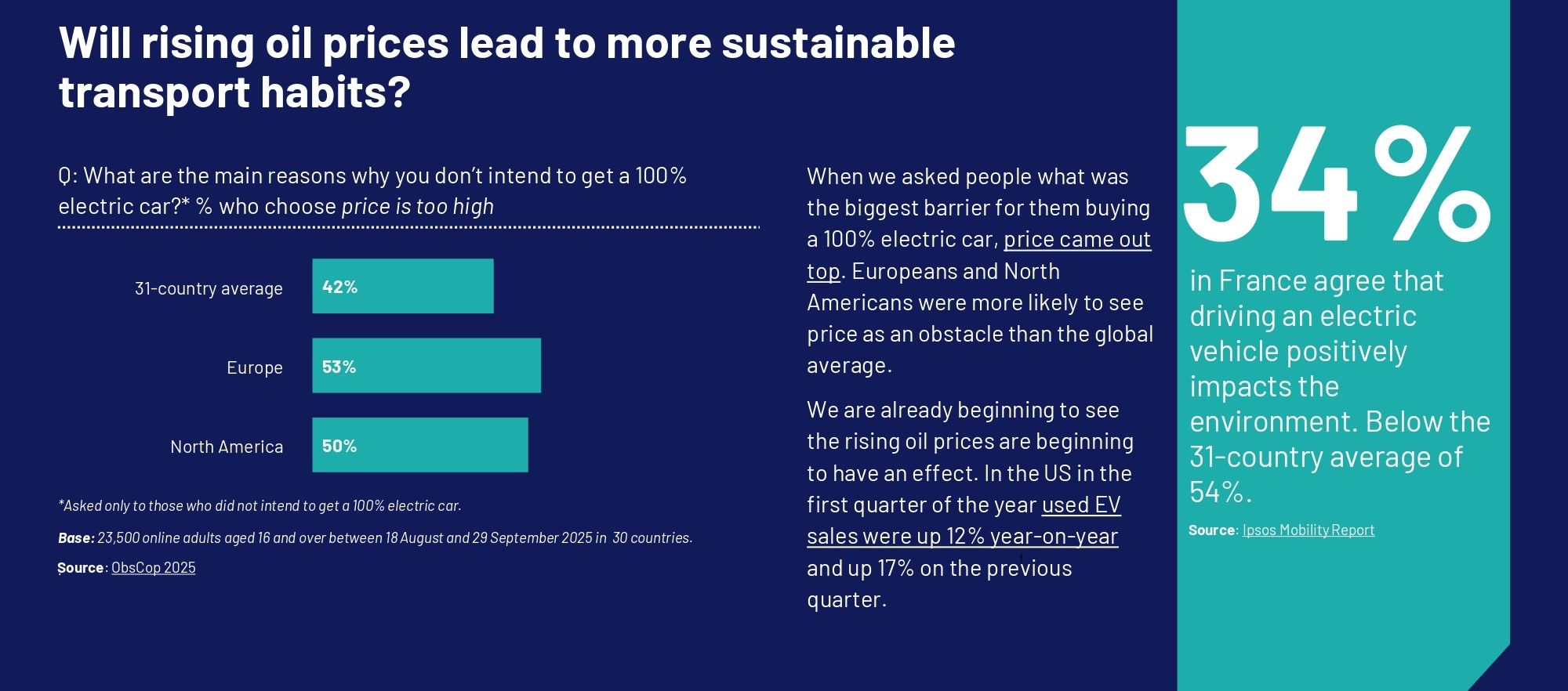
The barriers are well established but remain stubborn. Price continues to dominate, with 42% globally citing high upfront cost as the primary deterrent — rising to 53% in Europe and 50% in North America. Concerns about range, charging infrastructure and perceived effectiveness in reducing emissions further complicate adoption.
At the same time, there are early signs of momentum building under the pressure of higher fuel prices. Used EV sales in the United States rose 12% year-on-year in the first quarter, while Australia recorded a 50% surge in EV sales in March 2026. “As the cost of fuel rises, the higher upfront cost of an EV compared to a petrol or diesel car will be offset sooner,” notes the report.
This is a crucial inflection point. Rising oil prices improve the relative economics of EVs, but only to a degree. Without parallel improvements in affordability — through subsidies, financing models or cheaper models — the transition risks stalling at the level of early adopters.
The report’s findings from France illustrate this tension. While 47% view EVs favourably, only 7% are actively considering purchase. Cost remains the dominant barrier, cited by 62% of respondents, alongside concerns about range and charging infrastructure.
In effect, rising oil prices are necessary but not sufficient to drive mass EV adoption. They create the conditions for change, but not the certainty.
Energy Trilemma
At the heart of the transport transition lies what the report describes as the “energy trilemma”: the competing demands of cost, security and sustainability. Consumers want all three, but are increasingly aware that trade-offs are inevitable. “Cost, security and climate: people want all three, and they know they can’t always have them,” says the report.
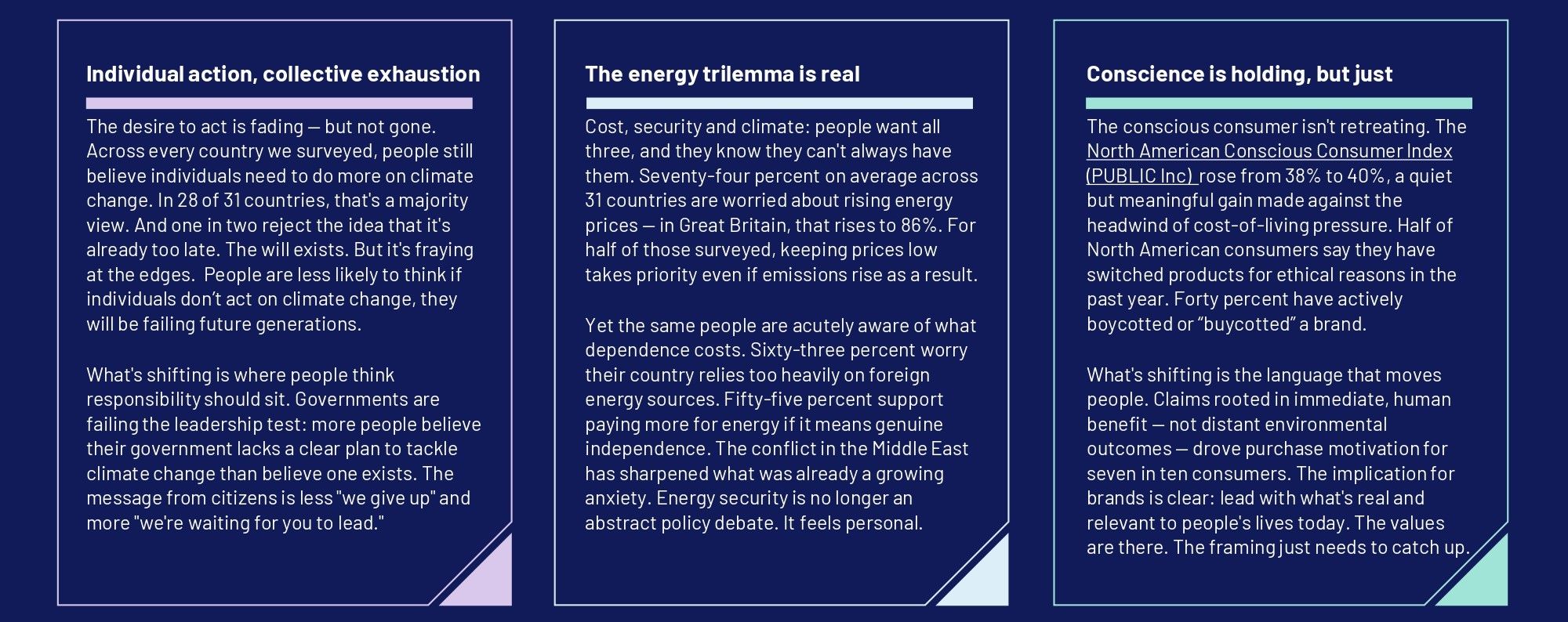
This tension is clearly visible in public attitudes. While there is strong concern about climate change, half of respondents globally say governments should prioritise keeping energy prices low even if emissions rise. At the same time, 55% support paying more for energy if it ensures independence from foreign sources.
This duality has direct implications for transport behaviour. On one hand, high fuel prices incentivise reduced consumption and interest in alternatives. On the other, economic pressure can delay capital-intensive decisions such as purchasing an EV. “Support for the energy transition remains broad but increasingly pragmatic, shaped by concerns about affordability, reliability, security, and climate,” says the report.
In practical terms, this means consumers are more likely to adopt incremental changes — driving less, using public transport, or opting for hybrid vehicles — rather than making immediate, large-scale shifts to fully electric mobility.
The report also highlights a deeper structural issue: confidence in energy systems. Only 46% of respondents globally believe their region will have sufficient electricity to meet future demand, while 39% worry about potential blackouts. Such concerns can dampen enthusiasm for electrification, particularly in markets where infrastructure is perceived as unreliable.
In this context, rising oil prices may accelerate behavioural change at the margins, but systemic transformation requires coordinated investment in infrastructure, policy support and clear communication.
Sustained Transition
The critical question is whether the current oil price shock will produce lasting change or merely temporary adjustment. Historical precedent suggests that behaviour often reverts once prices stabilise. The report acknowledges this uncertainty. “It remains to be seen whether this will lead to a long-term shift or will be reversed if the oil price falls,” says the report.
However, there are reasons to believe that this cycle may be different. The convergence of geopolitical instability, climate risk and technological change is creating a more durable case for transition.
First, energy security is becoming a central policy priority. With 63% of respondents worried about reliance on foreign energy sources, there is growing public support for domestic, renewable energy systems. This aligns with the electrification of transport, which reduces dependence on imported oil.
Second, climate awareness, while evolving, remains significant. Sixty-one percent of respondents say failure to act on climate change would mean failing future generations, even though this sentiment has declined in recent years. “People still believe action is needed — in 28 of 31 countries, a majority say individuals must do more,” finds the report.
Third, consumer behaviour is showing signs of resilience. Despite cost-of-living pressures, values-based decision-making persists, with the Conscious Consumer Index rising from 38% to 40%. This suggests that a larger share of purchasers now factor in social and environmental considerations when making purchases
Yet the Ipsos report also points to a growing sense of fatigue and shifting responsibility. Individuals increasingly expect governments and businesses to lead the transition. “The message from citizens is less ‘we give up’ and more ‘we’re waiting for you to lead’,” says the report.
This has direct implications for transport policy. Without clear incentives, infrastructure investment and regulatory frameworks, rising oil prices alone are unlikely to deliver a sustained shift to sustainable mobility.
Fragile Inflection Point
Rising oil prices are undeniably altering transport behaviour, but the nature of that change is nuanced. In the short term, higher fuel costs are prompting reduced driving and greater use of public transport. In the medium term, they are improving the economic case for electric vehicles. In the long term, they are reinforcing the strategic imperative of energy independence.
However, the transition to sustainable transport remains contingent on factors that extend beyond price signals. Affordability, infrastructure, policy clarity and consumer confidence will determine whether the current moment becomes a genuine inflection point or a missed opportunity.
Notably, the Ipsos report ultimately presents a picture of cautious momentum rather than decisive transformation. Rising oil prices are pushing consumers in a greener direction, but not yet pulling them across the line.
The answer to the central question, then, is conditional. Yes, rising oil prices can lead to more sustainable transport habits, but only if supported by systemic change. Without it, the risk is that today’s behavioural shifts remain just that: temporary responses to a volatile market, rather than the foundation of a cleaner mobility future.
(Cover photo by CHUTTERSNAP on Unsplash)