
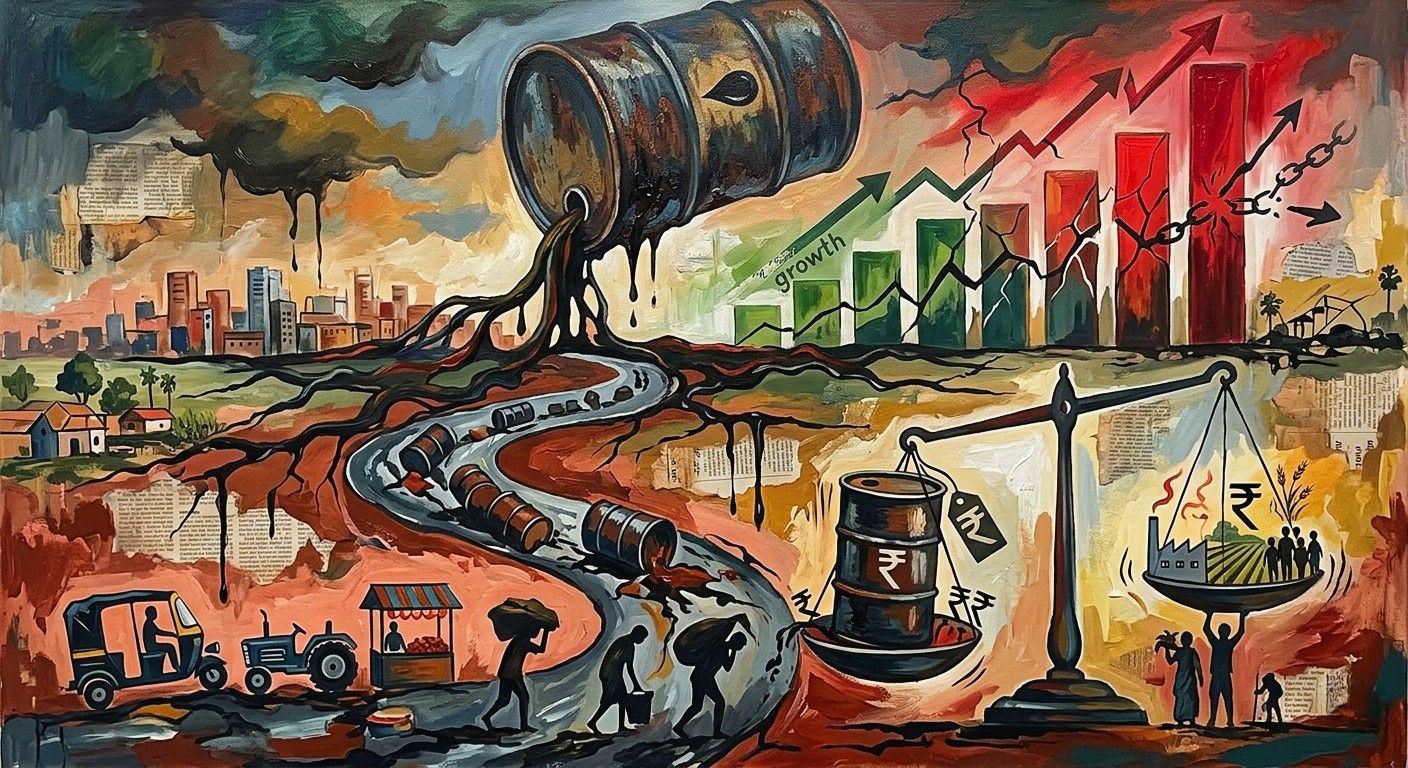

New Delhi: The Reserve Bank of India has flagged rising crude oil prices as a major threat to the country’s external sector outlook, warning that prolonged geopolitical tensions and supply disruptions could widen the current account deficit, fuel inflationary pressures and test macroeconomic stability.
In the May edition of the RBI Bulletin, the central bank said global economic conditions were becoming increasingly uncertain amid geopolitical fragmentation, financial market volatility and disruptions in energy supply chains.
“Energy prices have risen sharply amidst damages to energy infrastructure and disruptions in supply chains. It has already affected economic activity. If the crisis persists longer, it may also translate into second order inflationary pressures,” RBI Governor Sanjay Malhotra said in the Bulletin.
The RBI’s assessment comes at a time when global crude oil markets are witnessing heightened volatility due to escalating tensions in West Asia, a region that remains critical to global energy supplies. For India, one of the world’s largest crude importers, any sustained spike in oil prices directly impacts import costs, trade balances, inflation and the rupee.
The country’s apex bank underlined that the global economy was “navigating through a period of elevated uncertainty and challenges”, with trade restrictions, tariff wars and geopolitical rivalries reshaping financial and trade flows.
“Geo-economic fragmentation caused by tariffs, trade restrictions, and industrial policies are reshaping not only global supply chains, they are also affecting the free movement of capital and led to fragmentation of financial flows,” the RBI noted.
It also highlighted risks arising from high public debt levels in advanced economies, rising defence expenditure and stretched valuations in global financial markets. “Stretched valuations in certain asset classes, particularly equities including a few tech stocks, could also have implications across markets and geographies,” the report said.
Apart from commodity-linked risks, the RBI pointed to the rapid expansion of global private credit markets and growing inter-connectedness within financial systems as emerging sources of systemic vulnerability.
The Bulletin further observed that AI has added a new layer of uncertainty to the global economy. “While AI holds promise to enhance productivity, concerns remain about viability of certain business propositions, the level of efficiency gains, the speed of change and its impact on jobs,” the RBI said.

Strong domestic consumption and sustained public capex spending continue to anchor India’s growth momentum, with government investment catalysing private sector expansion and boosting productive capacity, according to the RBI. (Photo by Manik Choudhary on Unsplash)
India’s Economic Resilience
Despite the challenging external environment, the RBI maintained that India’s macroeconomic fundamentals remained robust and capable of withstanding global shocks better than many peer economies. “Against this challenging global backdrop, the Indian economy has shown remarkable resilience,” the Governor said.
According to the RBI, strong domestic demand, sustained government capital expenditure and improving corporate balance sheets continue to support economic growth momentum.
“Domestic demand continues to be supported by strong consumption and public investment. The government’s emphasis on capital expenditure has helped crowd-in private investment and improve productive capacity,” the report said.
India recorded an average growth of 8.2% during 2021-25, while growth for 2025-26 is estimated at 7.6%. The RBI has projected GDP growth of 6.9% for 2026-27.
The central bank also stressed that India’s banking and non-banking financial sectors had undergone a “remarkable transformation” in recent years, supported by stronger asset quality, profitability and capital adequacy.
Corporate financing conditions have also improved, with increased mobilisation through public and corporate bond markets.
On the external front, the RBI said India’s foreign exchange reserve position continued to provide a strong cushion against global volatility. “Our foreign exchange reserves remain comfortable, with 11 months of import cover,” Malhotra said.
The RBI acknowledged, however, that elevated crude oil prices would continue to exert pressure on India’s current account balance.
“The current account deficit (CAD) is sustainable; while elevated energy prices will exert upward pressure on the deficit, the recently concluded trade agreements should offset some of the impact,” he added.
The report also pointed to encouraging trends in foreign direct investment inflows. “Gross FDI grew from about $71 billion to more than $80 billion during 2024-25 and expected to have increased further to about $90 billion in 2025-26,” according to the report.
The RBI further noted that recent corrections in global financial markets could reduce repatriation pressures and improve India’s net capital account position in the coming quarters.
Inflation Watch Tightens
The central bank’s latest observations indicate that policymakers remain particularly concerned about the inflationary spillovers of higher crude oil prices, especially if energy shocks become prolonged and widespread.
Addressing a global monetary policy discussion cited in the Bulletin, the Governor said central banks across the world were increasingly adopting flexible and data-dependent policy approaches to navigate supply-side disruptions.
“Supply shocks pose a challenge – pre-emptive and sharp policy tightening, if the shock is temporary, can exacerbate loss of output (growth foregone), while delaying the same can lead to unhinging of inflation expectations,” he said.
The RBI Governor added that policymakers were carefully assessing whether current energy-related inflation pressures were temporary or broad-based enough to warrant monetary tightening.
“Regarding the current energy shock, we have clearly articulated in our MPC resolution of April 2026 that the economy is confronted with a supply shock and it may be prudent to wait and watch the changing circumstances and the evolving growth-inflation outlook,” Malhotra said.
“We are keeping a close vigil on whether and when the supply shock can become embedded in the general price level that may warrant monetary policy action,” he added.
The RBI also reiterated confidence in India’s inflation-targeting framework, arguing that the regime had improved inflation stability and policy credibility over the last decade despite repeated external shocks.
RBI Deputy Governor Poonam Gupta said India’s inflation dynamics had improved significantly since the adoption of inflation targeting.
“Inflation has declined and stabilized. The average headline CPI inflation has declined from 8.1 per cent in the pre-IT decade (2006-16) to 4.6 per cent in the IT period (2016-26),” she said.
The RBI also defended retaining the existing 4% inflation target with a tolerance band of +/-2%, saying the framework had provided sufficient flexibility to absorb shocks arising from the pandemic, the Russia-Ukraine conflict and commodity price volatility.
The Bulletin noted that over 90% of respondents consulted during the monetary policy framework review favoured retaining headline CPI inflation as the policy target, while most also supported continuation of the existing tolerance band.