

New Delhi: Global air passenger demand will continue to grow in 2026, but the aviation industry’s post-pandemic expansion is entering a markedly slower phase as geopolitical tensions and higher energy costs reshape travel patterns across the world.
Airlines are expected to navigate a far more challenging operating environment, with the conflict in the Middle East triggering an oil price shock that is raising costs, weakening economic growth and forcing carriers to adapt their networks, according to the IATA’s 2026 aviation industry outlook.
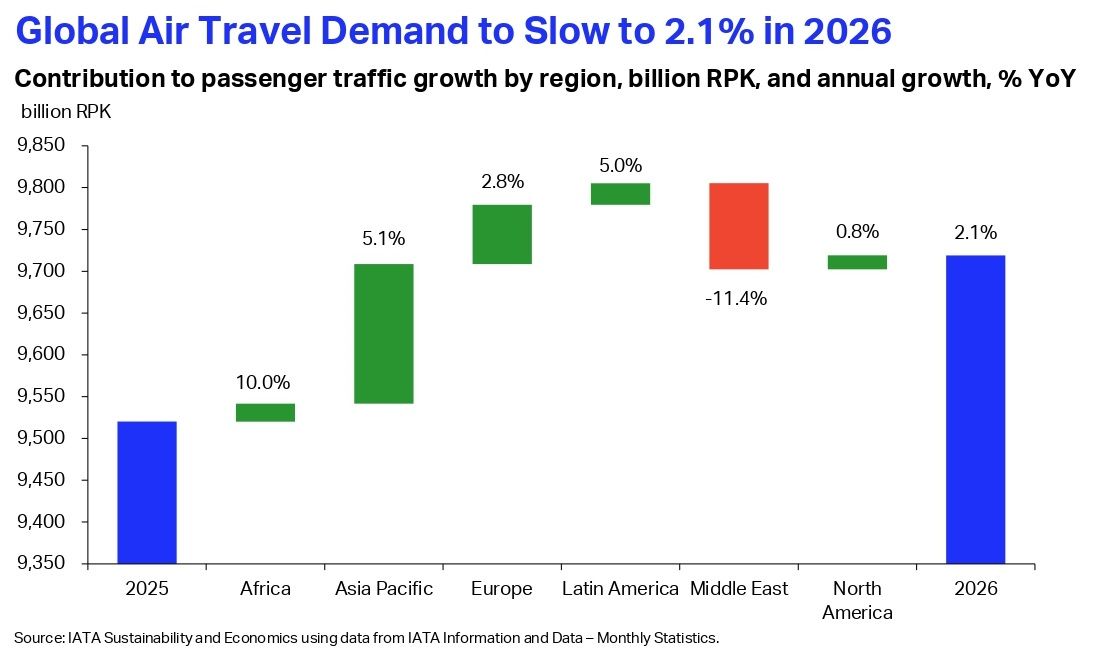
Industry-wide revenue passenger kilometres (RPK), the key measure of air travel demand, are forecast to grow by 2.1% year-on-year, a sharp slowdown from the rapid gains recorded in recent years. The deceleration reflects the direct impact of hostilities in the Middle East, which have disrupted airspace, increased operational costs, and undermined one of the world’s most important aviation hubs.
Regional Divide
The Middle East is expected to bear the brunt of the disruption, with passenger traffic projected to contract by 11.4% in 2026. Airspace restrictions and operational uncertainties are reducing connectivity and cutting into the region’s lucrative transfer traffic business, long a cornerstone of the global aviation network. Airlines are being forced to reroute flights, increasing flying times and fuel consumption while limiting the efficiency that has underpinned the growth of major Gulf hubs.
The energy shock is also expected to weigh on the broader global economy, says the IATA note. Higher oil prices and an even steeper rise in aviation fuel costs are likely to reduce airline profitability while simultaneously squeezing consumer spending power.
Global GDP growth is projected to slow to around 2.5%, roughly half a percentage point lower than previously anticipated, while inflation could climb to 5%. The combination is expected to make discretionary spending, including leisure travel, more vulnerable to economic pressures.
Despite the difficult backdrop, the aviation market is not moving in lockstep, according to IATA. Africa is forecast to deliver the strongest growth in passenger demand, with RPK expanding by 10%. The increase reflects changing travel patterns and the rerouting of some international traffic, although the region still accounts for a relatively small share of global aviation activity.
Asia Pacific is expected to remain the industry’s growth engine, with passenger traffic rising 5.1%. The region will contribute more than half of the total increase in global air travel demand, underlining the growing importance of Asian markets to the aviation sector. Strong economic fundamentals and sustained demand for both domestic and international travel are helping offset weakness elsewhere.
Latin America is projected to post a healthy 5% increase in passenger traffic, supported by comparatively resilient regional economies and steady demand for air connectivity. Europe is expected to record 2.8% growth, partly benefiting from traffic rerouted away from disrupted Middle Eastern long-haul corridors. The European market is also witnessing a shift in consumer behaviour, with travellers increasingly favouring leisure trips and visits to friends and relatives within closer geographic reach.
North America, by contrast, is likely to experience only modest growth of 0.8%. The maturity of the market and a slowing US economy are expected to limit expansion, particularly in the domestic segment, where demand has largely normalised after the post-pandemic recovery.
Industry Resilience
The uneven regional outlook highlights how global aviation is being reshaped by geopolitical risks and economic uncertainty. Airlines are adjusting flight paths, redeploying capacity and focusing on markets that continue to offer stronger growth prospects. The redistribution of traffic flows could create new opportunities for some regions while challenging traditional aviation powerhouses.
For the industry, the biggest immediate concern remains the cost environment. Fuel accounts for one of the largest airline expenses, and sustained increases in energy prices could place additional pressure on ticket prices and profit margins. At the same time, weaker economic growth and rising inflation threaten to erode household purchasing power, potentially dampening demand for discretionary travel.
Yet the broader picture remains one of resilience rather than retreat. Global passenger traffic is still expected to expand despite a combination of geopolitical conflict, supply chain pressures and macroeconomic headwinds. The aviation sector has repeatedly demonstrated its ability to adapt to sudden external shocks, whether through network adjustments, operational efficiencies or shifting market focus.
The 2026 outlook suggests that the era of explosive post-pandemic growth is giving way to a more measured phase of expansion. Growth will be slower, more uneven and increasingly influenced by geopolitical developments and energy markets. Even so, the continued rise in global passenger demand underscores a fundamental reality for the aviation industry: the need for people and businesses to travel remains robust, ensuring that air transport continues to grow even in a far more turbulent world.