

New Delhi: The global air cargo market suffered a sharp reversal in March, with data from the International Air Transport Association (IATA) revealing a 4.8% year-on-year contraction in cargo tonne-kilometres (CTK), alongside a 4.7% decline in available CTK. International operations, which account for 88% of global volumes, fared worse, with demand falling 5.5% and capacity down 6.8%.
At first glance, the contraction appears moderate. However, a deeper examination of the data reveals a highly uneven shock, concentrated overwhelmingly in the Middle East. The region, which accounts for 13.2% of global cargo traffic, recorded a dramatic 54.3% collapse in demand and a 52.4% reduction in capacity. In nominal terms, Middle Eastern carriers removed 1,742 million CTK from the market, dwarfing gains in all other regions combined.
By contrast, Asia Pacific — representing 36% of global cargo — grew 5.4%, adding 470 million CTK. Europe, with a 21.3% share, expanded 2.2%, contributing 120 million, while Africa posted the fastest growth at 7.0%, albeit from a low base. Latin America and the Caribbean rose 1.8%, and North America declined marginally by 1.2%.
The arithmetic is stark. Incremental gains across Asia, Europe, Africa, and Latin America together could not offset the sheer scale of contraction in the Middle East. The result was a net global decline, despite otherwise stable or growing regional markets.
“Air cargo demand fell 4.8% in March compared to the previous year. This was mostly due to severe disruptions at major Gulf hubs due to war in the Middle East. The timing of the usual post-Lunar New Year slowdown also added to the decline. The underlying demand trends, at this point, appear strong and global trade projections continue to point to growth in 2026,” said Willie Walsh, Director General of IATA.
Crucially, year-to-date figures still show growth. Global cargo demand is up 3.3% in the first quarter of 2026, while capacity has increased 1.9%. This divergence underscores that the March contraction is not cyclical but event-driven — a sharp geopolitical shock interrupting an otherwise expanding market.
Middle East: The Defining Drag
The Middle East’s centrality to global air cargo networks makes its collapse uniquely consequential. The region functions as a high-efficiency transit hub, linking Asia, Europe and Africa through integrated hub-and-spoke operations. The March data shows how quickly that system can disintegrate under geopolitical stress.
Middle Eastern carriers saw international cargo demand fall 54.2%, while capacity declined 53.0%. Cargo load factors in the region dropped by 1.9 percentage points to 45.7%, reflecting weakened utilisation amid network disruption. Year-to-date, the region remains deeply negative, with demand down 12.4% and capacity down 10.8%.
The impact is most visible in trade lane data. Middle East-Asia cargo flows contracted by 58.6%, while Europe-Middle East traffic declined by 57.6%. These are among the steepest declines recorded in major global corridors in recent years.
“The Middle East was the defining drag on industry performance. Demand contracted by more than half as hub connectivity deteriorated and aircraft utilisation fell sharply. In nominal terms, the region’s contraction overwhelmed incremental gains elsewhere, effectively pulling the global market into decline,” the IATA analysis noted.
The disruption has also manifested in capacity dynamics. Middle Eastern carriers removed approximately 3,538 million available CTK from the market. This compares with additions of around 890 million in Asia Pacific and 365 million in Europe, highlighting the imbalance in global capacity redistribution.
The suddenness of the collapse is equally significant. Compared to February, the pace of contraction accelerated sharply, indicating that geopolitical developments rapidly altered cargo routing patterns. Airlines were forced into immediate network adjustments, often at the cost of efficiency and reliability.
“The pace of deterioration underscores how sensitive global cargo networks are to geopolitical shocks. What took decades to build in terms of hub connectivity can be disrupted in a matter of weeks, forcing airlines to redesign networks in real time,” said an industry economist.
The data suggests that the Gulf’s role as a global cargo crossroads is not easily replaceable. While alternative routes exist, none offer the same combination of geographic advantage, infrastructure, and operational efficiency.
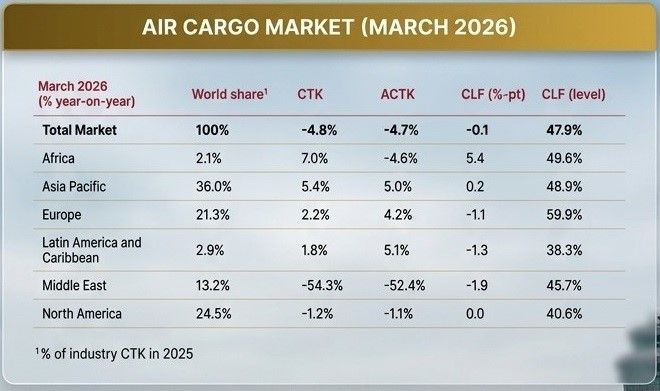
CTK (Cargo Tonne Kilometres): A measure of actual freight traffic (one tonne of revenue load carried one kilometre).
ACTK (Available Cargo Tonne Kilometres): A measure of total available capacity (one tonne of offered capacity flown one kilometre).
CLF (Cargo Load Factor): The percentage of ACTKs actually used. The $\%$-pt column shows the change in capacity utilization compared to the previous year.
Rerouting & Rebalancing
With Gulf hubs disrupted, global cargo flows have undergone rapid reconfiguration. The data shows clear divergence between corridors benefiting from rerouting and those exposed to Gulf-linked disruptions.
The Europe-Asia corridor emerged as the strongest performer, expanding 14.2% year-on-year and extending a 37-month growth streak. Dedicated freighter traffic on this route grew even faster, rising 17.9% and adding 469 million CTK. Within Asia, cargo demand increased 7.5%, supported by resilient regional manufacturing and trade.
Asia-North America traffic remained positive but slowed sharply, growing just 0.8%, while Europe-North America entered contraction, declining 3.4%. These trends suggest a normalisation of earlier distortions, particularly in trans-Atlantic and trans-Pacific markets.
However, the gains in rerouted corridors come with measurable inefficiencies. Longer flight paths, increased fuel consumption, and reduced network connectivity have raised operating costs and transit times. The data reflects this strain in cargo type performance.
Dedicated freighters proved more resilient, with demand declining just 0.9% year-on-year. In contrast, passenger belly cargo fell 12.1%, reflecting its dependence on interconnected passenger networks that have been disrupted by airspace restrictions and schedule reductions.
“Dedicated freighters have captured the bulk of displaced demand, particularly on Asia-linked corridors. Their operational flexibility has allowed them to adapt to longer routings and shifting network structures. Passenger-linked cargo, by contrast, has been heavily constrained by reduced connectivity and schedule adjustments,” the report observed.
Load factor data provides further insight into the rebalancing. Globally, cargo load factors remained stable at 47.9%, masking significant regional divergence. Africa saw the largest increase, with load factors rising 5.4 percentage points to 49.6%, while Asia Pacific improved slightly to 48.9%. Europe and Latin America saw declines of 1.1 and 1.3 percentage points respectively, while the Middle East recorded a 1.9-point drop.
“Load factor stability at the global level conceals significant regional variation. Tight capacity management and rerouting have helped maintain utilisation, but this comes at the cost of operational efficiency and increased complexity,” said a senior aviation analyst.
The data underscores a critical point: while the system has adapted, it has done so imperfectly, trading efficiency for resilience.
Market Under Pressure
Beyond network disruption, the air cargo market is facing an unprecedented cost shock. Jet fuel prices surged 106.6% year-on-year in March, reaching $183.7 per barrel — the highest level in more than 23 years. Month-on-month, prices rose 92.0%, marking one of the sharpest increases on record.
Crude prices climbed 43.1%, while refining margins surged over 300%, reflecting severe constraints in aviation fuel supply. These dynamics have pushed cargo yields sharply higher, with prices rising 13.6% year-on-year and month-on-month to $2.75 per kilogram.
The inflationary impact is evident across the system. Longer routings and higher fuel burn have compounded cost pressures, while reduced capacity has tightened supply. The result is a market characterised by rising prices despite falling volumes.
“Energy market volatility has pushed cargo economics into extreme territory. Jet fuel prices have reached levels not seen in over two decades, fundamentally altering the cost structure of air cargo operations. This is creating a sharply inflationary environment for freight rates,” the IATA report noted.
Yet, beneath these pressures, the macroeconomic backdrop remains supportive. Global industrial production grew 3.1% year-on-year in February, marking the 38th consecutive month of expansion. The global goods trade index rose 8.0%, while the Purchasing Managers’ Index stood at 51.4, indicating continued expansion in manufacturing.
Even more telling is the resilience in seasonally adjusted cargo demand, which rose 11.0% in February, suggesting that underlying demand remains strong despite the March disruption.
“The divergence between strong macroeconomic indicators and weak cargo performance highlights the supply-side nature of the current shock. Demand fundamentals remain intact, but the ability to move goods efficiently has been severely constrained by geopolitical and operational factors,” said a trade economist.
Looking ahead, the industry faces a complex balancing act. While underlying demand and trade growth provide a cushion, the combined impact of geopolitical disruption, network fragmentation, and soaring fuel costs is testing the limits of resilience.
For global air cargo, March 2026 may well be remembered as the month when a regional conflict exposed the fragility of an interconnected system — one where the loss of a single hub region can ripple across the entire global economy.
(Cover photo by Toni Pomar on Unsplash)