

New Delhi: NewSpace India Ltd (NSIL), the commercial arm of the Department of Space, has accelerated its end-to-end space operations following the recent sectoral reforms, positioning India as a stronger contender in the global satellite and launch services market.
In a statement to Parliament on Thursday, the Department of Space outlined major milestones and upcoming missions aimed at expanding India’s commercial footprint across both upstream and downstream space activities.
NSIL has so far deployed two commercial communication satellites to support India’s DTH and broadband sectors, with at least three more planned for launch within the next 3-4 years under its demand-driven satellite programme. On the launch services front, the agency has successfully placed 137 international customer satellites onboard PSLV, SSLV and LVM3 missions.
A major industry-building initiative is also under way. NSIL is overseeing the production of five PSLV-XL launch vehicles by a HAL-L&T consortium, marking India’s transition to industry-built rockets. The first fully industry-manufactured PSLV is slated for launch by Q1 2026. To further strengthen domestic capability, NSIL and IN-SPACe signed a technology transfer agreement with HAL in September 2025. According to the Department of Space, these missions will enhance India’s global competitiveness while advancing critical technologies.
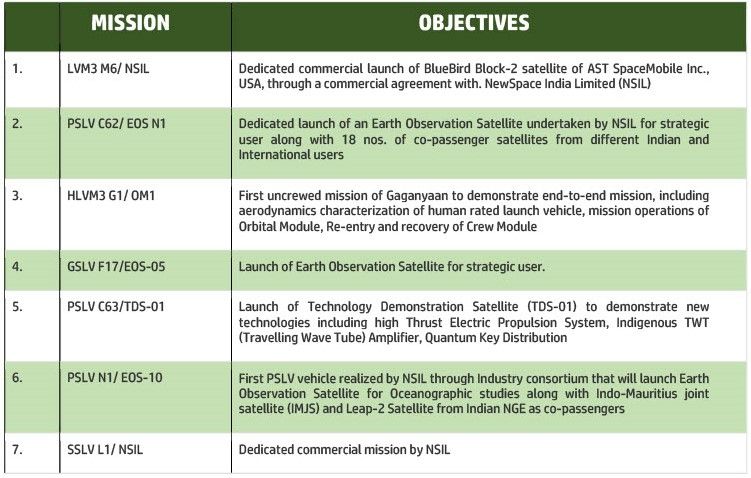
Upcoming demonstrations include a high-thrust electric propulsion system for future all-electric satellites and an indigenous Travelling Wave Tube Amplifier (TWT-A), both crucial steps toward self-reliance in satellite systems. The first un-crewed Gaganyaan mission will validate new systems ahead of India’s maiden human spaceflight.
Several satellite missions planned before March 2026 will support national applications.
The TDS-01 technology demonstrator will test indigenous components for future navigation and communication satellites. NVS-03, part of the NavIC constellation, will boost PNT services vital for vehicle tracking, rail monitoring and maritime communication. Meanwhile, Oceansat-3A (EOS-10) will join Oceansat-3 to deliver daily meteorological, oceanographic and land data, aiding cyclone forecasting, coastal management, ocean dynamics and numerical weather prediction.
The government emphasized that beyond scientific gains, space science missions play an important role in national capability-building, driving advanced skills in hardware and software, and inspiring STEM engagement among students, further strengthening India’s emergence as a rising global space power.