

New Delhi: India’s groundwater ecosystem is under mounting stress, with the Central Ground Water Board (CGWB) issuing fresh contamination alerts for multiple states across the north-west, central and southern regions.
Widespread exceedances of nitrate, fluoride, electrical conductivity (EC) and heavy metals were detected through 2024, prompting warnings to governments in Rajasthan, Haryana, Andhra Pradesh, Gujarat, Punjab, Madhya Pradesh, Maharashtra, Karnataka and Uttar Pradesh. Several eastern and north-eastern states have also recorded isolated exceedances of arsenic, manganese and iron, underscoring the urgent need for targeted surveillance and remedial action.
The warnings emerge from a nationwide groundwater quality assessment based on the standard operating procedure (SoP) implemented uniformly in 2023. The methodology, adopted across 15,259 sampling stations during the base year, seeks to establish a reliable national baseline and enable early response interventions.
In 2024, repeat sampling was carried out at 5,368 ‘trend stations’ during pre- and post-monsoon periods to understand seasonal fluctuations and the influence of aquifer recharge.
High Nitrate & Fluoride Levels
“Groundwater quality varies considerably across India. In certain states such as Arunachal Pradesh, Mizoram, Meghalaya and Jammu and Kashmir, 100% of the water samples met the BIS standards. In contrast, states like Rajasthan, Haryana, and Andhra Pradesh faced widespread contamination.
“Interestingly, the monsoon season showed some improvement in water quality, particularly in areas affected by high electrical conductivity (EC) and Fluoride. Post-monsoon, a modest reduction in EC levels and Fluoride was observed in some regions, indicating that monsoon recharge can temporarily improve water quality by diluting salts, says the report.
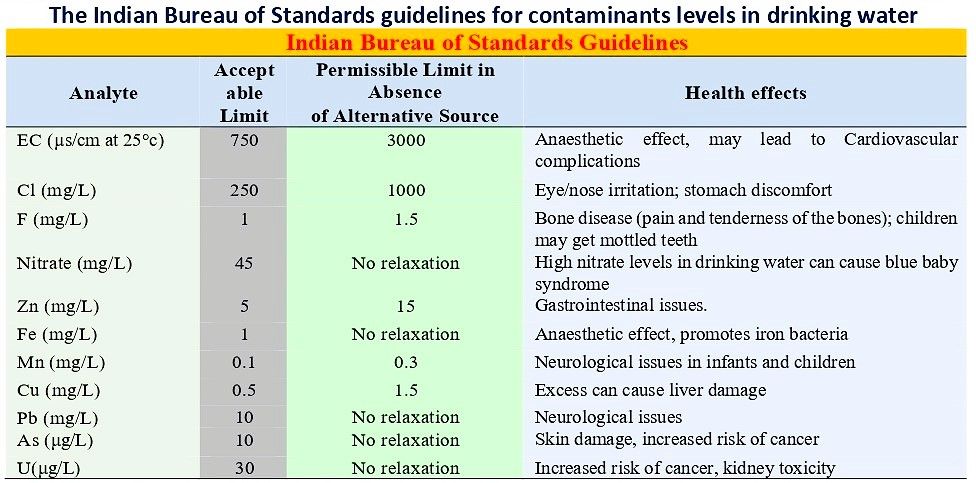
The countrywide dataset indicates nitrate contamination as the most pervasive threat. Around 20.7% of groundwater samples exceeded the permissible limit of 45 mg/L under BIS IS 10500:2012 standards. According to the report, the surge is largely anthropogenic and linked to excessive fertilizer use, poor sanitation, unlined septic systems, and unmanaged livestock waste entering aquifers.
Fluoride concentrations beyond the allowable 1.5 mg/L threshold were noted in 8.05% of samples, driven mainly by water-rock interactions in hard-rock terrains. High-risk belts include granitic regions of Rajasthan, Andhra Pradesh and Telangana, with long-term exposure raising the risk of dental and skeletal fluorosis in rural communities.
Rising salinity, reflected in high EC values, affects 7.23% of samples and is pronounced in arid belts of North-West India — notably Rajasthan, Haryana, Delhi and Gujarat. Hydrochemical analysis shows repeated wetting-drying cycles allow Na-Cl salts to crystallize in alluvial beds and subsequently dissolve back into groundwater during monsoonal recharge, increasing salinity over time.
Local & Multi-Directional Spread
To strengthen surveillance, the CGWB identified 340 contamination hotspots and collected 1,540 samples using a 2 km × 2 km grid-sampling framework. This allowed the Board to track the spread pattern rather than simply mark exceedance points.
Preliminary findings reveal sharp spatial variability. While some hotspots showed localized contamination confined to one or two grid points, others displayed multi-directional migration driven by fractured aquifers, declining groundwater levels and porous soil profiles. The hotspot mapping covers arsenic, fluoride, manganese, nitrate, uranium and salinity, enabling state agencies to design customized remediation strategies instead of adopting broad-brush solutions.
The alerts issued between June 2024 and March 2025 also reveal recurring heavy metal exceedances. Arsenic remains concentrated along the Ganga-Brahmaputra basin. Sporadic high uranium concentrations — surpassing 30 ppb — were identified in Rajasthan, Punjab, Haryana, Andhra Pradesh and Telangana. Manganese exceedances are widely spread, with cases in Assam, Karnataka, Odisha, Uttar Pradesh and West Bengal. Copper levels remain within safe limits nationally.
Mixed Seasonal Impact
Seasonal recharge — especially during the southwest monsoon — delivered mixed results. Several areas with historically high salinity and fluoride reported lower concentrations post-monsoon due to dilution. However, an equivalent number witnessed deterioration, suggesting that local geological controls, aquifer chemistry and contamination loads significantly influence outcomes.
From an agricultural perspective, groundwater was found largely suitable for irrigation. Around 94.3% of samples fall within the “excellent” category based on the Sodium Adsorption Ratio (SAR < 10), limiting the risk of soil degradation. Nearly 98.9% of national samples recorded SAR ≤ 26.
However, certain pockets reported severe sodium hazard: Bihar (SAR 505), Delhi (179.8) and Rajasthan (72.6). Delhi has the highest proportion of SAR exceedances (34.8%), followed by Rajasthan (12%).
Residual Sodium Carbonate (RSC) values crossed the permissible limit (2.5 meq/L) in 11.27% of samples, posing long-term concerns for soil health. Delhi (51.11%), Uttarakhand (41.94%), Andhra Pradesh (26.87%), Punjab (24.60%) and Rajasthan (24.42%) are among the worst affected.
Mitigation Strategy
The report outlines mitigation strategies covering prevention, treatment and long-term water source management.
• Fluoride mitigation: blending low- and high-fluoride water, community treatment plants, and robust source management.
• Nitrate control: improved fertilizer scheduling, soil testing and better waste and sewage management.
• Arsenic mitigation: sealing of contaminated wells, conjunctive water use and tapping deeper safe aquifers.
• Uranium mitigation: adsorption, coagulation, reverse osmosis and evaporation-based treatment depending on local feasibility.
• Iron and manganese: aeration, oxidation and filtration-based systems.
• Lead: removal through activated carbon, RO and stringent control of industrial discharge.
Surveillance Model
The CGWB now circulates groundwater quality alerts on a fortnightly basis to central departments including ICAR, DDWS, CPCB, MOHUA and GSI, besides state water agencies. The alerts are expected to help governments issue public advisories, conduct follow-up sampling, install emergency treatment units and prioritize contamination clusters for remediation.
While the national baseline serves as a reference point, the Board emphasizes the need for sustained resource monitoring due to rapid urbanization, erratic rainfall, intensive agriculture and geo-genic shifts.
The report underscores that groundwater protection will increasingly require multipronged efforts — local hydro-geological assessment, public participation and strict enforcement of pollution control — to avoid irreversible deterioration of India’s most relied-upon water source.