

New Delhi: In a significant shift in power dynamics within the ruling alliance in Bihar, the newly sworn-in cabinet under chief minister Nitish Kumar has marked a decisive reconfiguration of ministerial responsibilities. The most notable change is the relinquishment of the home ministry — a portfolio Nitish Kumar has controlled almost continuously since November 2005 — now handed over to Samrat Choudhary, BJP’s legislative party leader in Bihar. This move underscores BJP’s emerging dominance in the alliance and signals a recalibration of roles within the NDA in the state.
By entrusting the home department to Samrat Choudhary, BJP has made a bold statement: while Nitish Kumar retains the chief minister’s post for a tenth term, his grip on the most coveted ministry has loosened.
The home ministry — long regarded as the central lever of influence in Bihar — has historically been a symbol of Nitish’s authority. His decision to cede it to BJP points to a nuanced power-sharing calculus, one in which the saffron party is being explicitly acknowledged as the senior partner. At the same time, it invites speculation about a possible transition in leadership: grooming younger BJP hands for higher responsibility while positioning Nitish to focus on broader governance issues rather than day-to-day law and order.
Parallel to this, the allocation of other key portfolios reinforces BJP’s ascendancy. Vijay Kumar Sinha, the deputy leader of BJP’s legislative party, has been assigned the department of revenue and land reforms, an area with substantial financial and political levers. Mangal Pandey retains the health ministry and also takes on the law department, consolidating two critically visible functions in BJP’s hands.
Meanwhile, BJP state president Dilip Jaiswal has been given the industries portfolio, signalling the party’s ambition to oversee Bihar’s economic momentum and industrial policy.
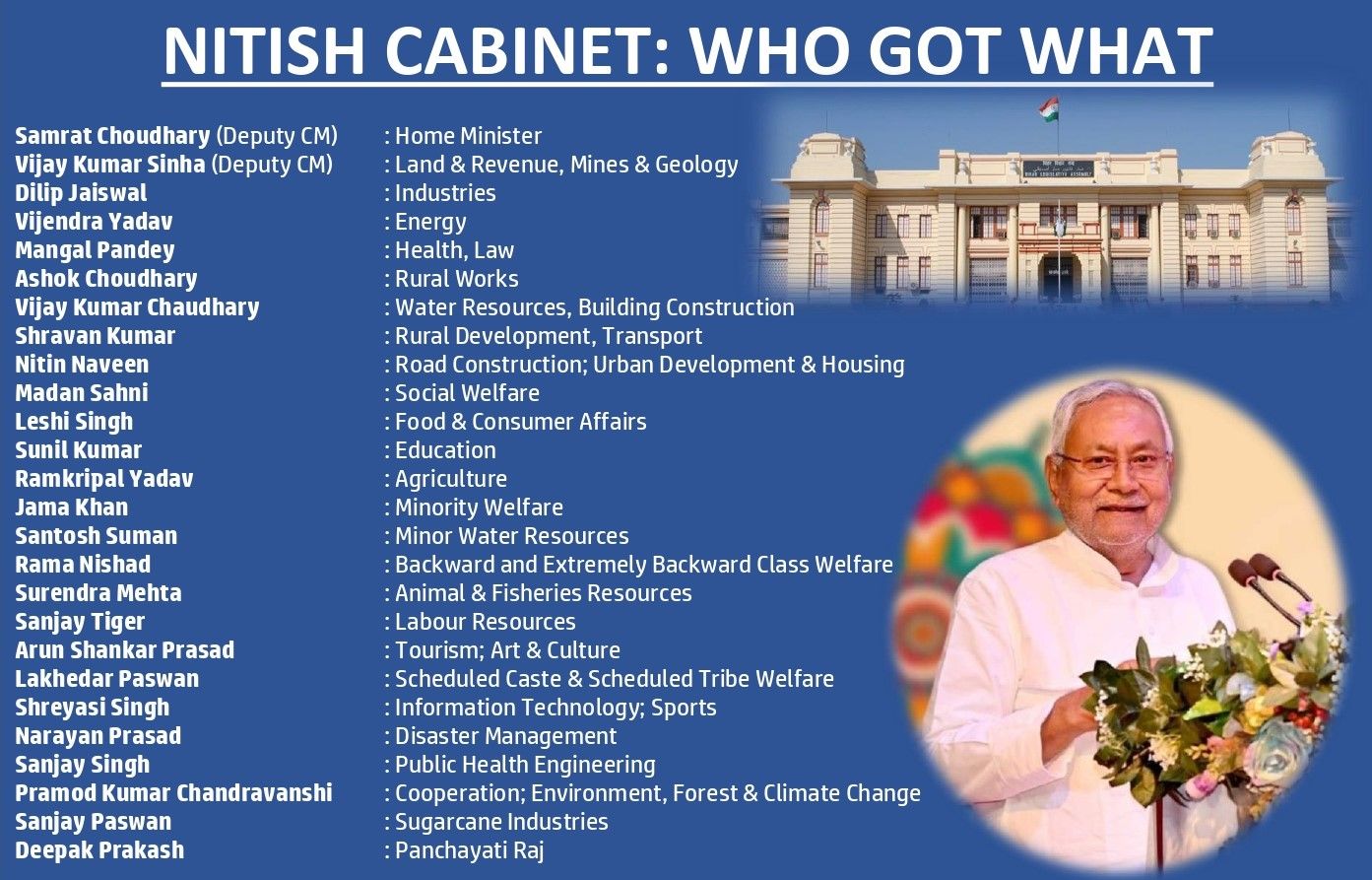
Within the 26-member cabinet sworn in at Patna’s Gandhi Maidan, BJP has secured the lion’s share of major departments: agriculture (Ram Kripal Yadav), backward classes welfare (Rama Nishad), disaster management (Narayan Prasad), industries, labour (Sanjay Singh Tiger), roads and housing (Nitin Nabin), SC & ST welfare (Lakhendra Raushan), tourism (Arun Shankar Prasad), IT and sports (Shreyasi Singh), fisheries and animal resources (Surendra Mehata), and environment and climate change (Pramod Kumar).
The JD(U), in contrast, while retaining key sectors such as social welfare (Madan Sahni), rural works (Ashok Choudhary), food and consumer protection (Leshi Singh), rural development and transport (Shrawon Kumar), water resources (V K Choudhary), energy (Vijendra Yadav), and education (Sunil Kumar), appears to have conceded ministerial heft relative to its ally.
Smaller coalition partners were also accommodated: Lok Janshakti Party (Ram Vilas) secured the sugarcane industry and public health engineering departments; HAM took minor water resources, and RLM was given panchayati raj.
This dispersal of portfolios underscores the alliance’s attempt to keep all partners vested while clearly delineating BJP’s pre-eminence.
The timing of these allocations is significant. In the recent elections, NDA captured 202 of the 243 seats, with BJP emerging as the single-largest party with 89 seats. JD(U) secured 85 seats, staging a comeback after its weaker showing in 2020.
The reassignment of the home ministry thus operates on multiple layers: acknowledging BJP’s strength, recalibrating internal alliance dynamics, and potentially marking the start of a post-Nitish era of leadership. By stepping back from the home portfolio, Nitish might be signalling an acceptance of a shifting political tide — letting BJP hold the reins of law and order while he concentrates on strategy, governance and coalition cohesion.
Taken together, the cabinet rejig is not merely an administrative exercise, it is a strategic re-orientation of power within the Bihar alliance. It is BJP asserting its seniority, JDU accommodating that shift while retaining the chief minister’s office, and Nitish preparing for the longer term. The message to observers is clear: although Nitish remains the face of governance, BJP now holds the operational levers of the key departments, making this a pivotal phase in Bihar’s political evolution.