


New Delhi: India has the potential to emerge as a leading global destination for higher education and research by 2047, with internationalization of universities acting as a key driver of human capital, innovation and soft power, according to a new policy report released by Niti Aayog on Monday.
The report calls for a sharp expansion in international student enrolment, deeper global research collaborations and the embedding of international standards within Indian campuses under the National Education Policy (NEP) 2020.
Titled ‘Internationalization of Higher Education in India: Prospects, Potential, and Policy Recommendations’, the study projects that India could host anywhere between 3 lakh and 11 lakh international students by 2047, depending on the intensity of policy implementation. In the near term, enrolment is estimated to range between 85,000 and 1.3 lakh by 2030, rising further by 2035. The projections are based on two forecasting models and are intended to provide a data-driven roadmap for achieving India’s long-term ambitions.
The report emphasizes “internationalization at home” as envisaged in NEP 2020, arguing that Indian students should be able to access global academic ecosystems without necessarily spending long periods overseas. It highlights opportunities for enhanced student and faculty mobility, stronger international academic and research collaborations, and the establishment of international branch campuses in India as well as Indian campuses abroad.
Prepared through a collaboration between Niti Aayog and an IIT Madras-led consortium of knowledge partners, the study is positioned as a pioneering publication from the Global South. It draws on extensive qualitative and quantitative research, including responses from 160 higher education institutions across 24 states to a detailed survey of more than 100 questions. Inputs were also gathered from 140 national and international stakeholders during a National Workshop at IIT Madras, along with Key Informant Interviews with experts from nearly 30 institutions across 16 countries.
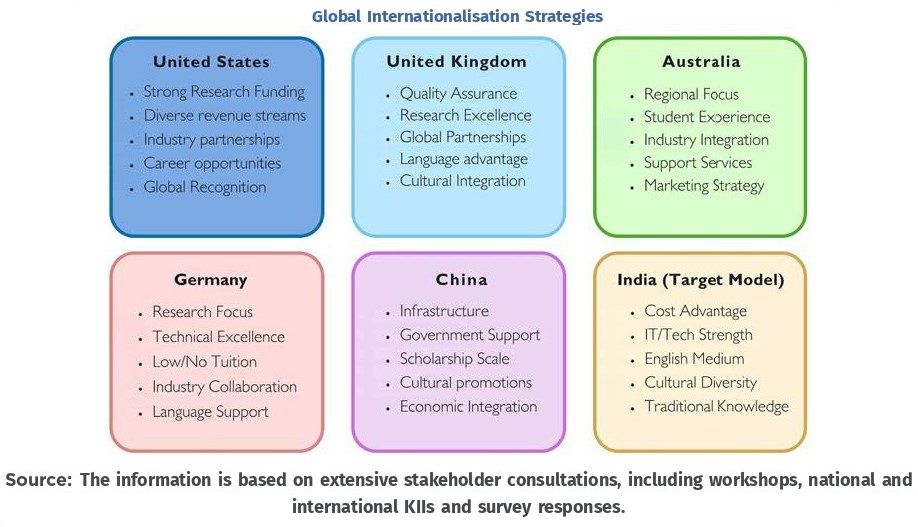
The report situates India’s ambitions within a changing global landscape, noting the relative retreat of traditional student-hosting nations in the Global North and the growing role of Asia as a centre of knowledge creation. Domestically, it points to a supportive policy ecosystem anchored in NEP 2020 and reinforced by UGC guidelines and regulations on international collaborations, branch campuses and equivalence of foreign qualifications.
Forward Looking
It outlines 22 policy recommendations, 76 action pathways and 125 performance success indicators across five thematic areas — strategy, regulation, finance, branding, communication and outreach, and curriculum and culture. These are directed at both central and state governments as well as leading public universities, particularly top NIRF-ranked institutions and Institutes of National Importance, which are seen as having the capacity to scale internationalization initiatives.
Releasing the report, Niti Aayog Vice Chairman Suman Bery said that there is a business case and a diplomatic case for promoting internationalization of higher education in India, especially as an instrument of soft power. V K Paul, Member (Education), placed the study in the context of NEP implementation and India’s vision for Viksit Bharat@2047, and said India must target hosting one lakh international students across Central and State universities by 2030.
Arvind Virmani, Member, observed that international students who have benefitted from the Indian system can contribute to the growth of India and the world, and stressed the need to strengthen doctoral programmes through greater international collaboration.
Niti Aayog CEO B V R Subrahmanyam highlighted that internationalization could improve course quality, reduce foreign exchange outflow and expand global research partnerships, while underlining the role of private universities, the Indian diaspora and ease of regulation.
Secretary, Department of Higher Education, Vineet Joshi said public and private universities must work together for India to become a global higher education hub, noting that UGC regulations have already facilitated the entry of nearly 13 international universities into the country.
Invoking India’s ancient centres of learning such as Nalanda and Takshashila, the report argues that the country can reclaim its historic role as a ‘Vishwa Guru’ by fostering a globally engaged yet locally grounded higher education system. It concludes that internationalization at home will be critical to strengthening research, innovation and employability, and to creating future-ready, world-ready talent aligned with India’s developmental aspirations.