


New Delhi: India is preparing to convert its demographic advantage into a global labour export strategy, with Niti Aayog urging states to build structured international mobility ecosystems for skilled workers amid mounting labour shortages across advanced economies.
Niti Aayog made the recommendations in its latest report, States’ Framework: Advancing International Mobility for Skilled Workers. The report argues that India’s working-age population peak over the next decade coincides with deepening labour deficits in Europe, the Gulf, Japan, Canada and Australia, creating a rare opportunity for India to emerge as a long-term supplier of skilled manpower.
The government think tank also highlights “the challenge” in economic terms. “Currently, about 65% of India’s population is under the age of 35,” says the report, adding that the country’s working-age population is projected to reach 65.05% by 2030. The report warns that this demographic dividend is time-bound and must be strategically deployed before India itself begins to age.
The report says advanced economies are already struggling with persistent vacancies in healthcare, construction, logistics, manufacturing and digital services. Europe alone has more than 1.05 crore vacancies, while the US has around 72 lakh openings and Gulf economies nearly 27 lakh, according to labour market estimates cited by the report.
“Within this context, a structured and standards-aligned mobility system for skilled Indian workers offers dual benefits,” says the report. “Internationally, it supports labour markets facing sustained shortages by supplying trained workers through predictable, rights-based channels linked to verified sectoral demand.”
Remittances: Strategic Economic Lever
The Niti report positions overseas employment not merely as migration policy but as a macroeconomic growth strategy tied directly to remittances, foreign exchange stability and labour market management.
India received $137.67 billion in remittances in 2024, equivalent to 3.5% of GDP, reinforcing its status as the world’s largest remittance recipient. According to the report, remittance inflows have more than doubled since 2010-11 and now cover nearly half of India’s merchandise trade deficit.
The report says India’s overseas workforce has expanded from 6.6 million in 1990 to 18.5 million in 2024, accounting for over 6% of global migrants. Unlike debt or portfolio inflows, remittances have remained resilient during periods of global economic disruption, giving them outsized importance in India’s external sector management.
“Remittances have become a vital component of India’s macroeconomic landscape, contributing to economic stability and resilience amid cross-border uncertainties… Unlike private debt or equity flows, remittances are non-repayable and counter-cyclical.”
It also highlights a structural shift in migration patterns. While Gulf economies remain critical destinations for low and semi-skilled labour, developed economies such as the US, Canada, Australia and parts of Europe are increasingly attracting highly skilled Indian workers through education-linked migration and long-term employment pathways.
By 2023-24, the US alone accounted for 27.7% of India’s remittances, reflecting the growing influence of high-income professional migration. The report says this transition marks a move away from temporary, low-skilled Gulf migration toward long-duration, skill-intensive global mobility.
States Asked to Build ‘Global Skills Capital’
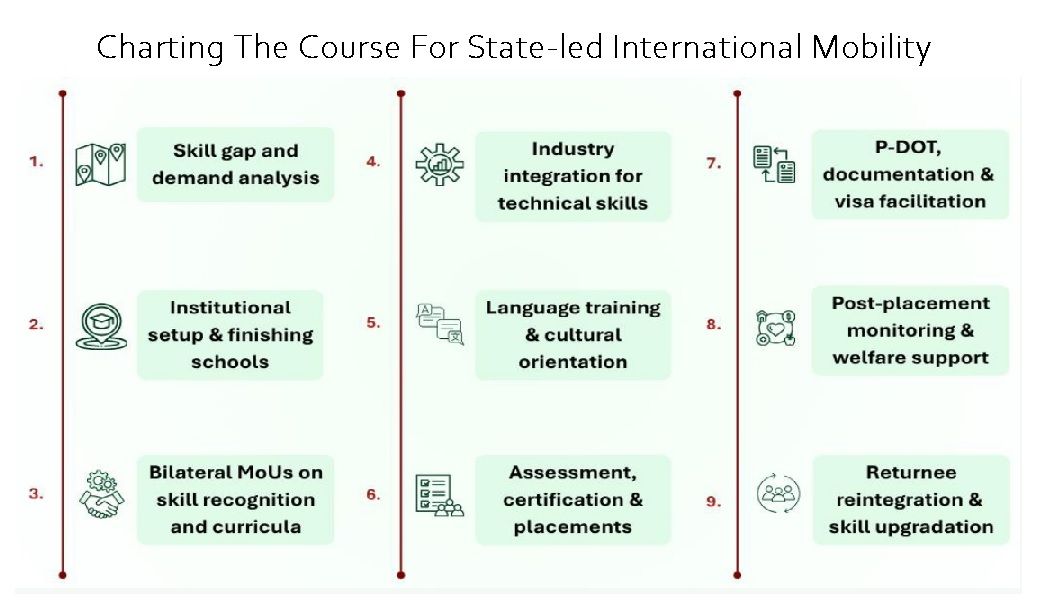
The Niti report’s central proposition is that states — not merely the Union government — must become the operational engines of India’s international labour mobility strategy.
According to the report, states should create dedicated migration dashboards, internationally aligned finishing schools, language training systems, certification mechanisms and overseas placement pipelines tailored to destination-country demand.
“States are not passive executors but co-architects of international mobility pathways,” says the report. “States can play a catalytic role in advancing safe, orderly, demand-responsive and circular international mobility of skilled workers.”
The report identifies Kerala, Karnataka, Telangana, Odisha and Madhya Pradesh as examples of states already building structured migration ecosystems. Kerala’s NORKA Roots model, Odisha’s World Skill Centre and Madhya Pradesh’s Sant Shiromani Ravidas Global Skills Park are cited as institutional templates for combining technical skilling, foreign-language training and employer-linked placements.
Niti Aayog in its report also proposes a stronger role for state-run recruitment agencies to reduce exploitation and improve transparency in overseas placements. It recommends that all international placements, including those to non-ECR countries, be routed through registered recruitment channels integrated with the government’s eMigrate platform.
“International mobility emerges not merely as an adjunct to skilling, but as a pivotal instrument of economic transformation, demographic optimisation, and geostrategic positioning,” says the report.
From Migration Policy to Economic Diplomacy
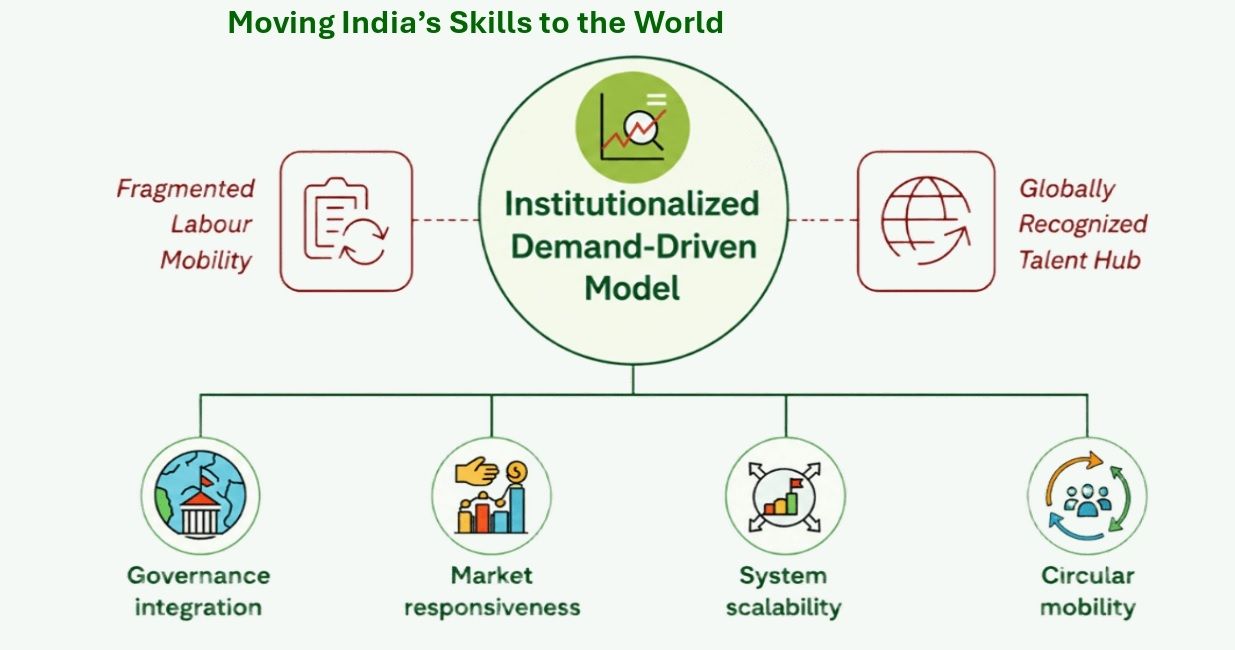
The Niti report signals a broader shift in India’s policy thinking — from managing emigration to strategically exporting talent through bilateral agreements, trade partnerships and globally benchmarked certification systems.
The Union government has already signed multiple labour mobility and vocational training agreements with countries including Australia, Germany, Japan, Singapore, Denmark, Qatar and the UAE. These arrangements are increasingly tied to skill recognition, qualification equivalence and labour market access.
The report also points to the rapid expansion of digital migration governance infrastructure. India’s revamped eMigrate 2.0 platform, integrated with DigiLocker, UMANG, BHASHINI and the Passport Seva system, processed 3,87,075 emigration clearances in 2024 for workers moving to ECR countries.
The report argues that India must move away from fragmented migration systems driven by informal networks and low-end labour demand. Instead, it advocates a “circular mobility” framework under which workers gain overseas experience, return with capital and skills, and re-enter global labour markets through regulated pathways.
“When framed as a mutually beneficial compact, circular mobility transforms temporary migration into a regenerative economic mechanism,” says the report. “With systematic governance, such mobility evolves beyond a binary of exit and return, sustaining instead a continuous arc of human capital renewal.”