


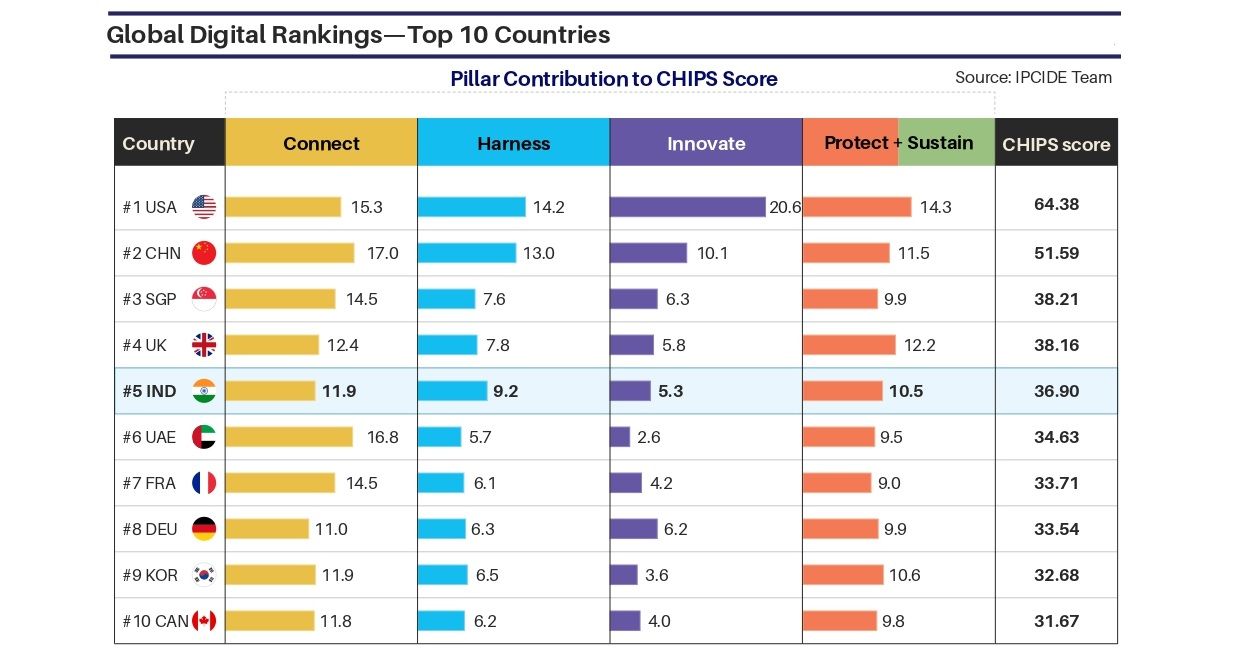
New Delhi: India has quietly crossed a milestone that would have seemed improbable a decade ago. It is now the world’s fifth most digitalised country, ahead of several advanced economies and firmly positioned among the leading powers shaping the future of the digital economy.
Yet the bigger story is not the ranking itself. It is what the ranking reveals about the changing geography of technology, the emergence of AI as a new development opportunity, and the mounting risks that accompany rapid digital expansion.
The findings come from the State of India’s Digital Economy-2026, published by the ICRIER-Prosus Centre for Internet and Digital Economy (IPCIDE), which argues that digitalisation and AI are no longer merely economic trends. They have become instruments of geopolitical competition, investment attraction and strategic influence. In that world, global rankings matter because they increasingly shape narratives about national capability and future economic power.
The report highlights four striking findings: India is now the fifth most digitalised country in the world; (ii) global benchmarking has become a weapon in the AI race; (iii) developing countries are performing better on AI diffusion than on traditional digitalisation; (iv) hidden costs of digitalisation — from cybercrime to e-waste — are becoming too large to ignore.
The Ranking Race
The global digital map is undergoing a profound shift. For decades, digital leadership was concentrated in North America and Western Europe. That dominance is now being challenged by the Indo-Pacific, where China, Singapore and India have emerged as major digital powers.
According to the report’s CHIPS framework — covering Connect, Harness, Innovate, Protect and Sustain — the United States remains the clear leader with a score of 64.4. China follows at 51.6. India has climbed from eighth place in 2025 to fifth in 2026, joining an elite group that includes Singapore and the United Kingdom.
The rise is significant not only because of India’s position but because of what it says about the changing balance of technological influence. “The global digital map is becoming more distributed and tri-polar. Digital leadership was historically concentrated in North America and Western Europe, with Japan as the Asian outpost. That order is changing,” says the report.
It also makes a provocative argument about the politics of measurement. In one of the report’s sharpest observations, the authors write: “Rankings are no longer academic exercises; they are increasingly shaping investment flows, policy narratives, and even geopolitics.”
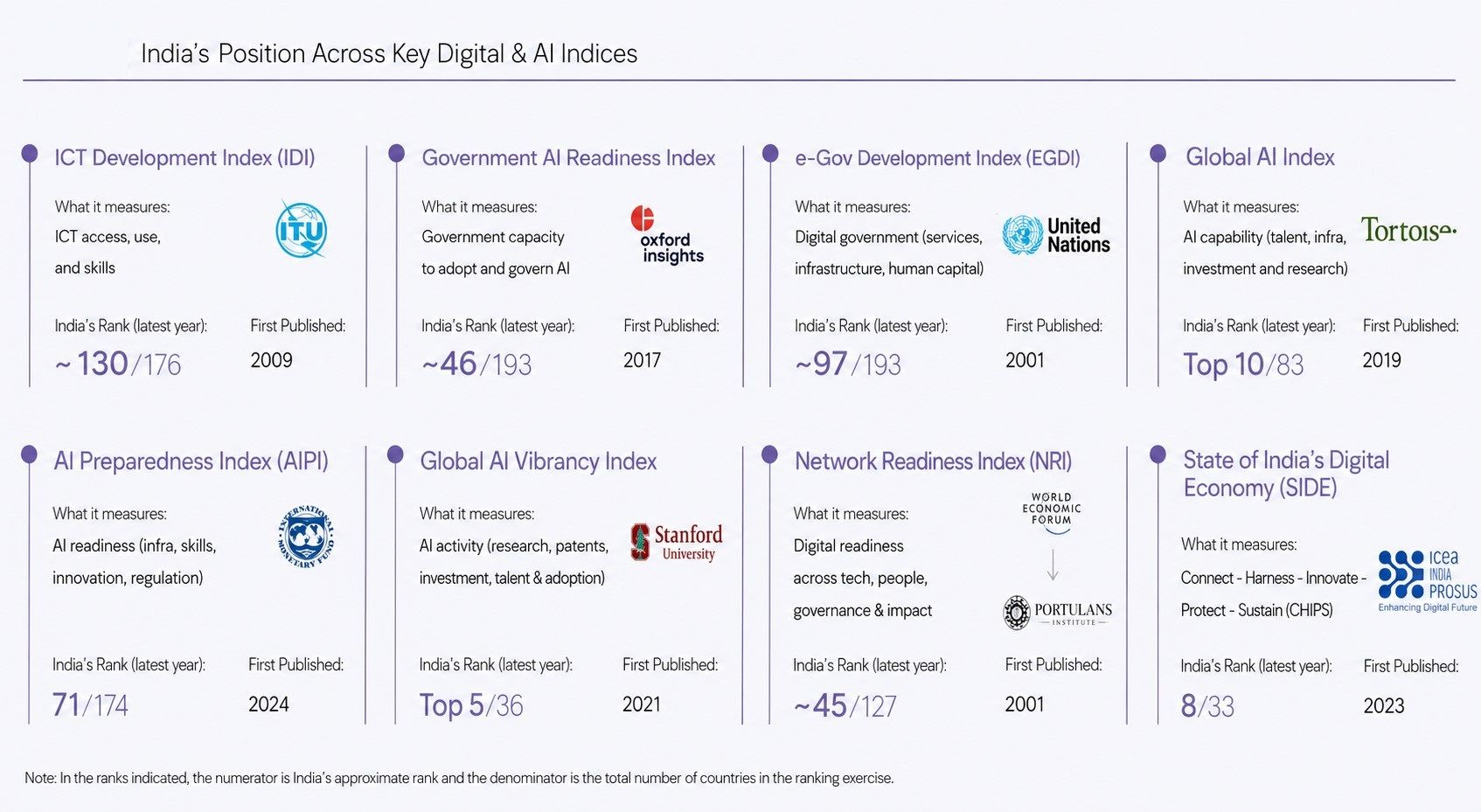
That debate came into focus earlier this year when IMF Managing Director Kristalina Georgieva presented the IMF’s AI Preparedness Index at Davos, placing India in the ‘Second Tier’ of AI readiness. India’s Minister for Electronics and Information Technology, Ashwini Vaishnaw, publicly challenged the methodology, arguing that other global indices place India much higher. The episode underlined how benchmarking itself has become part of the global AI competition.
India’s ascent has been driven by stronger connectivity, greater use of digital technologies, rapid adoption of digital public infrastructure and a growing AI talent base. Internet users in India expanded by 8.8%, compared with an average growth rate of 2.1% among other top-10 digital economies.
The report, however, injects a note of caution. Some of the improvement reflects methodological changes, including expanded country coverage and the removal of indicators where India traditionally performed less strongly. Even so, the authors conclude that India now clearly belongs in the top decile of global digital rankings.
AI Opportunity Window
If digitalisation was the first revolution, AI is rapidly becoming the second.
The report describes Generative AI as “the fastest-diffusing technology in history”, reaching mass adoption far more quickly than the internet, smartphones, e-commerce or digital payments. Within three years of launch, developing countries accounted for 72% of global AI users. China and India alone account for nearly two-fifths of the global total.
This is a remarkable departure from earlier technology waves, which were initially dominated by advanced economies. “Within three years of GenAI’s launch, it has already become a developing-country phenomenon, with emerging Markets and Developing Economies (EMDEs) accounting for 72% of global AI users, compared with 28% in developed countries. China and India dominate: each has more AI users than all developed countries combined, excluding the United States.”
India’s performance is especially noteworthy. In the report’s standalone AI index, the country ranks fourth globally, behind only the United States, China and Singapore, while outperforming Germany, France, Japan, Canada and South Korea.
The authors argue that developing economies may be doing better on AI than on traditional digitalisation because AI rewards scale, talent and rapid adoption. India appears to embody all three. Its vast user base, expanding startup ecosystem and deep reservoir of technical skills have enabled it to punch above its economic weight.
“There are good reasons to believe that India has not missed the AI train. Its opportunity lies not in replicating the capital-heavy AI strategies of the United States or China, but in building a talent-led, application-driven AI ecosystem that reflects its own comparative advantage,” says the report.
That observation echoes the broader argument advanced by Deepak Mishra, Distinguished Professor (Visiting), ICRIER, and lead author of the report. Rather than competing directly in capital-intensive areas such as advanced chips and large-scale compute infrastructure, India’s comparative advantage lies in applications, talent and mass adoption.
However, the report is careful not to overstate India’s achievement. Many AI indicators measure inputs such as patents, publications, skills, GitHub activity and startup funding rather than actual productivity gains, exports or economic growth. India’s AI success story, therefore, remains promising but unfinished.
Costs Beneath Growth
The most valuable contribution of the report may be its insistence on looking beyond digital triumphalism.
Digital technologies have generated growth, jobs and better public services. But they have also created vulnerabilities that remain underappreciated in public debate.
“Digital technologies also create new risks and hidden costs, which receive far less attention in the literature than they deserve. A balanced assessment of digitalisation, therefore, must look not only at its benefits, but also at its risks,” the report cautions.
Those risks are increasingly visible.
Globally, the production of digital technologies remains highly concentrated even as their use becomes more widespread. Most digital consumers now live in developing countries, yet advanced economies continue to dominate frontier technologies, cloud infrastructure, advanced semiconductors and AI models. India is a notable exception in digitally delivered services, exporting roughly $328 billion worth of such services despite being a lower-middle-income country.
Cybersecurity presents another challenge. As economies become more connected, exposure to ransomware attacks, data breaches and digital fraud rises sharply. India has emerged as one of the larger cybersecurity markets, but spending remains modest relative to the scale of its digital economy and user base.
Then there is the environmental cost. E-waste is rising globally alongside digital consumption. While India’s per capita e-waste remains comparatively low, the report argues that policymakers must act early by strengthening producer responsibility systems, integrating informal recyclers and promoting repair and reuse ecosystems.
India’s digital transformation is real, substantial and globally significant. It has become a leading digital economy not because it replicated Western models but because it leveraged scale, digital public infrastructure and talent. Yet leadership in the digital age will require more than rankings and adoption figures.
The next phase will depend on whether India can convert digital scale into innovation, AI talent into productivity, and technological growth into sustainable development. The country has established itself as a major player in the global digital economy. The harder task now is ensuring that the gains are durable, inclusive and resilient.