


New Delhi: India stands at a pivotal moment in its economic trajectory, with the promise of its demographic dividend approaching both its peak and its test.
The ‘State of Working India 2026’ report, released by Azim Premji University, reveals a nuanced picture of our country that has made undeniable strides in expanding access to education and reducing social disparities, yet continues to struggle with translating these gains into meaningful employment outcomes.
Over the past four decades, India has significantly broadened access to higher education, particularly for women and historically disadvantaged groups. According to the report, tertiary enrolment has reached 28%, placing India in line with countries at similar levels of per capita income. The democratisation of education is evident in the rising share of students from the poorest households, which nearly doubled from 8% in 2007 to 15% in 2017. These gains reflect what the report describes as “real achievements”, pointing to sustained policy efforts and social change. “More young people today are educated, informed, and ambitious than ever before. These are real achievements of which we can be proud,” said Indu Prasad, President, Azim Premji Universities.
The rapid expansion of educational institutions has also played a role, with the number of colleges increasing from 29 per lakh youth in 2010 to 45 in 2021, largely driven by private providers. However, this expansion has been uneven and, in some cases, shallow. Moreover, regional disparities in access persist, particularly in northern and eastern states.
More critically, the growth in student enrolment has not been matched by a proportional increase in faculty. The report notes that while regulatory norms prescribe 15-20 students per teacher, private institutions average 28 students per teacher and public institutions 47, raising concerns that “learning outcomes are not compromised due to resource constraints” only if hiring gaps are urgently addressed.
A similar pattern is visible in vocational training, where Industrial Training Institutes (ITIs) have expanded by nearly 300% since the 2010s, again led by private players, but often at the cost of institutional quality and weak linkages to industry demand.
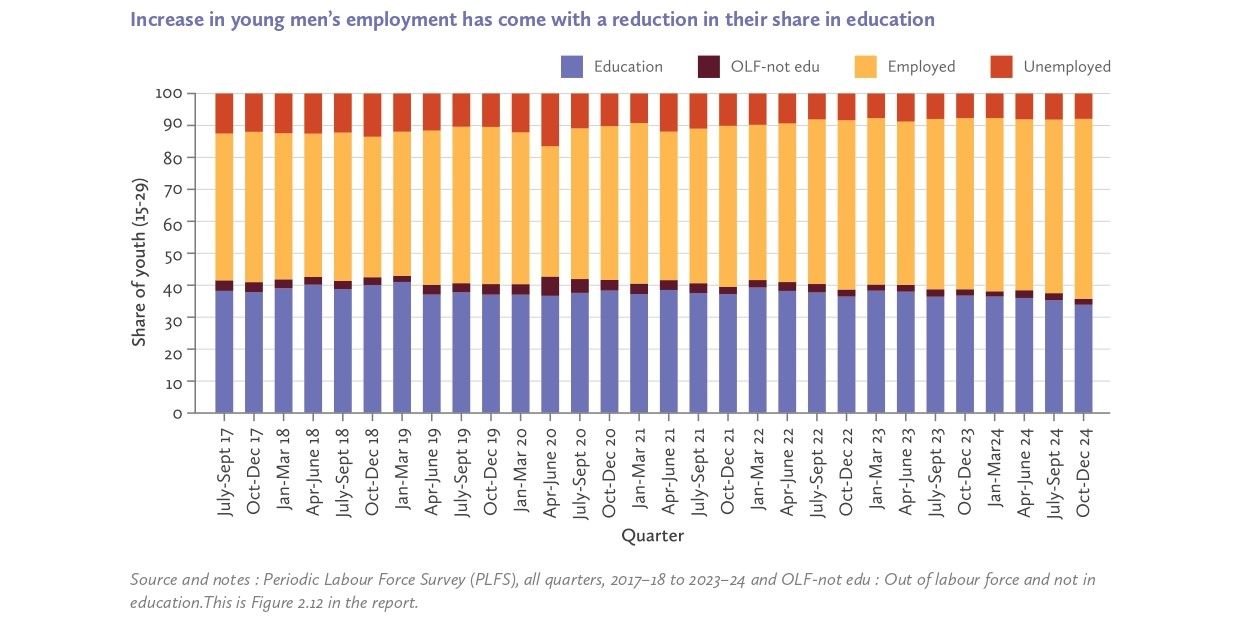
A particularly worrying trend is the recent decline in male participation in higher education. The share of young men enrolled fell from 38% in 2017 to 34% in late 2024, with an increasing proportion citing financial pressures and the need to support household incomes as the primary reason for dropping out. As the report underlines, “the most common reason given for withdrawing from education is the need to support household incomes,” a figure that has risen sharply in recent years. This underscores the persistent role of economic constraints, which continue to shape educational choices despite broader access.
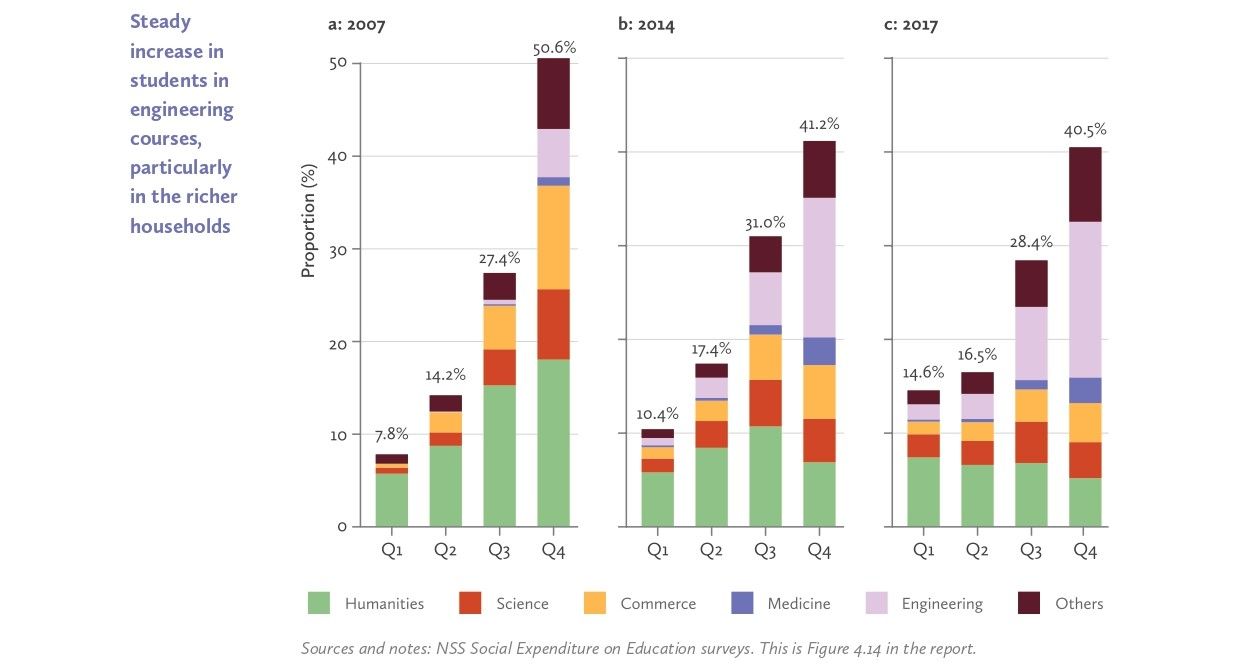
Financial barriers remain especially acute in professional education. Courses in engineering and medicine are still disproportionately accessed by students from wealthier households, as their costs often exceed the annual per capita expenditure of poorer families. While some narrowing of this gap has occurred, structural inequalities in access to high-return education persist, reinforcing unequal access to better-paying occupations.
If the education system tells a story of expansion with gaps, the labour market reflects a deeper structural challenge. The transition from education to employment remains fraught, particularly for graduates. Unemployment rates among young graduates are strikingly high, nearing 40% for those aged 15-25 and 20% for those aged 25-29. Even among those who find work, only a small fraction secure stable salaried employment within a year of completing their education, pointing to a systemic bottleneck.
This disconnect is further illustrated by the mismatch between the growth in the number of graduates and the pace of job creation. Between 2004-05 and 2023, approximately 5 million graduates were added annually, but only about 2.8 million found employment, with an even smaller share entering salaried roles. The result has been rising graduate unemployment and slowing earnings growth, even as aspirations continue to climb.
Paradoxically, a strong wage premium for graduates persists. At entry, graduates earn roughly twice as much as non-graduates, and this gap widens over time. However, this premium has stagnated for men in recent years, with entry-level salaries showing little growth since 2011. At the same time, gender gaps in earnings have narrowed, indicating some improvement in labour market outcomes for women.
India’s employment landscape has also undergone a structural shift, though not always in the expected direction. Young workers are leaving agriculture faster than older cohorts and increasingly moving into manufacturing and services. Young women, in particular, are entering sectors such as information technology, automobile manufacturing and business services, signalling changing occupational pathways. Yet, the post-pandemic period has seen a surprising resurgence of agriculture as a source of employment. Of the 83 million jobs added between 2021-22 and 2023-24, nearly 40 million were in agriculture, with women accounting for a disproportionately large share.
This trend reflects both the resilience and the limitations of India’s labour market. While overall employment has increased — from 490 million to 572 million in the same period — much of this growth has been in low-productivity sectors or self-employment. The number of women in own-account self-employment has risen sharply since 2017, but earnings in both self-employment and salaried work have largely stagnated.
Encouragingly, the report points to a gradual weakening of caste- and gender-based occupational segregation. Younger cohorts are less tied to traditional occupations associated with their social backgrounds, indicating greater mobility and diversification. Migration, too, has emerged as a key adjustment mechanism. As the report notes that “youth migration helps balance regional disparities”, with labour flowing from poorer, younger states to richer, ageing ones.
All of this unfolds against the backdrop of a narrowing demographic window. India is “nearing the peak of its demographic dividend”, with the working-age population share expected to begin declining after 2030. With 367 million individuals aged 15 to 29 — that’s nearly a third of the working-age population — the country is at a critical juncture. Of these, 263 million are not in education and represent the immediate potential workforce.
The central question, as the ‘State of Working India’ report makes clear, is whether the economy can generate sufficient, quality employment opportunities for this large, increasingly educated and aspirational cohort.
“More young people today are educated, informed, and ambitious than ever before,” the report notes, but without commensurate job creation, this advantage may not translate into economic gains.
The report ultimately paints a picture of partial success. India has succeeded in expanding access to education and reducing long-standing social barriers, creating a more capable and connected generation. Yet, the failure to ensure a smooth transition from education to stable, remunerative employment remains a critical weakness. As the report itself states, it seeks to “trace the journey of a young worker - from education to job search and employment”, and in doing so reveals the structural gaps that persist.
Whether India’s demographic dividend translates into an economic one will depend not just on the number of young people entering the workforce, but on the quality of opportunities available to them. The coming decade will be decisive.
(Cover photo by Resume Genius on Unsplash)