


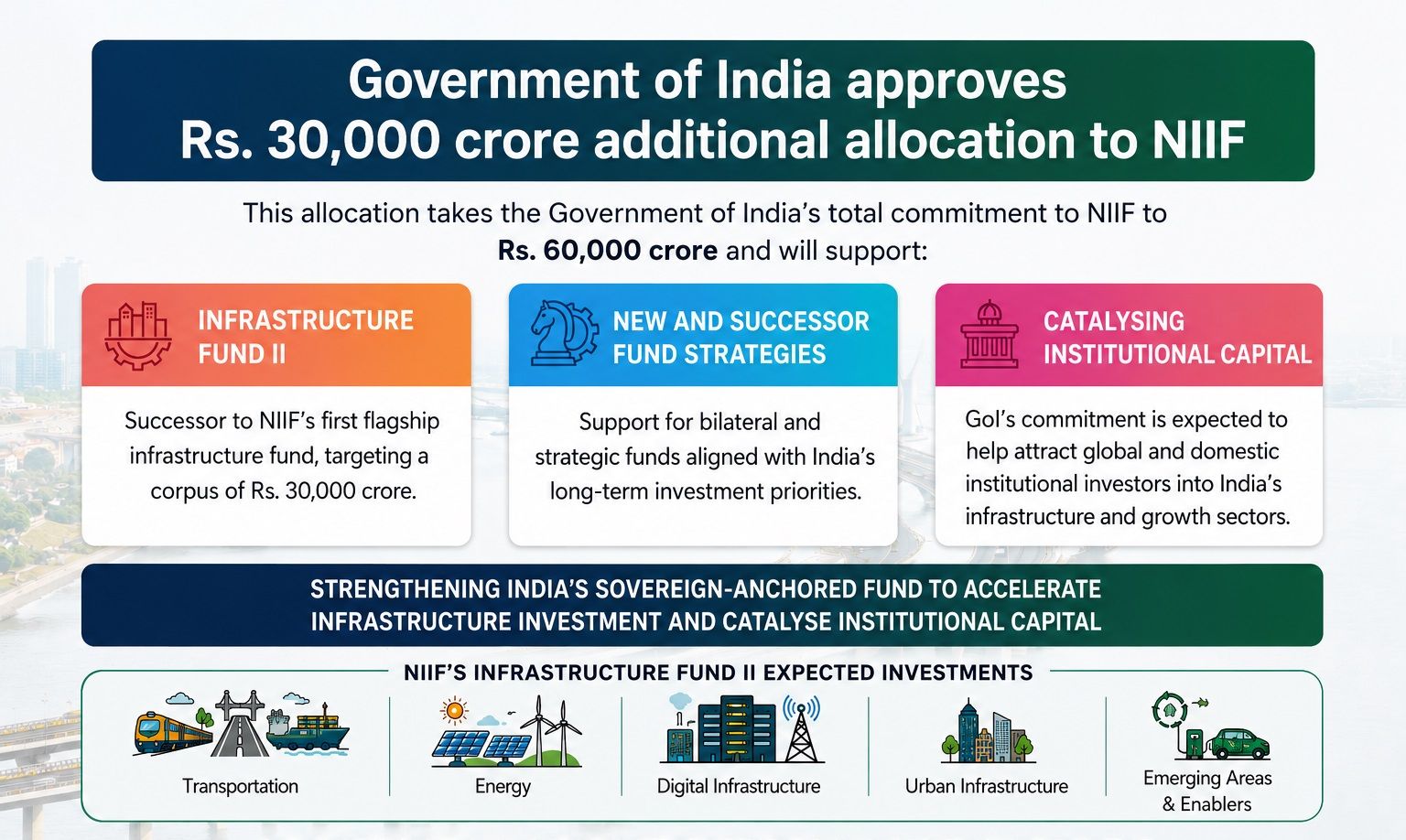
New Delhi: The Union Cabinet has approved an additional investment commitment of ₹30,000 crore in the National Investment and Infrastructure Fund (NIIF), doubling the Government of India's total commitment to ₹60,000 crore and reinforcing New Delhi's strategy of using sovereign capital to attract significantly larger pools of domestic and global institutional investment into India’s infrastructure sector.
The fresh allocation marks one of the government’s biggest commitments to infrastructure-focused investment platforms and comes at a time when India is accelerating capital expenditure to sustain economic growth, modernise logistics and achieve its long-term goal of becoming a developed economy by 2047. The additional funding will primarily be used to establish NIIF Infrastructure Fund II, the successor to its flagship infrastructure fund, while also supporting new investment strategies and future bilateral funds.
The move underlines the government’s confidence in NIIF’s ability to mobilise private capital alongside sovereign funding, creating a multiplier effect across infrastructure and nationally significant sectors.
Global Capital Confidence
Established as India’s sovereign-anchored investment platform, NIIF is professionally managed by National Investment and Infrastructure Fund Limited (NIIFL), with the Government of India holding a 49% shareholding. The platform currently manages capital commitments of nearly ₹40,000 crore across multiple funds and investment strategies.
NIIF has built a strong investment track record since its inception, returning close to ₹12,000 crore to investors through large portfolio exits while steadily deploying capital into critical sectors of the economy.
Its ability to attract marquee global investors has emerged as one of its biggest strengths. The investor base includes sovereign wealth funds, pension funds, multilateral development institutions and leading domestic financial institutions such as Abu Dhabi Investment Authority, AustralianSuper, CPP Investments, Ontario Teachers' Pension Plan, PSP Investments, Temasek, Asian Infrastructure Investment Bank, New Development Bank, Asian Development Bank, Japan Bank for International Cooperation, US International Development Finance Corporation, Axis Bank, HDFC Group, ICICI Bank, Kotak Mahindra Life Insurance and State Bank of India.
These investors represent major financial institutions across Australia, Canada, Japan, Singapore, the United Arab Emirates and the United States, reflecting sustained international confidence in India’s economic prospects, investment environment and NIIF's governance standards.
Investment Strategy Broadens
NIIF currently operates four investment platforms covering infrastructure, private markets, growth equity and climate investments through the India-Japan Business Corridor.
Its first infrastructure fund, with a corpus of ₹16,000 crore, has become India’s largest domestic infrastructure fund. Investments span transportation assets including roads, ports, logistics and airports, alongside renewable energy, smart metering, electricity transmission and digital infrastructure.
The Private Markets Fund has backed several domestic alternative investment funds managed by Indian fund managers, enabling investments in climate-focused businesses, affordable housing, affordable healthcare and venture capital-led technology enterprises.
Meanwhile, the Strategic Opportunities Fund has focused on sectors including financial services, healthcare and manufacturing, while the India-Japan Fund — the country’s first bilateral investment fund of its kind — supports investments in climate technologies, circular economy projects, energy transition and initiatives that deepen the India-Japan business corridor.
Collectively, NIIF-managed funds have invested across transportation, energy transition, healthcare, digital infrastructure, electric mobility, affordable housing, manufacturing and technology projects spread across multiple states and Union Territories. These investments complement flagship government initiatives including Gati Shakti, Digital India, Make in India, India’s COP climate commitments, FAME and PM E-DRIVE.
Beyond investing capital, NIIF has emerged as an important policy and advisory institution, assisting both the Centre and states in structuring new public-private partnership projects and investment frameworks. Its advisory work includes support for the proposed Maritime Development Fund, the Research Development and Innovation Fund, asset monetisation initiatives and PPP structures designed to attract larger private-sector participation.
Infrastructure Growth Multiplier
The government’s additional ₹30,000 crore commitment will anchor NIIF Infrastructure Fund II, which is expected to target a corpus of nearly ₹30,000 crore. The successor fund will invest across transportation, energy and digital infrastructure while expanding into emerging sectors such as urban infrastructure and electric mobility.
The allocation will also provide capital for NIIF’s upcoming fund strategies and successor bilateral investment vehicles, broadening its investment platform as India seeks to deepen long-term institutional participation in infrastructure financing.
Officials expect the fresh sovereign commitment to crowd in significantly larger volumes of private domestic and international capital, accelerating the creation of high-quality infrastructure assets while generating direct and indirect employment opportunities. The investments are also expected to strengthen manufacturing, clean energy, urban development and digital connectivity, supporting the government’s Atmanirbhar Bharat agenda and its broader ambition of transforming India into a Viksit Bharat by 2047.
With infrastructure financing requirements expected to remain elevated over the coming decades, the expanded NIIF commitment positions the sovereign-backed platform to play a larger role in bridging India’s long-term investment gap while providing institutional investors with access to professionally managed, diversified infrastructure opportunities.
(Cover photo by Zoshua Colah on Unsplash)