

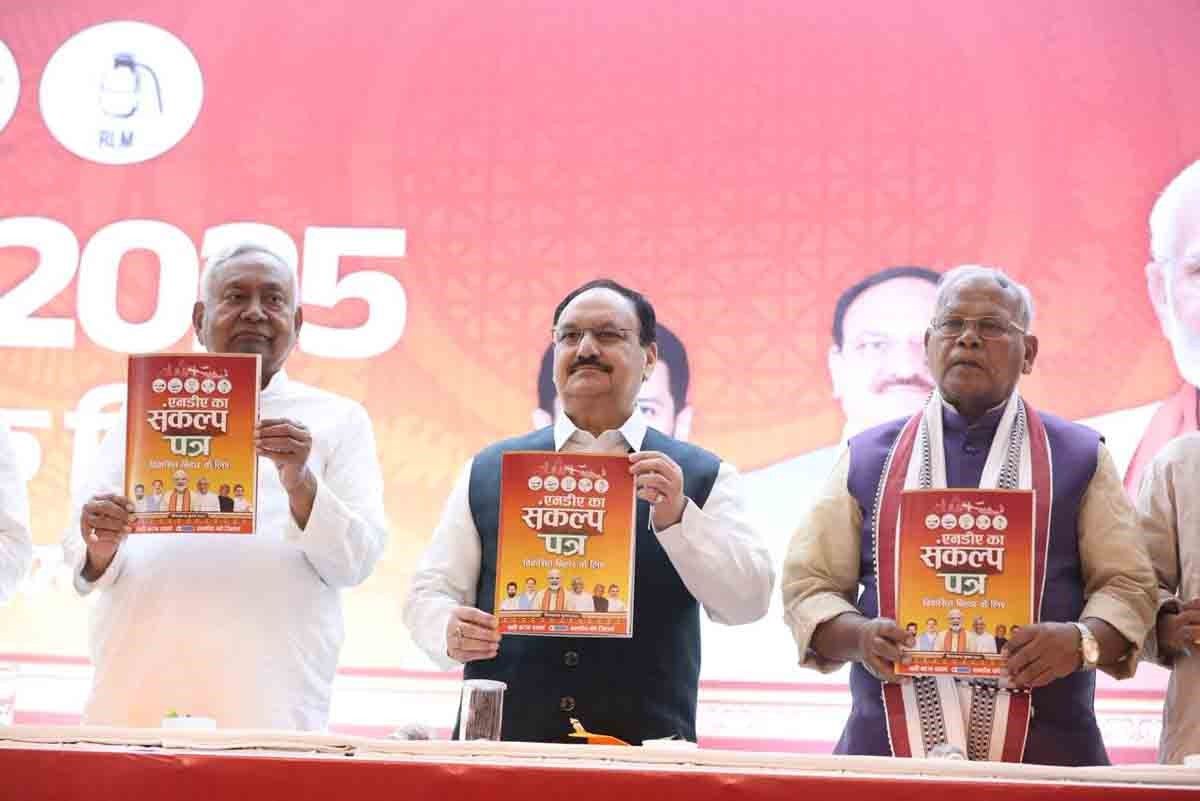
New Delhi: Setting the stage for one of the most closely watched assembly elections in Bihar in a decade, the NDA unveiled its election manifesto, ‘Sankalp Patra 2025’, in Patna on Friday. It blends expansive welfare promises with large-scale industrial and infrastructural pledges, attempting to appeal simultaneously to the poor, the aspirational youth, and the middle class.
The political framing of the launch — where senior BJP and JD(U) leaders spoke of “trust”, “guarantee”, and “continuity” — reveals that aims to defend its long governance record while promising a leap into a modern, self-reliant Bihar.
Big Promises: Jobs, Growth & Infrastructure
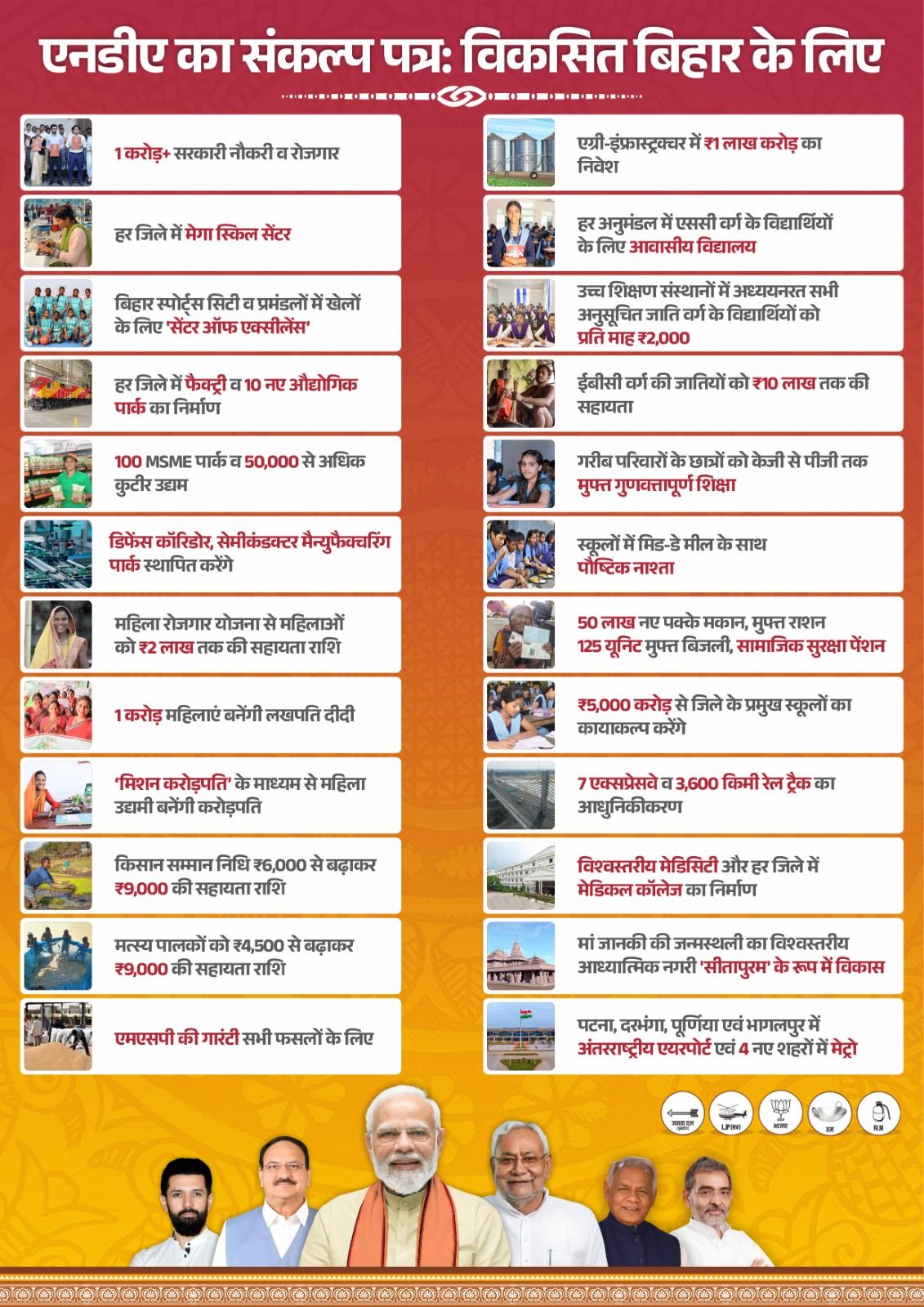
The manifesto’s headline commitment is unmissable: “One crore jobs and employment opportunities” for the youth of Bihar.
Deputy chief minister Samrat Choudhary declared during the launch that the NDA was “focused on every citizen — from farmers and women to Dalits and youth — and will continue to empower all sections of society”. His phrasing captured the manifesto’s tone: a mix of inclusivity and reassurance.
Employment forms the manifesto’s centrepiece. It promises the establishment of Mega Skill Centres in every district, 10 new industrial parks per district, and the creation of defence and semiconductor corridors to attract new-age industries. Alongside these, a ₹9 lakh crore investment in infrastructure is pledged, including seven new expressways, modernization of railway lines, metro systems in four cities, and new international airports. The vision, on paper, is of Bihar emerging as a hub of connectivity and production rather than a source of migration.
Such targets are designed to signal scale and seriousness. The NDA hopes that the optics of planning for expressways and industrial parks can resonate with young voters weary of economic stagnation. The alliance’s pitch here is straightforward: the time for welfare alone has passed; Bihar’s next decade should belong to opportunity and industrialization.
Women, Farmers and Rural Promise
A notable section of the Sankalp Patra is devoted to women’s empowerment. The manifesto speaks of turning “one crore women into Lakhpati Didis” — a direct echo of Prime Minister Narendra Modi’s national pledge to promote female entrepreneurship and micro-finance networks.
Women entrepreneurs are promised access to loans of up to ₹22 lakh, and a new ‘Mission Crorepati’ is floated to support successful enterprises. The symbolism is clear: where the 2015 and 2020 elections leaned heavily on liquor prohibition and welfare transfers, the NDA now wants to pivot toward women as income generators, not merely beneficiaries.
In agriculture, the alliance has promised to raise annual assistance under PM-Kisan to ₹9,000, double the financial aid for fishermen, and expand minimum support prices (MSP) to cover all crops. The promise of guaranteed procurement for small farmers — if delivered — could be politically potent in a state where agriculture remains the mainstay for over 60% of the population.
Education, Social Justice, and Welfare
For students and marginalized communities, the manifesto pledges residential schools for Scheduled Castes and Tribes in every division, monthly stipends for disadvantaged students, and free education from kindergarten to postgraduate level for children from poor households. These commitments signal an attempt to expand social mobility while reinforcing the NDA’s claim that it governs for all.
At the same time, the Sankalp Patra includes conventional welfare promises — housing for every family, low-cost or free electricity, and improved healthcare facilities. It also talks about building a ‘World-Class Medical City’ in Bihar, a pledge aimed at curbing the state’s high rate of medical out-migration.
Political Framing: Continuity & ‘Guarantee”
The NDA’s leadership deliberately framed the manifesto as a “guarantee” rather than a mere set of campaign promises. BJP’s Bihar unit chief Dilip Jaiswal called it “the guarantee of Prime Minister Modi and the trust of Chief Minister Nitish Kumar,” dubbing it the “guarantee of the five Pandavas”. His metaphor invoked unity and moral strength, a symbolic counterpoint to the opposition’s charge that the ruling coalition was a marriage of convenience.
By invoking Modi’s “guarantee” politics — a theme that has been a central plank in BJP campaigns across India — the NDA is clearly leaning on national leadership credibility to bolster a state-level campaign. The implicit message is that Bihar’s progress depends on continuity with the Centre, not confrontation.
Strategy Behind the Document
The NDA’s manifesto operates on three intertwined objectives:
Reclaim Aspirations: Bihar’s youth, who have historically migrated out for jobs, remain a crucial voter bloc. The massive employment figure is as much a psychological reassurance as an economic promise, a way of telling young voters that Bihar, too, can host opportunity.
Broaden the Coalition: By spotlighting women entrepreneurs, farmers, Dalits, and backward castes, the alliance seeks to consolidate support across social strata. Nitish Kumar’s traditional backward-class base and Modi’s broader Hindutva appeal are meant to complement one another.
Project Stability vs Chaos: The NDA contrasts its own “tested partnership” with what it portrays as an unstable and opportunistic opposition front. The “guarantee” framing and repeated references to Modi’s leadership underscore this positioning.
Opposition & the Credibility Question
Yet, for all its ambition, the manifesto has drawn immediate scepticism. Opposition leader Tejashwi Yadav dismissed it as a “Sorry Patra”, arguing that after nearly two decades of NDA rule in Bihar, the alliance should publish a report card, not another list of unfulfilled promises. Congress leaders mocked the brevity of the manifesto’s press conference — reportedly lasting less than half a minute — as evidence of a “lack of seriousness.”
Critics also question the feasibility of simultaneously delivering free electricity, MSP guarantees, metro projects, and millions of jobs. Bihar’s fiscal base remains limited, and large-scale industrialisation will require more than headline numbers — it will demand land reform, consistent power supply, and administrative overhaul. If past development promises are any guide, voters may weigh words against lived experience rather than glossy pledges.
Strengths: Coherence and Political Targeting
Despite such doubts, the manifesto’s structure is politically astute. It connects local aspirations to a national narrative of growth and self-reliance. Its mixture of welfare and modernisation allows the NDA to address both old and new voter sensibilities — those who depend on subsidies and those who seek upward mobility.
The inclusion of quotes like Samrat Choudhary’s “We have focused on every individual and will continue to do so” encapsulates a continuity message that few other political alliances in Bihar can claim. The visual of Nitish Kumar and BJP leaders sharing the stage reinforces a perception of stability, even if the alliance has had a turbulent history.
Risks: Over-promising and Voter Fatigue
The central risk is credibility fatigue. Many voters may view the “one crore jobs” target as implausible, recalling earlier promises that failed to transform Bihar’s employment landscape. Over-ambition without clarity can turn into scepticism, particularly among educated youth who expect realistic timelines and transparency.
Fiscal strain is another concern. Expanding welfare schemes while promising record infrastructure spending could test the state’s limited revenue capacity. Implementation bottlenecks — from land acquisition to inter-departmental coordination — could blunt delivery.
Moreover, the political opposition has learned to counter “Modi’s guarantee” by framing it as “Modi’s marketing.” If public debate shifts from what is promised to what has been delivered, the NDA’s advantage may narrow.
The Sankalp Patra 2025 represents an effort to fuse welfare populism with developmental nationalism. The NDA is not abandoning subsidies or rural support; rather, it is layering them with industrial ambition and digital-era vocabulary — defence corridors, semiconductor hubs, and metro projects.
This hybrid vision could resonate with a young electorate that wants dignity, jobs, and mobility, not just cash transfers. However, the success of this strategy depends on whether voters believe that the alliance, after many years in office, still has the capacity and will to deliver transformative change.
The manifesto’s language — “guarantee,” “trust,” “every individual” — reveals a leadership conscious of both its record and its fatigue. By wrapping promises in moral conviction, the NDA hopes to bridge the gap between aspiration and experience. Whether that emotional bond translates into votes will depend on ground sentiment in early November.