


New Delhi: In a sweeping overhaul of India’s labour regulatory framework, the Union government has notified the enforcement of all four labour codes — Code on Wages (2019), Industrial Relations Code (2020), Code on Social Security (2020), and Occupational Safety, Health and Working Conditions Code (2020) — bringing them into force from today (November 21, 2025).
With the official gazette notifications issued by the labour ministry, these codes now replace 29 central labour laws, marking what the government has described as a “historic modernisation” of India’s labour legislation.
The reforms, which had been pending implementation since their passage in Parliament between 2019 and 2020, are intended to unify an otherwise fragmented labour regulatory landscape that, according to the government, had become outdated, complex and inconsistent across sectors and regions.
Prime Minister Narendra Modi welcomed the rollout on X, stating: “Today, our Government has given effect to the Four Labour Codes. It is one of the most comprehensive and progressive labour-oriented reforms since Independence. It greatly empowers our workers and significantly simplifies compliance while promoting ‘Ease of Doing Business’,” adding the phrase “Shramev Jayate”.
Union Labour Minister Mansukh Mandaviya also praised the transition, asserting that the reforms are guided by labour dignity and social protection. He described the measures as “not just ordinary changes, but a major step for the welfare of the workforce,” and emphasised that the government’s “guarantee is dignity for every worker”.
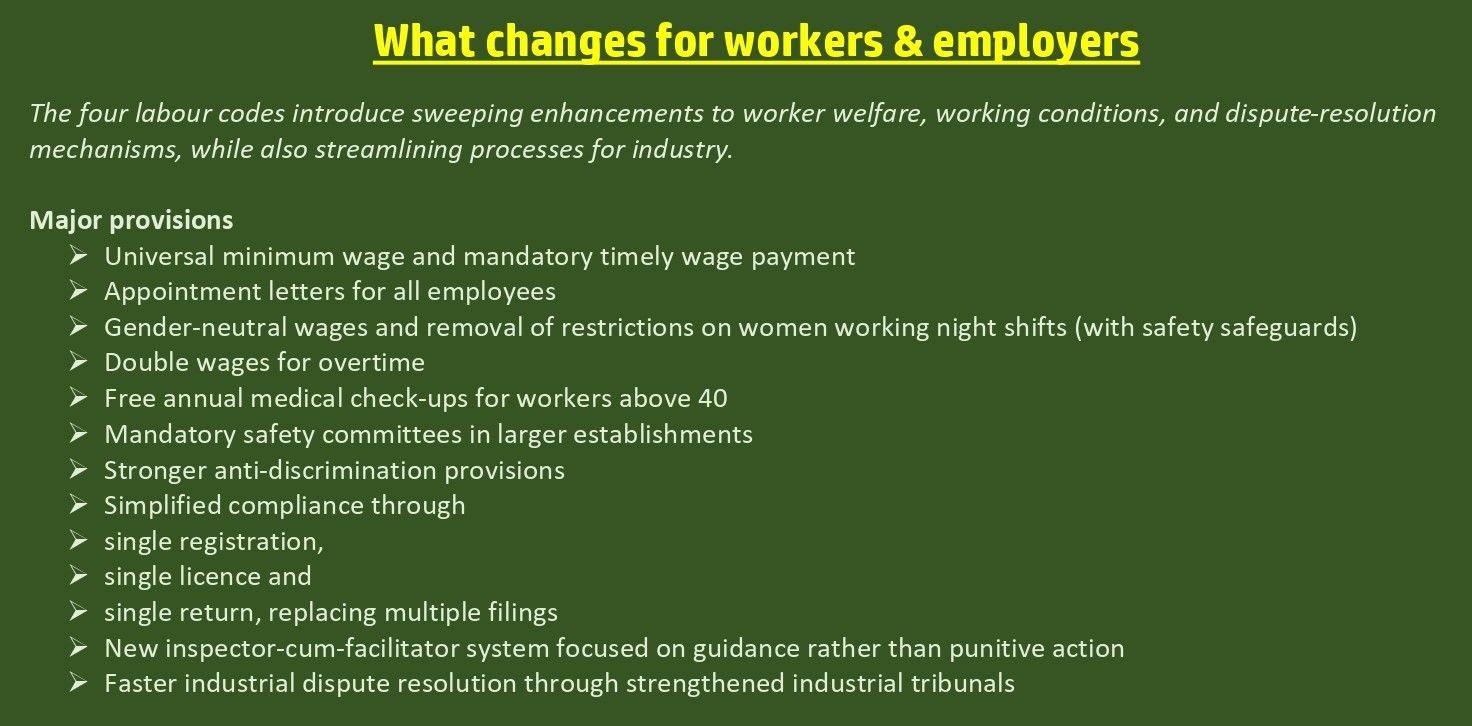
Under the new framework, several major provisions reshape entitlements for workers and compliance requirements for employers. The reform ensures a universal minimum wage and makes timely wage payments mandatory. Every employee must receive a formal appointment letter, and the codes introduce gender-neutral wages along with the removal of restrictions on women working night shifts, subject to prescribed safety safeguards.
Overtime will now be compensated at twice the regular wage rate. Workers above the age of 40 are entitled to free annual medical check-ups, and larger establishments are required to set up safety committees.
The codes reinforce anti-discrimination protections and overhaul compliance procedures by enabling a single registration, a single licence and a single return, replacing multiple regulatory filings. Inspectors have been replaced with an inspector-cum-facilitator model that emphasises guidance rather than punitive action, and strengthened industrial tribunals are expected to make dispute resolution faster.
The Code on Social Security significantly expands the protective net by including gig workers, platform workers, contract workers, migrant workers, MSME workers and fixed-term employees. Fixed-term employees will now qualify for gratuity after just one year of service.
ESIC benefits will extend to all states and to establishments with even a single worker engaged in hazardous processes. Gig and platform workers are set to receive social-security benefits financed in part through contributions from digital aggregators.
The codes also introduce sector-specific improvements in areas such as mining, plantations, IT and ITeS, export-oriented units, ports, textiles, beedi and cigar manufacturing, and the media and entertainment industry, particularly concerning safety measures and working conditions.
During the transition, provisions under existing laws will remain applicable wherever corresponding rules under the new codes are still undergoing stakeholder consultations. Officials have pointed out that India’s social-security coverage has already grown from 19% of the workforce in 2015 to more than 64% in 2025, and the new labour codes are expected to expand it even further.
The government has argued that the codification aligns India’s labour governance with global standards by combining robust worker protections with industrial flexibility. Some trade unions, however, have expressed concerns and continue to demand a phased rollout, saying that certain provisions, particularly those linked to hiring and firing norms, may dilute worker rights.
Even with differing opinions, the operationalization of the four labour codes represents a decisive shift in India’s labour market policy. Policymakers maintain that this transformation is essential for creating a “protected, productive and future-ready workforce” while enhancing the competitiveness of Indian industry across sectors.