
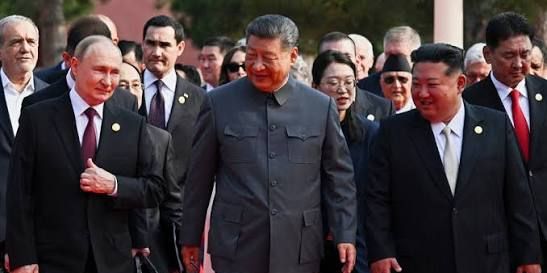

As of August 5, 2026, the geopolitical landscape in East Asia is undergoing a significant transformation, marked by Tokyo’s increasingly urgent warnings regarding a new era of regional instability. In its latest security assessments, the Japanese government has identified a burgeoning military alignment between Russia, North Korea, and China as a primary threat to regional peace. This shift has prompted a fundamental recalibration of Japan’s defense posture, moving toward what officials describe as a mobilization of "overall national strength."
The Rising Tripartite Threat
Central to Tokyo’s concerns is the deepening military cooperation between Moscow and Pyongyang. Japan has officially warned that the "Russia-North Korea axis" represents a growing security threat that cannot be ignored. This partnership, which has seen increased military ties and strategic coordination, is being viewed in tandem with China’s expanding influence.
Japan’s latest defense report characterizes the challenge posed by China as one that must be met with the country’s collective resources. The government is now advocating for a strategy based on "overall national strength," signaling that defense is no longer a siloed military concern but a comprehensive national priority involving economic and technological integration.
Strategic Rearmament and Intelligence Reform
In response to these perceived threats, Japan is accelerating its domestic defense capabilities. A significant milestone in this shift was the deployment of Japan’s first indigenous long-range missile system, a move intended to bolster its deterrent capabilities. Furthermore, the government is moving to modernize its information-gathering apparatus. Japan is planning the creation of a centralized intelligence agency to better navigate the complex security environment.
Interestingly, Tokyo is also attempting to frame this massive increase in defense investment as a domestic advantage. Japan’s new security white paper casts defense spending as an "engine for economic growth." By localizing production and fostering a robust defense industry, the administration hopes to align national security goals with economic revitalization.
Regional Counter-Pressures and Escalation
Tokyo’s pivot toward rearmament has not gone unnoticed by its neighbors, leading to a cycle of warnings and counter-warnings. On August 5, 2026, North Korea issued a direct warning, stating it would take "more military steps" in response to what it perceives as Japan’s provocative rearmament.
This follows long-standing friction with Beijing; China had previously warned that the deployment of advanced systems, such as the Typhon missile system, poses a direct threat to regional stability. The current atmosphere suggests that as Japan moves to secure its borders through indigenous technology and new alliances, the risk of a reactive military buildup from the Russia-North Korea-China alignment remains a critical concern for the international community.