

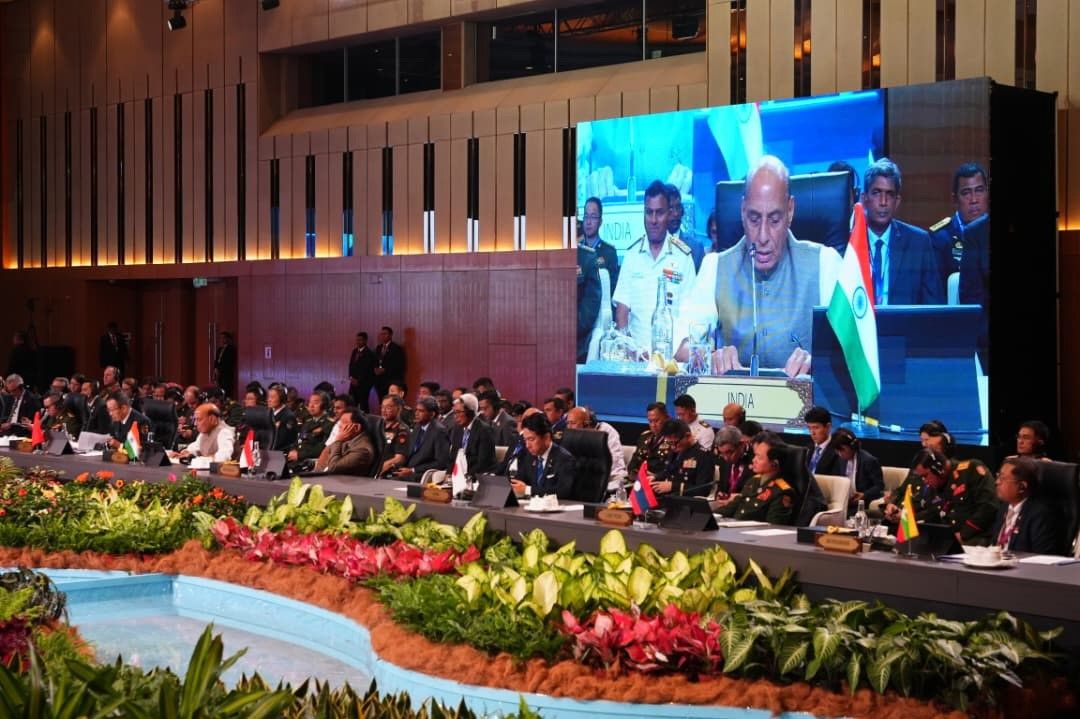
Defence Minister Rajnath Singh addressing the 12th ADMM-Plus at Kuala Lumpur on Saturday.
New Delhi: India reiterated its commitment to the rule of law, freedom of navigation, and an open, inclusive Indo-Pacific at the 12th ASEAN Defence Ministers’ Meeting-Plus (ADMM-Plus) held in Kuala Lumpur on Saturday.
Addressing the forum on ‘Reflection on 15 Years of ADMM-Plus and Charting a Way Forward’,Defence Minister Rajnath Singh emphasized that India’s emphasis on the United Nations Convention on the Law of the Sea (UNCLOS) and the principle of free navigation is not directed against any country, but seeks to safeguard the collective interests of all regional stakeholders.
The defence minister stressed that India’s partnership with ASEAN is guided by enduring principles rather than short-term interests, rooted in the vision of an Indo-Pacific that stays open, inclusive, and free from coercive influence — a message delivered against the backdrop of growing international unease over China’s expanding military assertiveness in the region.
He lauded Malaysia’s chairmanship theme of ‘Inclusivity and Sustainability’ as timely, noting that inclusivity ensures that all nations — big or small — have a role in shaping the regional order, while sustainability calls for resilient, adaptable, and cooperative security frameworks.
“India’s security vision for the Indo-Pacific integrates defence cooperation with economic development, technology sharing, and human resource advancement,” he said, adding that these interlinked aspects define India’s partnership with ASEAN.
Describing ADMM-Plus as a cornerstone of India’s Act East Policy and Indo-Pacific strategy, the defence minister said India views cooperation with ASEAN and Plus countries as a contribution to regional peace, stability, and capacity building. As the forum enters its 16th year, he pledged India’s readiness to deepen practical cooperation in all areas of mutual interest and to advance dialogue over discord.
Rajnath stressed that the experience of the past 15 years demonstrates that inclusive cooperation enhances legitimacy, and collective security strengthens individual sovereignty. These, he said, will continue to guide India’s engagement with ASEAN and ADMM-Plus in the spirit of ‘Mutual and Holistic Advancement for Security and Growth across Regions (MAHASAGAR)’.
Highlighting India’s sustained involvement, Rajnath noted that India has co-chaired four expert working groups— on humanitarian mine action with Vietnam (2014-17), military medicine with Myanmar (2017-20), humanitarian assistance and disaster relief with Indonesia (2020-24), and currently counter-terrorism with Malaysia (2024-27). India has also hosted and participated in numerous field exercises and contributed to the creation of shared operational standards, aligning its initiatives with ASEAN’s strategic outlook.
On Friday, the defence minister also met his ASEAN counterparts during the second India-ASEAN defence ministers’ informal meeting in Kuala Lumpur. The ASEAN ministers lauded India’s role in maintaining peace and stability in the Indo-Pacific and expressed interest in deepening defence cooperation.
India Initiatives
At the meeting, Rajnath announced two forward-looking initiatives: the ASEAN-India Initiative on Women in UN Peacekeeping Operations and the ASEAN-India Defence Think-Tank Interaction, both aimed at expanding collaboration under the ASEAN-India Plan of Action (2026-30).
Malaysia’s defence minister, chairing the ADMM, described India as a “superpower” and said ASEAN would benefit from closer cooperation in cyber and digital defence, defence industry, and innovation. He praised India’s self-reliant defence manufacturing ecosystem as a model for regional capacity-building.
The Philippines defence minister hailed India’s respect for international law and multilateralism, particularly its adherence to UNCLOS, calling it an example for others in the region. He also welcomed India’s role as a first responder in the Indo-Pacific, extending support for the forthcoming India-ASEAN maritime exercise and a joint cooperative activity in the Philippines’ Exclusive Economic Zone.
Echoing similar sentiments, the Cambodian defence minister thanked India for its training support in UN peacekeeping, humanitarian mine Action, and military medicine, while his Singapore’s counterpart underscored ASEAN’s faith in India’s capability to ensure regional peace and proposed greater engagement through joint exercises, policy dialogues, and youth exchanges.
The Thai defence minister emphasized the need for regional self-reliance in defence production and welcomed India’s role in advancing that vision.
The ASEAN defence ministers collectively welcomed India’s initiatives and expressed optimism that the deepening strategic and defence ties with New Delhi would further strengthen the ASEAN-India Comprehensive Strategic Partnership and contribute to peace, stability, and prosperity across the Indo-Pacific region.