
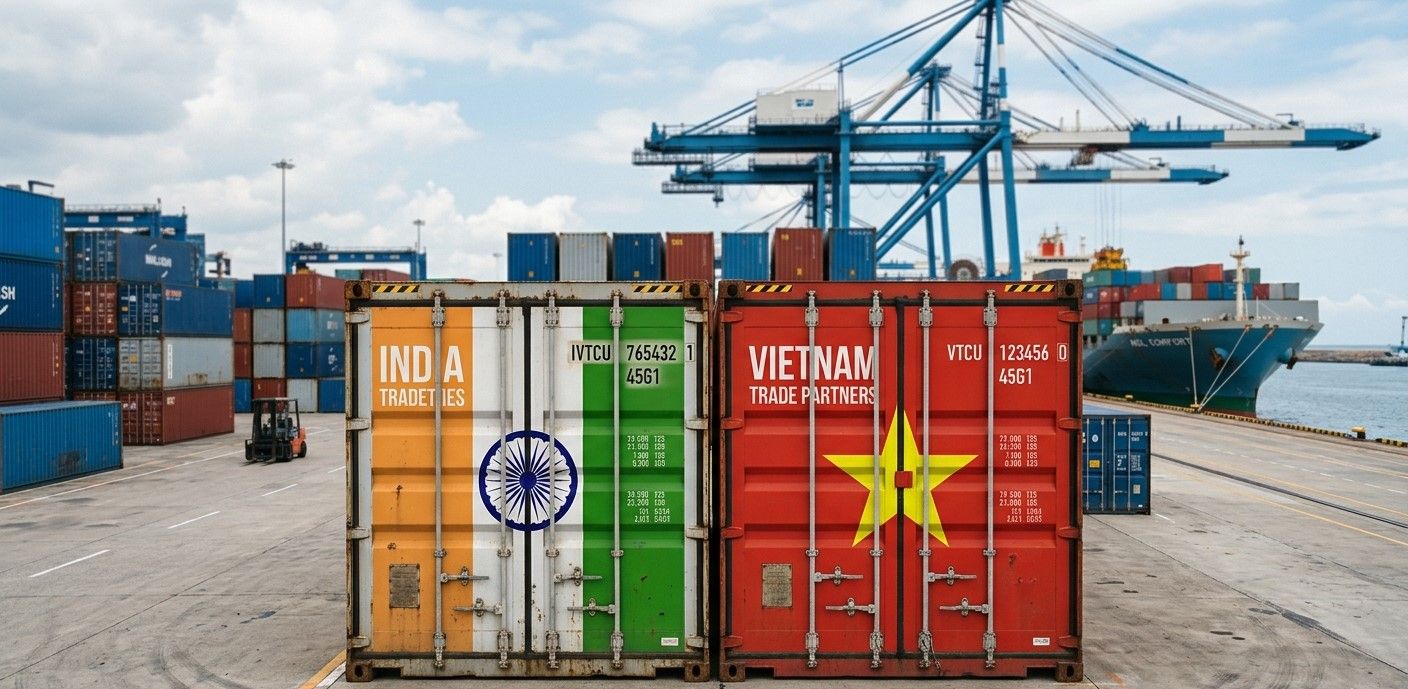
New Delhi: India and Vietnam have charted an ambitious roadmap to elevate bilateral trade to $25 billion by 2030, signalling a shift toward deeper economic, strategic and technological alignment amid a rapidly evolving geopolitical landscape. The agreement emerged from high-level talks in New Delhi between Prime Minister Narendra Modi and Vietnam’s President To Lam, culminating in an upgraded ‘Enhanced Comprehensive Strategic Partnership’ that broadens cooperation across trade, defence, connectivity and critical technologies.
The leaders underscored the urgency of expanding two-way trade in a “balanced and mutually beneficial” manner, while committing to remove market barriers and improve access for key agricultural exports. India secured market entry for grapes, while Vietnam gained access for durians. Both sides also agreed to fast-track approvals for Indian pomegranates and Vietnamese pomelos, reflecting a pragmatic push to diversify and scale trade volumes.
At the heart of the economic agenda lies the review of the ASEAN India Trade in Goods Agreement (AITIGA), which both countries want concluded at the earliest, with an updated framework expected to inject fresh momentum into regional trade and investment flows. The push aligns with a broader strategy to strengthen supply chain resilience, particularly in critical minerals and rare earths, areas where dependence on China remains a global concern. A series of agreements, including cooperation in rare earths, signals intent to diversify sourcing and enhance economic security.
The talks also reflected growing convergence between New Delhi and Hanoi on regional security, particularly in the Indo-Pacific. Against the backdrop of heightened tensions in the South China Sea, both leaders reaffirmed their commitment to freedom of navigation and overflight, while advocating peaceful dispute resolution in accordance with international law. Their joint stance highlights a shared interest in maintaining stability without escalating conflict.
Defence Partnership
One of the key points of the partnership is defence ties. The two sides are exploring the establishment of a ‘two-plus-two’ dialogue involving foreign and defence ministries, a format typically reserved for close strategic partners. India has also offered maintenance, repair and overhaul support for Vietnam’s military platforms, including Sukhoi-30 aircraft and Kilo-class submarines, while discussions continue on potential defence procurements, including the BrahMos supersonic cruise missile.
Recent engagement between Vietnam and Indian defence manufacturers further underscores the expanding scope of military-industrial collaboration. The emphasis is not just on sales, but on understanding Vietnam’s operational requirements and building long-term capability partnerships.
Security cooperation extends beyond defence into counterterrorism and transnational threats. Both leaders strongly condemned terrorism in all its forms, including cross-border networks, and called for dismantling terror infrastructure, choking financing channels and bringing perpetrators to justice swiftly. Vietnam reiterated its support for India on terrorism-related concerns, while both sides acknowledged rising risks from money laundering, cybercrime and online scams.
Healthcare and pharmaceuticals also featured in the discussions, with a new agreement between drug regulatory authorities expected to improve access for Indian medicines in Vietnam, further strengthening India’s role as a reliable healthcare partner.
Energy and nuclear cooperation are emerging as new frontiers. Vietnam has invited India to participate in its nuclear power sector, opening avenues for collaboration in clean energy and long-term sustainability initiatives.
Beyond bilateral priorities, both countries reaffirmed their commitment to multilateralism and called for reforms in global institutions, including the UN Security Council, to better reflect contemporary geopolitical realities.
Vietnam’s calibrated diplomacy — balancing ties with China while deepening strategic engagement with India — adds another layer of significance to the partnership. President To Lam’s visit to Beijing shortly after assuming office underscores Hanoi’s cautious approach, even as it strengthens cooperation with New Delhi in areas where interests align.
The India-Vietnam partnership is thus evolving into a multi-dimensional alliance that blends economic ambition with strategic intent. With trade targets set, defence ties expanding and supply chains being reimagined, the relationship is poised to play a consequential role in shaping the Indo-Pacific order in the years ahead.