

New Delhi: India is set to scale up its sovereign AI compute backbone, with 20,000 additional graphics processing units (GPUs) to be added to the existing 38,000-GPU national capacity in the coming weeks, Union Minister for Electronics and IT Ashwini Vaishnaw announced at the India AI Impact Summit 2026 on Tuesday.
The expansion signals a decisive push into the next phase of India’s AI strategy — one that pairs high-performance computing scale with distributed access and regulatory guardrails.
Addressing reporters in New Delhi, Vaishnaw said the enlarged GPU cluster will strengthen India’s ability to train large-scale foundation models, support inference workloads, and power AI applications across public and private sectors. Unlike compute models concentrated within a handful of hyper-scalers globally, India’s approach prioritises broader access — enabling startups, research institutions, and public-sector innovators to tap into the national AI infrastructure.
The additional 20,000 GPUs will significantly enhance parallel processing capacity, critical for training large language models (LLMs), multi-modal systems, and sector-specific AI solutions in healthcare, agriculture, governance, and education. The minister reiterated that widening AI adoption in public-service delivery remains central to the government’s strategy.
Vaishnaw projected that over $200 billion in AI-linked investments could flow into India over the next two years, spanning semiconductor design, AI infrastructure, model development, applications, and services — the five core layers of the AI stack. Venture capital funding, he said, is increasingly targeting deep-tech startups building foundational technologies alongside scalable AI applications.
On energy, he underscored India’s structural advantage: over 50% (around 51%) of the country’s installed power generation capacity now comes from clean sources. This positions India favourably as AI workloads — particularly large-scale model training and data centre operations—drive up power demand. The government is simultaneously investing in clean-energy-backed data centres and in efficiency research aimed at reducing AI infrastructure energy use by up to 35%.
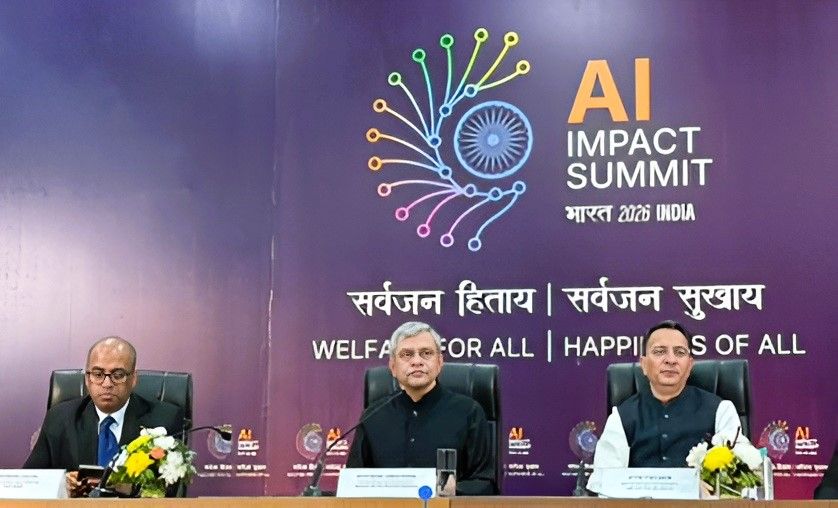
India is positioning itself not merely as a consumer of AI systems, but as a builder of core infrastructure and sovereign AI capabilities, said Ashwini Vaishnaw (centre) , Union Minister for Electronics and IT.
Human capital remains a parallel priority. The Future Skills programme is being reoriented toward AI reskilling, while the Ministry of Education and AICTE are updating curricula to integrate machine learning, data science, semiconductor design, and AI ethics into mainstream technical education. The strategy operates across three vectors: upskilling the current workforce, building a new talent pipeline, and preparing school-level learners for emerging technologies.
On sovereign AI models unveiled at the Summit, Vaishnaw said several systems have been benchmarked against global standards and have demonstrated competitive — at times superior — performance across select parameters. He cited global academic rankings placing India among the top three AI nations worldwide.
At the regulatory level, the minister called for a techno-legal governance framework combining algorithmic safeguards, model auditing, and regulatory oversight to mitigate risks such as bias, misinformation, and misuse. India’s AI Safety Institute, operating as a virtual collaborative network with academic institutions, is developing technical evaluation protocols and safety testing mechanisms.
Reaffirming the government’s Semiconductor Mission, Vaishnaw said ‘Semiconductor 2.0’ will focus sharply on chip design capabilities, reinforcing upstream innovation. The ecosystem, he noted, could see at least 50 deep-tech startups emerge as compute capacity, capital flows, and policy support converge.
Framing AI as the engine of the “fifth industrial revolution,” Vaishnaw pointed to real-world deployments showcased at the Summit — from AI-assisted diagnostics reducing healthcare costs to adaptive learning platforms delivering personalized education at scale.
With expanded GPU capacity, clean-energy backing, semiconductor ambitions, and a widening innovation base, India is positioning itself not merely as a consumer of AI systems, but as a builder of core infrastructure and sovereign AI capabilities, he said.
(Cover photo by Igor Omilaev on Unsplash)