


New Delhi: India’s external sector remained remarkably resilient through a year marked by geopolitical tensions, supply-chain disruptions and rising protectionism, with total merchandise and services trade touching $1.84 trillion in FY2025-26. Yet beneath the headline growth lies a more strategic challenge: whether India can convert its dominance in generic medicines into leadership in high-value pharmaceutical innovation.
The latest quarterly assessment released by Niti Aayog shows that while goods exports struggled against a difficult global backdrop, services continued to power India’s trade engine. Services exports expanded 9% in the January-March quarter, helping cushion a widening merchandise trade deficit and reinforcing India’s position as the world’s eighth-largest services exporter.
The Trade Watch Quarterly: Jan-Mar (Q4) — Thematic Analysis: Pharmaceutical Trade, was released by Niti Aayog Vice-Chairman Ashok Kumar Lahiri on Tuesday (June 23). The report combines an assessment of India’s trade performance with a detailed examination of the pharmaceutical sector, which it identifies as a strategic pillar for the country’s next phase of export growth.
Trade Resilience Tested
India’s total trade in goods and services grew 5.4% year-on-year during April 2025-March 2026, reaching $1.84 trillion. Exports rose 4.2% to $860.1 billion, while imports increased 6.5% to $979.4 billion, reflecting continued domestic demand and industrial expansion despite weakening global trade conditions.
The quarterly numbers reveal a mixed picture. Merchandise exports declined 2.8% in the January-March period to $112 billion, while imports surged 11.9% to $195.5 billion. Services, however, remained the standout performer, with exports climbing to $111.1 billion and generating a surplus of $60.4 billion.
India’s services success has become increasingly central to external-sector stability. Services exports have grown at a compound annual growth rate of 10.3% over the past decade, significantly outpacing the global average of 6.6%. The country’s share in global services exports has consequently risen to 4.3% in 2025.
Trade patterns also point to a gradual geographic realignment. Export growth was concentrated in Asian markets such as Hong Kong, Singapore and China, while shipments to traditional destinations including the US, UAE and the UK moderated. The shift reflects both changing demand patterns and India’s effort to diversify trade relationships amid global uncertainty.
Pharma Growth Challenge
The Niti Aayog report’s central focus, however, lies on the pharmaceutical sector. Global pharmaceutical and active pharmaceutical ingredient (API) demand is estimated at roughly $1.3 trillion in 2025, yet India’s pharmaceutical and API exports amounted to just $35.8 billion, highlighting the gap between domestic capabilities and global market opportunities.
India remains one of the world’s largest suppliers of generic medicines and vaccines. The country accounts for about 20% of global generic drug supply and serves more than 200 export destinations, including highly regulated markets in North America and Europe. Pharmaceutical exports excluding APIs reached about $25.8 billion in 2025.
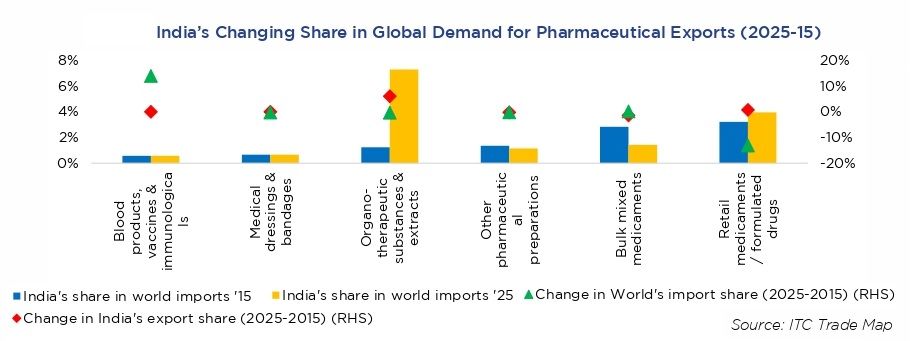
Yet the report argues that India’s strengths remain concentrated in conventional formulations, particularly retail medicaments and generic drugs. Exports in this category reached $22.6 billion and captured a 4% share of global demand. By contrast, India’s participation in fast-growing segments such as biologics, immunologicals and advanced therapeutics remains limited.
This matters because the global pharmaceutical industry is undergoing a structural shift. Blood products, vaccines and immunologicals have emerged as the fastest-growing segment worldwide, with imports reaching $390.2 billion. India’s exports in this category, however, were only $2.2 billion, translating into a global share of just 0.6%.
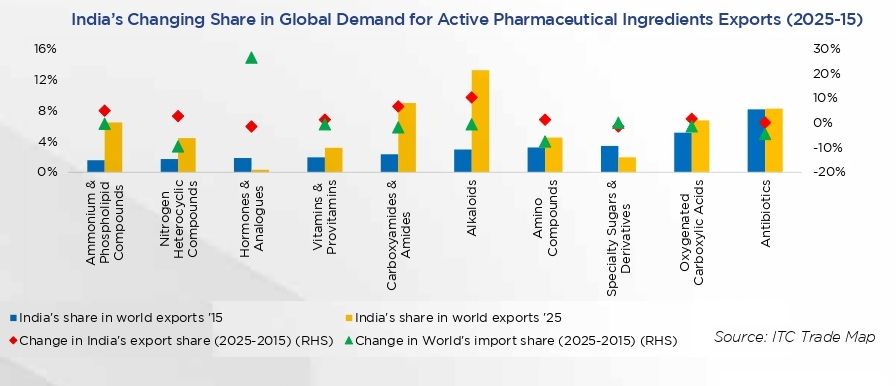
The challenge extends to APIs. While India exported $10 billion worth of APIs in 2025 and remains a net exporter, dependence on imported raw materials and intermediates — particularly from China — continues to expose vulnerabilities in the supply chain. The report notes that China still supplies between 66% and 86% of India’s top API import categories.
Innovation Imperative Ahead
The Niti Aayog report identifies Telangana, Gujarat and Maharashtra as the three states driving India’s pharmaceutical success. Together they account for a substantial share of production, exports and integration into global value chains through strong manufacturing ecosystems, industrial clusters and research capabilities.
At the same time, it warns that India’s next phase of growth cannot rely solely on scale and cost competitiveness. Patent filings in life sciences have risen eightfold over the past decade, but research spending by Indian pharmaceutical firms remains around 7% of sales, well below the 15-20% levels common among global leaders.
Releasing the report, Lahiri said, “As global trade undergoes structural shifts, India’s ability to diversify its export base while strengthening domestic capabilities in key sectors will be critical to sustaining growth and enhancing resilience. The pharmaceutical sector illustrates both India’s strengths and future opportunities.”
He added, “While India has emerged as a leading supplier of generic medicines to the world, the next phase of growth will depend on moving towards innovation-driven segments, strengthening domestic production of critical inputs, and improving access to global markets.”
The report echoes that assessment. It argues that India must scale up investment in frontier R&D, biologics, biosimilars and advanced therapeutics while building stronger innovation ecosystems and regulatory frameworks. Without that transition, the country risks remaining the world’s preferred supplier of low-cost medicines while surrendering the most profitable segments of pharmaceutical trade to innovation-driven economies.
India’s trade sector has demonstrated resilience in a turbulent global environment, and services exports continue to provide a powerful competitive advantage. But if the country is to transform from the “pharmacy of the world” into a global pharmaceutical innovation hub, the next decade will require deeper investments in science, technology, intellectual property and supply-chain self-reliance. The opportunity is vast; so is the challenge.
(Cover photo by freestocks on Unsplash)