

New Delhi: India’s central infrastructure pipeline is showing signs of accelerating execution, with projects worth ₹42.5 lakh crore progressing through various stages of development and an increasing number nearing completion. Spanning transport, energy, urban development, telecommunications and water systems, these projects underscore the scale of the country’s public investment programme.
The Ministry of Statistics and Programme Implementation (MoSPI) said its PAIMANA platform was tracking 1,987 infrastructure projects costing ₹150 crore and above as of May 2026. The projects, spread across 17 ministries and departments, have already recorded cumulative expenditure of ₹21.82 lakh crore, equivalent to 51.34% of their revised project costs.
The latest numbers suggest India is simultaneously expanding its infrastructure pipeline and moving a significant portion of existing projects towards completion, reinforcing infrastructure spending as a key pillar of economic growth.
Execution Gains Momentum
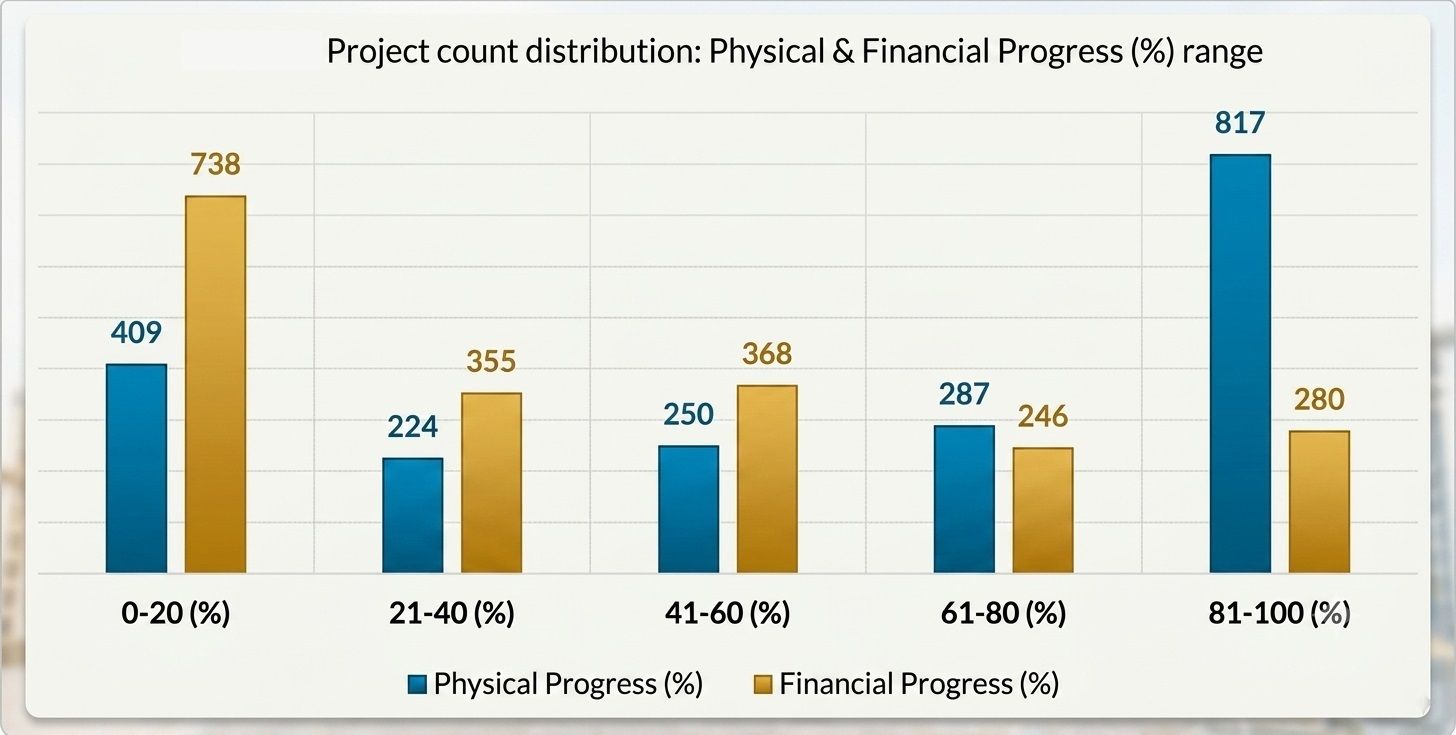
A growing share of projects is reaching advanced stages of implementation. As many as 817 projects, or about 41% of the total portfolio, have achieved more than 80% physical progress, while 280 projects have crossed the 80% financial completion mark.
“Physical and financial progress broadly move in tandem, with a large number of projects clustered at the initial (0-20%) and advanced (81–100%) stages, indicating a pipeline of newly-started projects alongside many nearing completions,” MoSPI said.
“While physical progress exceeds financial progress in the 81-100% range, financial progress is relatively higher in the early stages, reflecting upfront expenditure patterns in project implementation.”
The portfolio includes 813 mega projects costing ₹1,000 crore and above, with an original investment value of ₹31.58 lakh crore. Another 1,174 major projects, valued between ₹150 crore and ₹1,000 crore, account for ₹5.52 lakh crore.
The data points to a balanced infrastructure cycle, with new projects continuing to enter the system even as hundreds of existing projects move closer to commissioning.
Transport Still Dominates
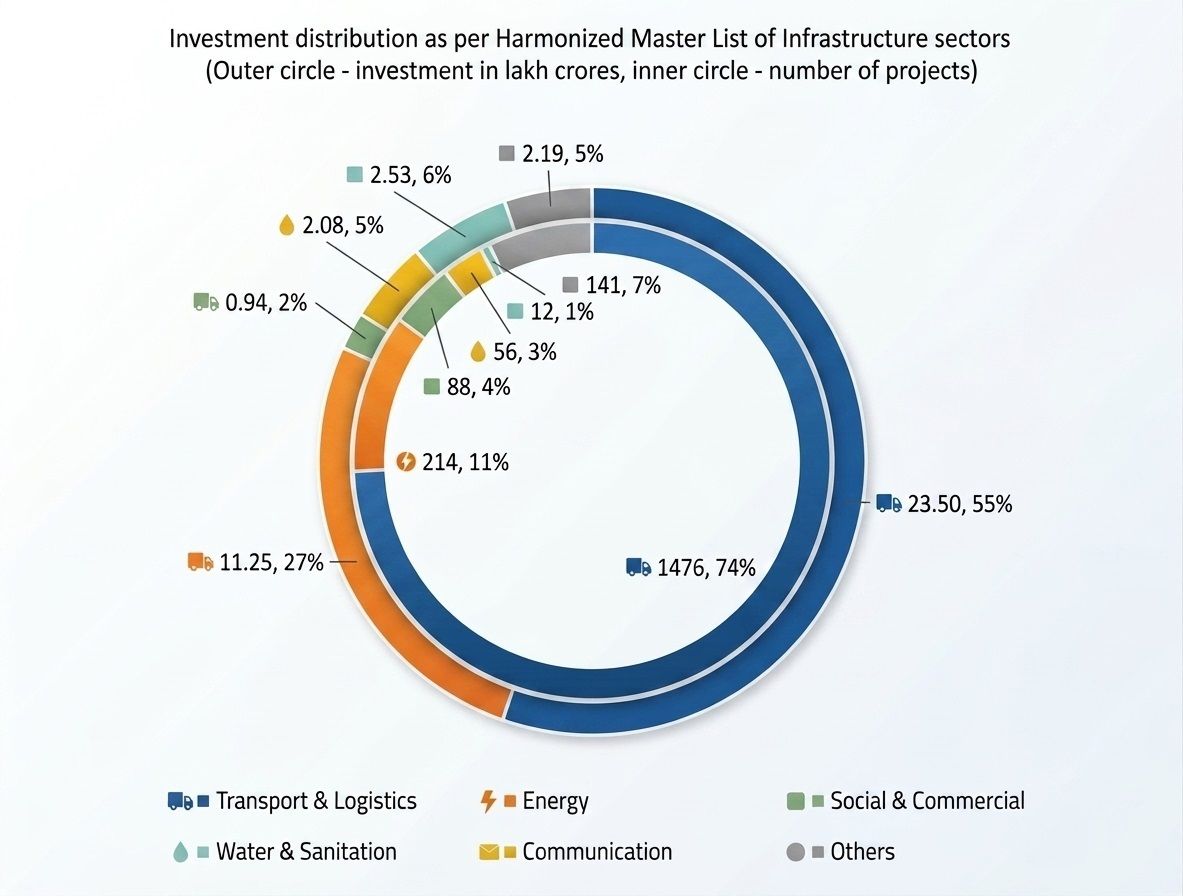
Transport and logistics, representing 74% of all monitored projects and 55% of the total revised project cost, continues to absorb the largest share of infrastructure spending. “The transport & logistics sector (as per the DEA’s Harmonized Master List) accounts for the highest number of ongoing projects (1476), with revised estimates of ₹23.50 lakh crore underscoring priority to connectivity-driven infrastructure growth,” the ministry said.
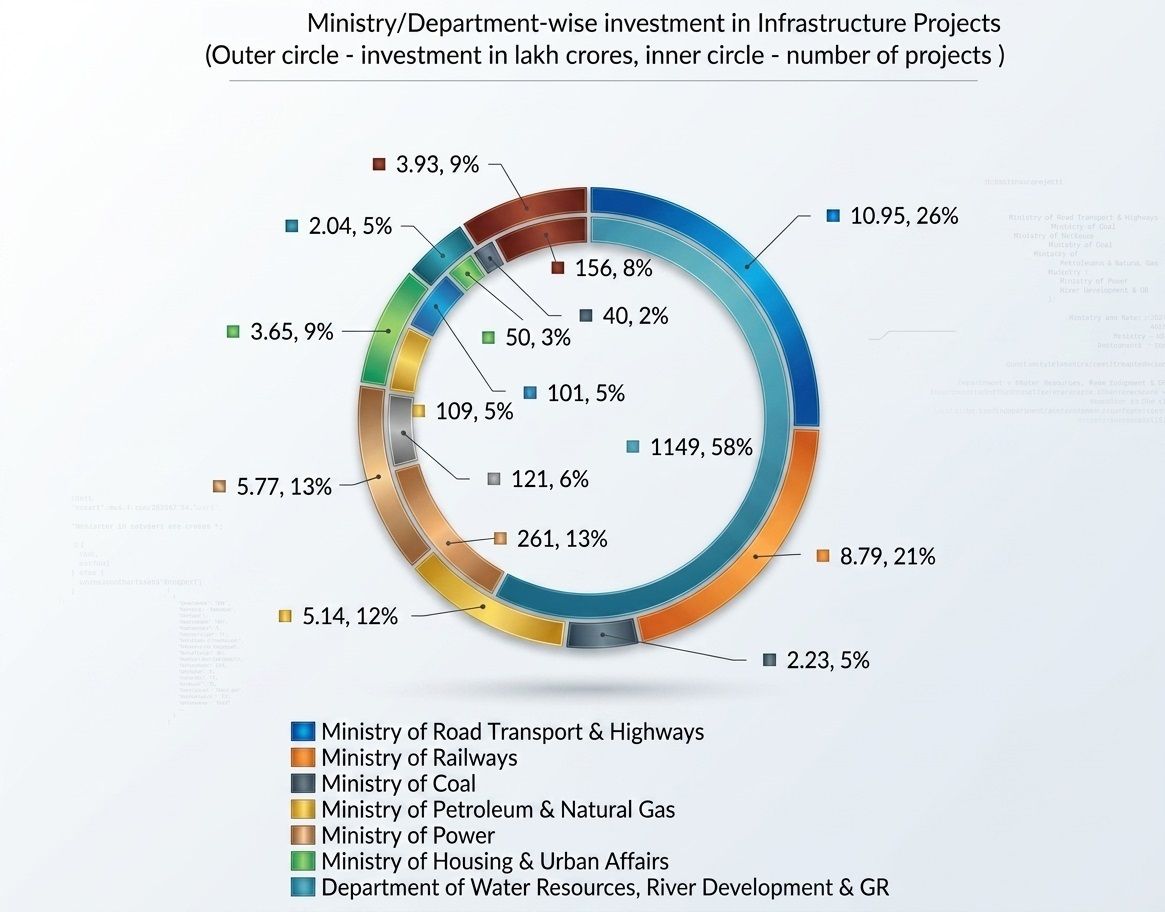
Roads remain the backbone of the programme. The Ministry of Road Transport and Highways is implementing 1,149 projects — 58% of all monitored projects — with a revised cost of ₹10.95 lakh crore.
The Ministry of Railways follows with 261 projects worth ₹8.79 lakh crore, reflecting continued investment in freight corridors, network expansion and capacity enhancement.
The transport basket also includes projects under civil aviation, ports, shipping, inland waterways and urban public transport, reinforcing the government’s strategy of improving logistics efficiency and reducing transportation costs across the economy.
Energy Expands Footprint
While transport dominates by project count, the energy sector remains the second-largest investment destination, accounting for 214 projects worth ₹11.25 lakh crore, or 27% of the total revised project cost.
The sector spans electricity generation, transmission and distribution infrastructure, oil and gas assets, and energy storage systems.
The Ministry of Power is implementing 101 projects with a revised cost of ₹5.77 lakh crore, while the Ministry of Petroleum and Natural Gas is overseeing 109 projects worth ₹5.14 lakh crore.
Coal continues to play a significant role in the infrastructure pipeline. The Ministry of Coal is implementing 121 projects valued at ₹2.23 lakh crore, including several large-scale mining and power-related assets.
The breadth of investment across power, fuel supply and transmission networks highlights the government’s efforts to support rising energy demand while strengthening industrial and urban infrastructure.
Digital & Urban Build-Out
India’s infrastructure expansion is increasingly extending beyond transport and energy.
Communication infrastructure accounts for 12 projects with a revised cost of ₹2.53 lakh crore, representing about 5% of total project spending. The investments are focused on strengthening digital connectivity and expanding telecommunications capacity.
Urban infrastructure also remains a major focus area. The Ministry of Housing and Urban Affairs is implementing 50 projects worth ₹3.65 lakh crore, including metro rail systems, urban mobility networks and city infrastructure projects.
Water and sanitation projects account for 56 projects with a revised cost of ₹2.08 lakh crore. The Department of Water Resources, River Development and Ganga Rejuvenation is implementing 40 projects valued at ₹2.04 lakh crore, reflecting continued investment in irrigation, water security and river management programmes.
Social and commercial infrastructure — including education, healthcare, tourism and real estate — accounts for 88 projects worth ₹0.94 lakh crore. Although representing only 2% of total project costs, these projects support broader improvements in public services and quality of life.
Another 141 projects worth ₹2.19 lakh crore fall under the ‘Others’ category, spanning coal, steel, metals and mining infrastructure, underscoring efforts to strengthen industrial supply chains and resource development.
Meanwhile, 156 projects worth ₹3.93 lakh crore are spread across ministries including higher education, civil aviation, steel, telecommunications, labour & employment, ports, shipping & waterways, health & family welfare, mines, DPIIT and sports.
Fresh Additions Arrive
The infrastructure pipeline continued to expand in May, with 35 new projects brought under PAIMANA monitoring.
Among the largest additions was the Telangana Super Thermal Power Project Stage-II, a ₹29,344.85 crore investment under the Ministry of Power. Rail infrastructure received a boost through the ₹9,889.24 crore Nidadavolu-Duvvada third and fourth line project, while the Ministry of Road Transport and Highways added the ₹3,147 crore four-laning of the Pathalgaon-Kunkuri-Chhattisgarh-Jharkhand border section of NH-43.
At the same time, 16 projects were commissioned during the month.
“During May 2026, 16 projects were commissioned, including major assets in coal, housing & urban affairs, power, road transport & highways, petroleum & natural gas and labour & employment,” MoSPI said.
Among the largest completed assets were the ₹21,780.94 crore Ghatampur Thermal Power Plant (3x660 MW), the ₹12,924.55 crore Ahmedabad Metro Rail Project Phase-I and the ₹8,255 crore Mumbai-Nagpur-Jharsuguda Pipeline project.
Taken together, the figures suggest India’s infrastructure programme is broadening beyond roads and railways into a multi-sector investment cycle spanning energy, digital connectivity, water systems, urban infrastructure and industrial assets. With more than half of total project costs already spent and hundreds of projects nearing completion, the focus is increasingly shifting from project announcements to execution and delivery — a transition that could determine the pace of economic expansion in the years ahead.