

New Delhi: India has entered a phase of structurally stronger growth, supported by macroeconomic stability, declining inflation volatility, and broad-based welfare gains across states, said Poonam Gupta in a speech delivered at the ‘Columbia Indian Economy Summit 2026’ on Monday (April 11). In her speech at Columbia University, she particularly highlighted how India’s economic transformation is now being driven not only at the national level, but increasingly by the states themselves.
This shift reflects a broader evolution in India’s growth story. The country’s economic rise is no longer merely a national narrative; it is increasingly a state-level story marked by uneven prosperity, sharper inter-state competition, and a gradual narrowing of long-standing developmental gaps. As different regions build on their comparative strengths, states are emerging as key engines of growth and innovation.
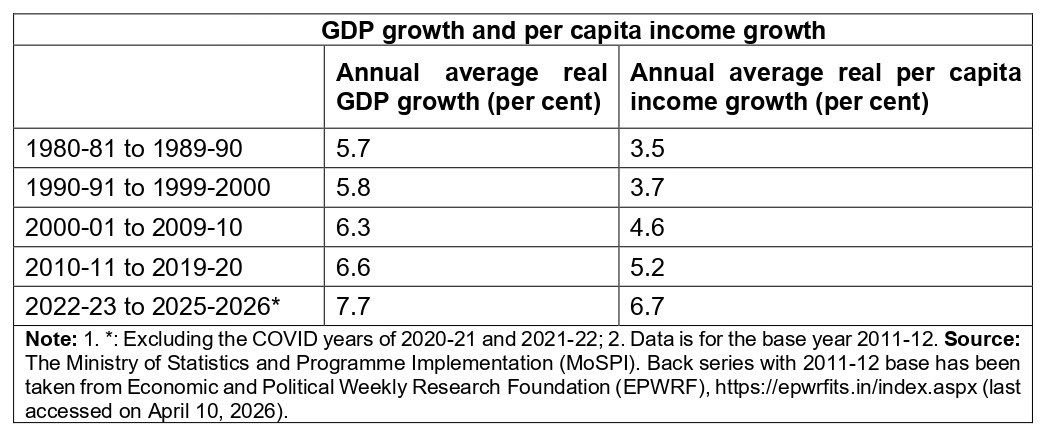
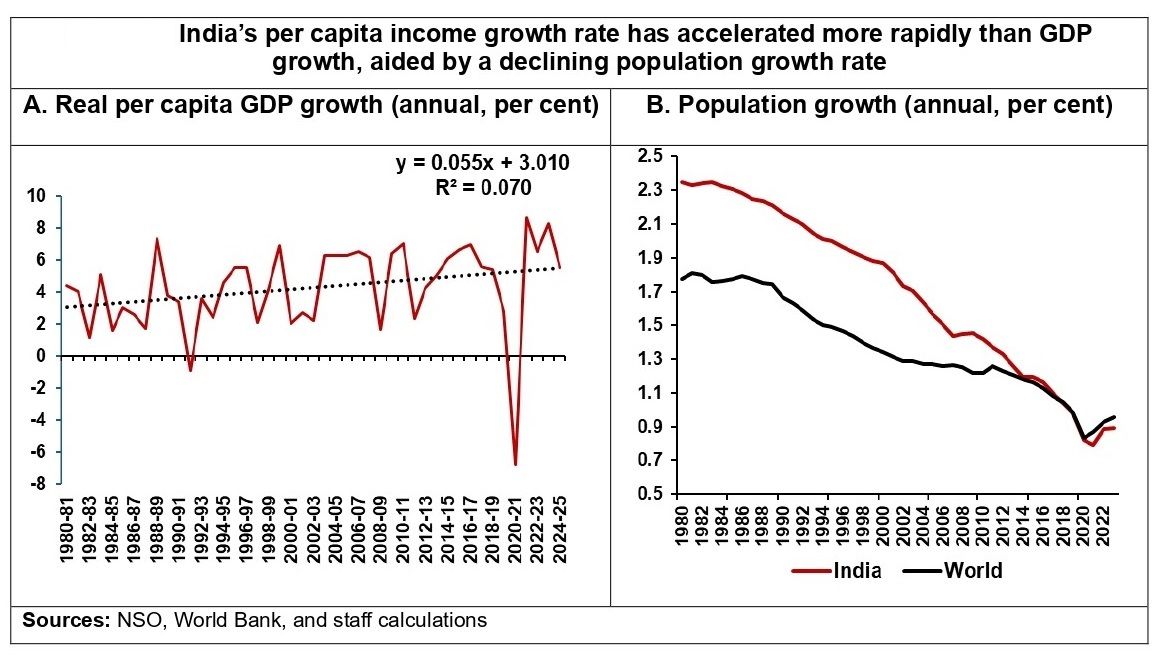
The momentum is also visible in India’s long-term economic performance. Average GDP growth has accelerated steadily over the past four decades, rising from 5.7% in the 1980s to 7.7% in the latest four-year period excluding the pandemic years. Per capita income growth has been even more striking, increasing from about $274 in 1981 to nearly $2,700 in 2024, reflecting both sustained expansion and improving living standards across the country.
“India has attained a virtuous cycle of accelerated growth and macroeconomic stability. Macroeconomic stability is reflected in sustainable and resilient outcomes across inflation, the current account balance, fiscal position, debt quality, and financial sector health, among others. Key macroeconomic outcomes, especially growth and inflation, are broadly less volatile and move within a narrower, more predictable range,” said Dr Gupta.
That assessment comes at a time when India is positioning itself as the world’s fastest-growing major economy while simultaneously attempting to reduce disparities between richer and poorer states.
Rich States Still Lead, But Gap Is Shrinking
The RBI Deputy Governor’s speech presents a nuanced picture of inter-state growth. Prosperity has expanded across the country, but richer states continue to outperform poorer ones in absolute income growth.
States such as Sikkim, Telangana, Karnataka and Tamil Nadu have recorded some of the strongest per capita income gains over the past two decades. Average per capita incomes across states have risen nearly five-fold in current $ terms since 2003-04.
The more significant trend, however, is that the pace of divergence is slowing.
“The pace of income growth has varied across states. Some states have become five to ten times more prosperous over the last two decades, while others have recorded more modest gains of around three times. One strong correlation of the relative performance is their initial prosperity levels,” said Dr Gupta.
She added that while richer states historically grew faster, the relationship between initial prosperity and future growth has weakened sharply in the last decade. Lower-income states such as Odisha, Assam and Uttar Pradesh have begun improving their growth trajectories, reducing the intensity of interstate divergence.
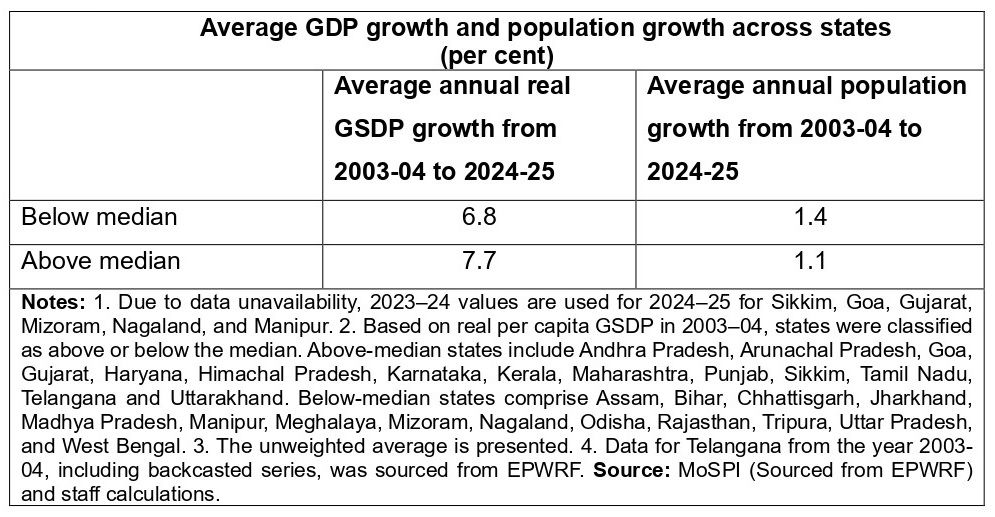
She also highlighted that above-median income states benefited from both stronger economic growth and slower population growth. That combination accelerated gains in per capita income compared with poorer states.
Still, the data suggest India is moving towards a more balanced economic structure than in previous decades, even if full income convergence remains distant.
Welfare Gains Driving Real Convergence
Where India’s transformation becomes more striking is beyond the headline GDP numbers.
The RBI Deputy Governor argues that while income convergence has been gradual, convergence in welfare indicators has been far more decisive. Consumption growth, financial inclusion, health access and basic services are improving faster in poorer states than in richer ones.
“While income convergence across states remains gradual, several other welfare indicators, most notably per capita consumption expenditure, have been converging more decisively. However, in the recent period, states with historically lower consumption levels are now recording faster consumption growth,” said Dr Gupta.
The breadth of these gains is significant. Access to electricity, sanitation, drinking water, bank accounts and healthcare coverage has improved sharply across states. Women’s financial inclusion has seen one of the most dramatic shifts, with the percentage of women holding bank accounts rising to nearly 80% during 2019-21 from just 14% in 2005-06.
“Beyond consumption expenditure, multiple other dimensions of socio-economic wellbeing have been converging. Indicators spanning health, education, demography, physical infrastructure, access to electricity, safe drinking water, sanitation, clean cooking fuel, and financial inclusion have all trended toward greater parity across states,” said Dr Gupta.
This pattern has major implications for India’s long-term domestic demand cycle. Rising consumption in historically weaker states could create a broader and more resilient national growth base over the next two decades.
The findings also reinforce the argument that India’s growth story is increasingly being driven by structural welfare improvements rather than urban income expansion alone.
What Comes Next
The most consequential message from the RBI Deputy Governor’s speech lies in what comes next.
If current trajectories hold, India’s per capita income could quadruple by 2047. More importantly, several states could move close to high-income thresholds under prevailing global benchmarks.
But Dr Gupta made it clear that sustaining such growth will require far more state-specific policymaking.
“For above-median (growth) states, the focus ought to be on innovation and scale, planned urbanization, attracting global and domestic talent, expanding market share both domestically and internationally, and actively taking part in shaping national frameworks on trade, FDI, and finance,” she said.
Dr. Gupta argued that poorer states would need a different playbook centred on agricultural productivity, labour-intensive manufacturing, skill development and stronger fiscal capacity.
The speech also draws a sharper distinction between the Centre’s macroeconomic role and the states’ execution responsibilities. While monetary policy, financial regulation and trade policy remain nationally driven, states increasingly determine competitiveness through land reforms, labour flexibility, public service delivery and infrastructure quality.
“At the state level, the policy space and levers available are different, though no less consequential. State governments shape the ease of doing business environment; determine land and labour market conditions; quality and reach of education and health services; delivery of public services; and enhancing the quality of public finances,” said Dr Gupta.
That framing effectively positions India’s next phase of economic growth as a decentralised competition among states rather than a purely national macroeconomic exercise.
For investors, policymakers and global institutions watching India’s rise, the message is becoming clearer: the future of the Indian economy will increasingly be decided not only in New Delhi, but across state capitals competing to define the country’s path to prosperity by 2047.