
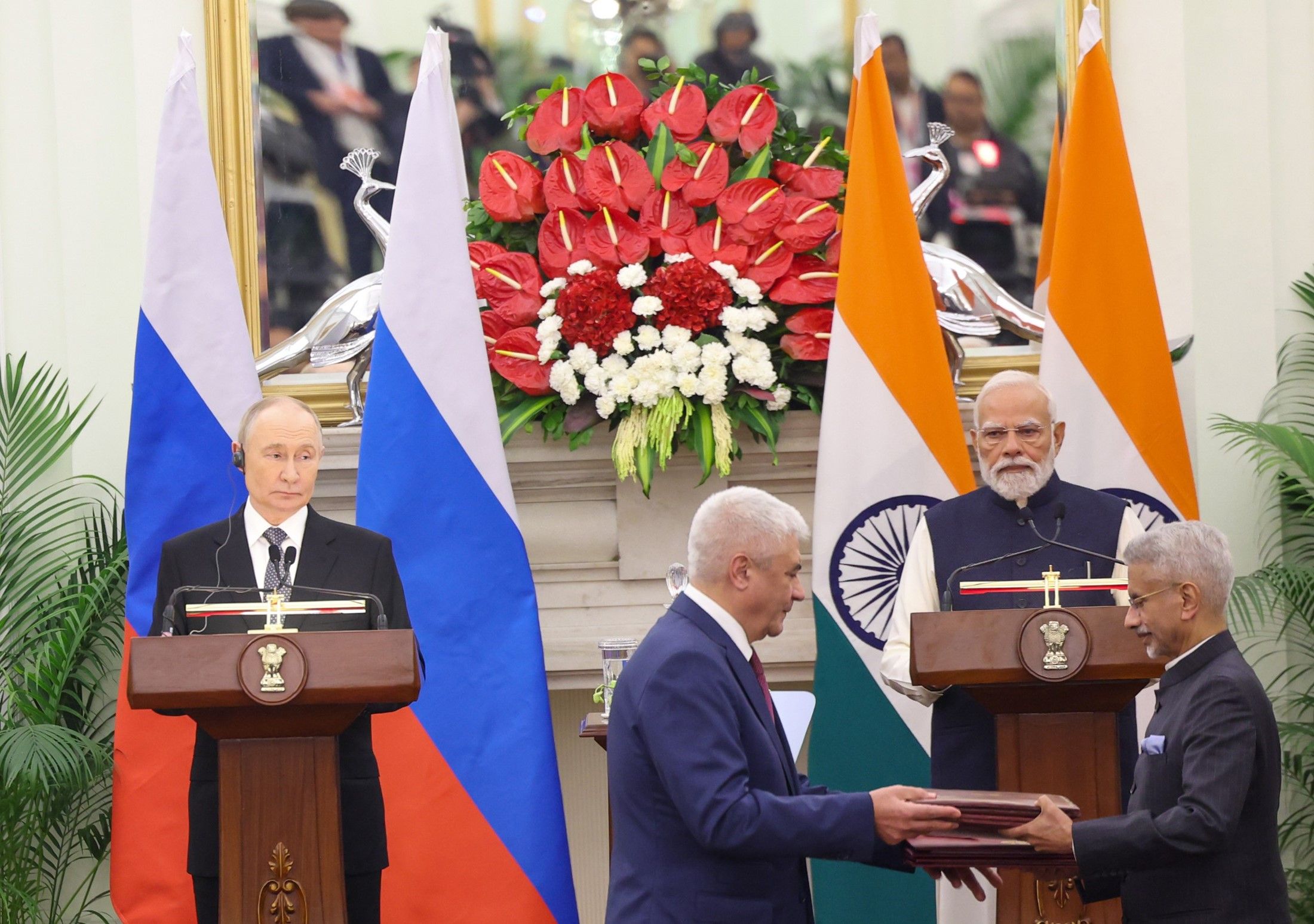

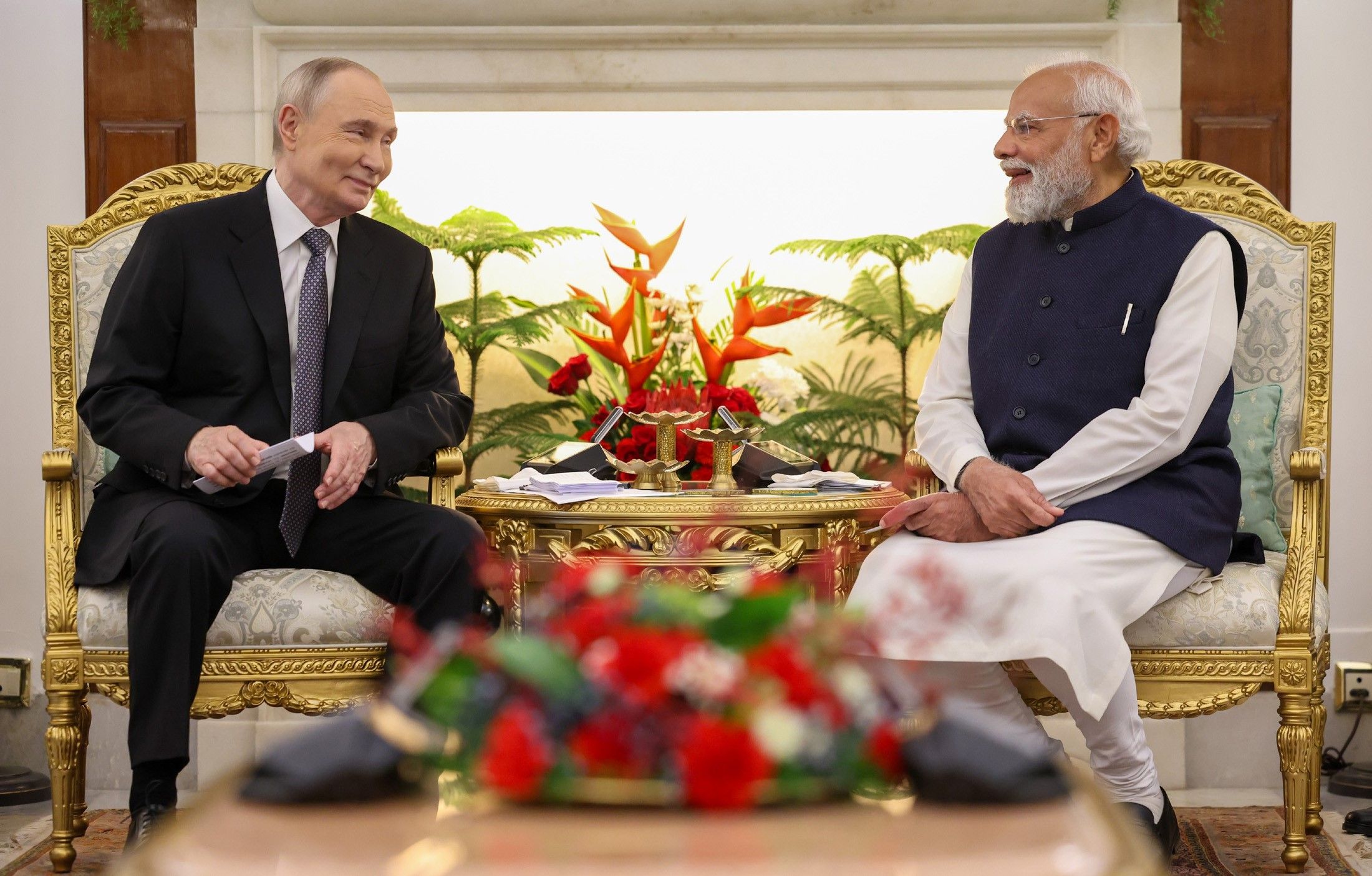
New Delhi: Reaffirming what they called a “time-tested, mutually respectful and trust-anchored” relationship, Prime Minister Narendra Modi and Russian President Vladimir Putin held the 23rd India-Russia Annual Summit in New Delhi on Friday.
The talks, held in the 25th anniversary year of the Declaration on Strategic Partnership signed during Putin’s first State visit to India in 2000, produced a joint statement detailing cooperation across defence, nuclear energy, trade, connectivity, the Arctic, technology, multilateral platforms and counter-terrorism.
Both sides underlined the “special nature” of the long-standing partnership, noting that it has remained “resilient” despite a “complex, challenging and uncertain geopolitical situation.”
Stressing strategic convergence and respect for each other’s core interests, the leaders said the bilateral relationship “continues to be an anchor of global peace and stability” founded on “equal and indivisible security”.
They also took stock of intensified high-level political engagement since the previous summit — including meetings at the BRICS Summit in Kazan and the SCO Summit in Tianjin—along with ministerial visits, parliamentary exchanges, strategic dialogues and multiple working-level mechanisms across security, trade and cultural fields.
Trade Push, 2030 Economic Programme
Modi and Putin placed significant emphasis on expanding bilateral trade “in a balanced and sustainable manner”, particularly by boosting India’s exports to Russia and forging new industrial and technological partnerships. They endorsed the programme for the development of strategic areas of India-Russia Economic Cooperation till 2030, envisaging cooperation in advanced manufacturing, high technology, energy, critical minerals and logistics.
The leaders also welcomed progress on a Free Trade Agreement between India and the Eurasian Economic Union and urged speedier negotiations on a bilateral investment protection pact. They said the immediate priorities for achieving the revised trade target of $100 billion by 2030 include smoothing logistics, removing tariff and non-tariff barriers, improving insurance and reinsurance solutions, and expanding direct business exchanges.
To safeguard trade flows amid global financial uncertainties, both sides agreed to continue refining settlement systems using national currencies and exploring interoperability between digital currency platforms and national payment and financial messaging systems.
They also welcomed steps to secure long-term fertilizer supplies for India, possibilities for joint ventures in the sector, and agreements facilitating mobility of skilled workers. Both sides acknowledged the role of the India-Russia business forums in 2024 and 2025, which helped expand investment linkages.
Emphasizing the strategic role of mineral resources — including energy supplies, precious metals and critical raw materials — the two sides said cooperation in this domain is crucial for national security and global supply-chain resilience.
Defence: Joint R&D, Manufacturing
Defence and military-technical cooperation — the backbone of the partnership — received renewed focus. The 22nd IRIGC-M&MTC meeting in New Delhi endorsed a shift towards “joint research and development, co-development and co-production of advanced defence technology and systems” in line with India’s self-reliance goals.
Both sides supported joint manufacturing in India of spare parts and components for Russian-origin defence platforms, with potential exports to “mutually friendly third countries”. They expressed satisfaction with regular military exchanges and confirmed the continuation of joint exercises such as INDRA.
Energy: Oil, Gas, Nuclear
Energy cooperation remained at the centre of the talks. The leaders commended progress between companies in oil, gas, petrochemicals, LNG and LPG infrastructure, oilfield services, upstream technologies and underground coal gasification. They agreed to iron out outstanding issues hampering investments and committed to “expeditious resolution” of concerns faced by companies in the energy sector.
Civil nuclear cooperation was highlighted as a major pillar of the partnership. Both sides reiterated support for the ongoing and future units of the Kudankulam Nuclear Power Plant (KKNPP) and agreed to adhere to timelines for supply of fuel and equipment.
India reiterated that it will “strive to finalise formal allotment” of the long-pending second NPP site for future Russian-designed reactors.
They also decided to advance technical and commercial discussions on VVER reactors, joint R&D in nuclear technology, and greater localization and joint manufacturing of nuclear equipment and fuel assemblies — key for India’s plan to scale nuclear capacity to 100 GW by 2047.
They expressed interest in deepening cooperation on critical minerals and rare earths, boosting joint R&D, and enhancing innovation ecosystems for start-ups and SMEs.
Connectivity: INSTC, Chennai-Vladivostok & the Arctic
Transport and connectivity featured prominently, with both sides underlining the urgency of expanding logistics corridors such as the International North-South Transport Corridor, the Chennai-Vladivostok Maritime Corridor and the Northern Sea Route. They welcomed an MoU on training polar-water navigation specialists and cited “fruitful cooperation” between the national railways, including technology exchanges.
India reaffirmed its readiness to deepen its involvement in Russia’s Far East and Arctic regions. The program of India-Russia Cooperation in the Russian Far East (2024-29) is expected to guide collaboration in agriculture, manpower, mining, energy, pharmaceuticals, shipping and diamonds.
Space Ties & Advanced Tech
The leaders welcomed expanding cooperation between ISRO and Roscosmos across human spaceflight, satellite navigation, planetary exploration and rocket engine development.
In science and technology, both sides called for ramping up government, academic and private-sector collaboration in critical and emerging technologies, including information security and protection of critical infrastructure.
They expressed interest in deepening cooperation on critical minerals and rare earths, boosting joint R&D, and enhancing innovation ecosystems for start-ups and SMEs through soft-support programmes and collaborative technology development.
Multilateral Cooperation: UN, G20, Brics, SCO
The leaders reaffirmed strong cooperation at the UN and called for comprehensive UNSC reform. Russia reiterated its “steadfast support” for India’s bid for permanent membership. Both sides highlighted the primacy of the UN Charter and international law and advocated for “reinvigorated multilateralism”.
They also endorsed the continuity of priorities set during India’s G20 Presidency in 2023, including greater representation of the Global South and the African Union’s inclusion as a full member. They reaffirmed the G20’s role as the premier global economic platform functioning by consensus.
On Brics, both sides emphasised deepening cooperation under its expanded framework and reaffirmed the grouping’s guiding spirit of “sovereign equality, solidarity, openness, inclusiveness and consensus”. Russia pledged “full support” for India’s Brics chairship in 2026.
Both sides praised cooperation within the SCO and acknowledged its growing role in shaping a “fair multipolar world order”. They emphasised modernization of SCO mechanisms, including counter-terrorism, narcotics control, information security and the operationalisation of new centres in Tashkent and Dushanbe.
Russia welcomed India’s initiative to establish the SCO Civilizational Dialogue Forum, whose inaugural session will take place in India in 2026.
Climate Change, Biodiversity, Economic Governance
Both sides reaffirmed commitment to the UNFCCC and Paris Agreement, welcoming the first meeting of the joint working group on climate change and low-carbon development held in New Delhi in September 2025. They agreed to deepen dialogue on Article 6 mechanisms, low-carbon technologies and sustainable finance.
They supported ongoing Brics initiatives on climate research and sustainable development and welcomed Russia’s adoption of the framework agreement to join the International Big Cat Alliance. India reiterated expectations for Russia’s early membership in the International Solar Alliance and the Coalition for Disaster Resilient Infrastructure.
Counter-Terrorism, Regional Issues
Modi and Putin issued a strong statement against terrorism, reaffirming a zero-tolerance approach and condemning the April 2025 Pahalgam attack in India and the March 2024 Crocus City Hall attack in Russia. They called for “concerted actions against all UN-listed terrorist groups”, stressing the need to eliminate financing networks, safe havens and cross-border movement of terrorists.
They urged swift adoption of the Comprehensive Convention on International Terrorism and welcomed the Delhi Declaration of 2022 on countering misuse of emerging technologies by terrorists.
On Afghanistan, both sides highlighted close coordination through security council dialogues and the Moscow Format. They called for sustained humanitarian assistance and effective counter-terrorism measures against groups like ISIS and ISKP.
Reviewing the Middle East situation, they called for restraint, protection of civilians and adherence to international law. They expressed concern over the humanitarian crisis in Gaza and emphasized dialogue to resolve the Iran nuclear issue.
The leaders expressed satisfaction with the “resilience” of the India-Russia partnership and reiterated that as “major powers”, both countries will continue working for global peace and stability in a multipolar world. President Putin thanked Modi for the hospitality extended to him in New Delhi and invited him to Russia in 2026 for the next summit.