


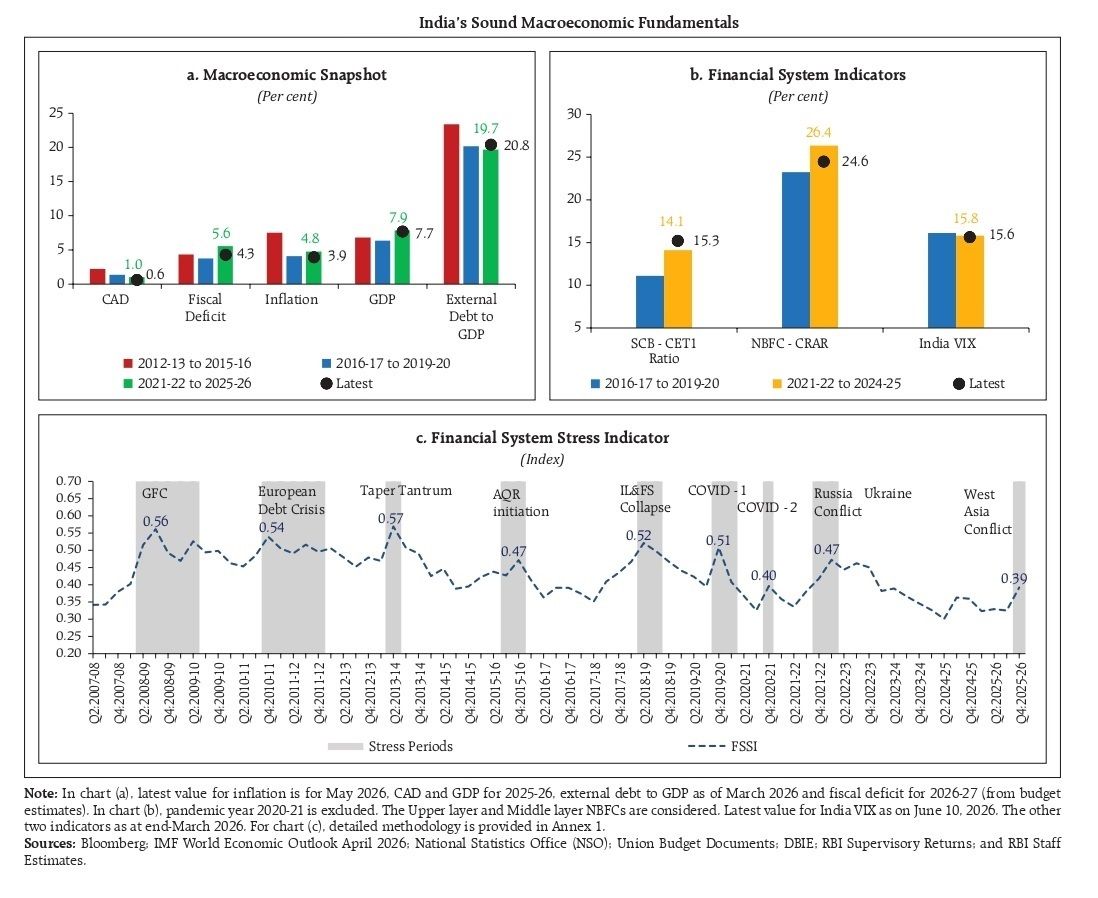
New Delhi: India has emerged as one of the world’s best-positioned major economies to withstand escalating global financial turbulence, with stronger bank balance sheets, resilient non-bank lenders and improving macroeconomic fundamentals providing a formidable buffer against external shocks, according to the Reserve Bank of India’s Financial Stability Report, June 2026.
RBI’s latest assessment comes at a time when geopolitical tensions, elevated sovereign debt, volatile capital flows, and richly valued global financial markets continue to test economies worldwide. Yet the central bank believes India’s financial system is entering this uncertain phase from a position of considerably greater strength than during previous crises, reflecting years of regulatory reforms, healthier balance sheets and prudent macroeconomic management.
The report says the balance of risks has turned favourable following the interim peace agreement in West Asia and policy measures introduced by the government and the RBI to strengthen capital inflows. “The Indian economy and the financial system have demonstrated remarkable resilience despite facing external shocks of significant magnitude. Strong growth, low inflation, healthy balance sheets of financial and non-financial firms, and ample buffers have helped preserve macro-financial stability,” RBI Governor Sanjay Malhotra said in the report.
India’s current account deficit remained within manageable limits during FY26 even though the balance of payments stayed in deficit for the second consecutive year because of weaker capital inflows. Exchange-rate pressures and higher government bond yields that followed the outbreak of the West Asia conflict have eased considerably after coordinated policy interventions by the government and the RBI to attract foreign capital. The central bank notes that despite a modest increase in the ‘Financial System Stress Indicator’, overall stress remains significantly below levels witnessed during the global financial meltdown, the taper tantrum, the IL&FS collapse and the Covid-19 pandemic.
Global Faultlines Deepen
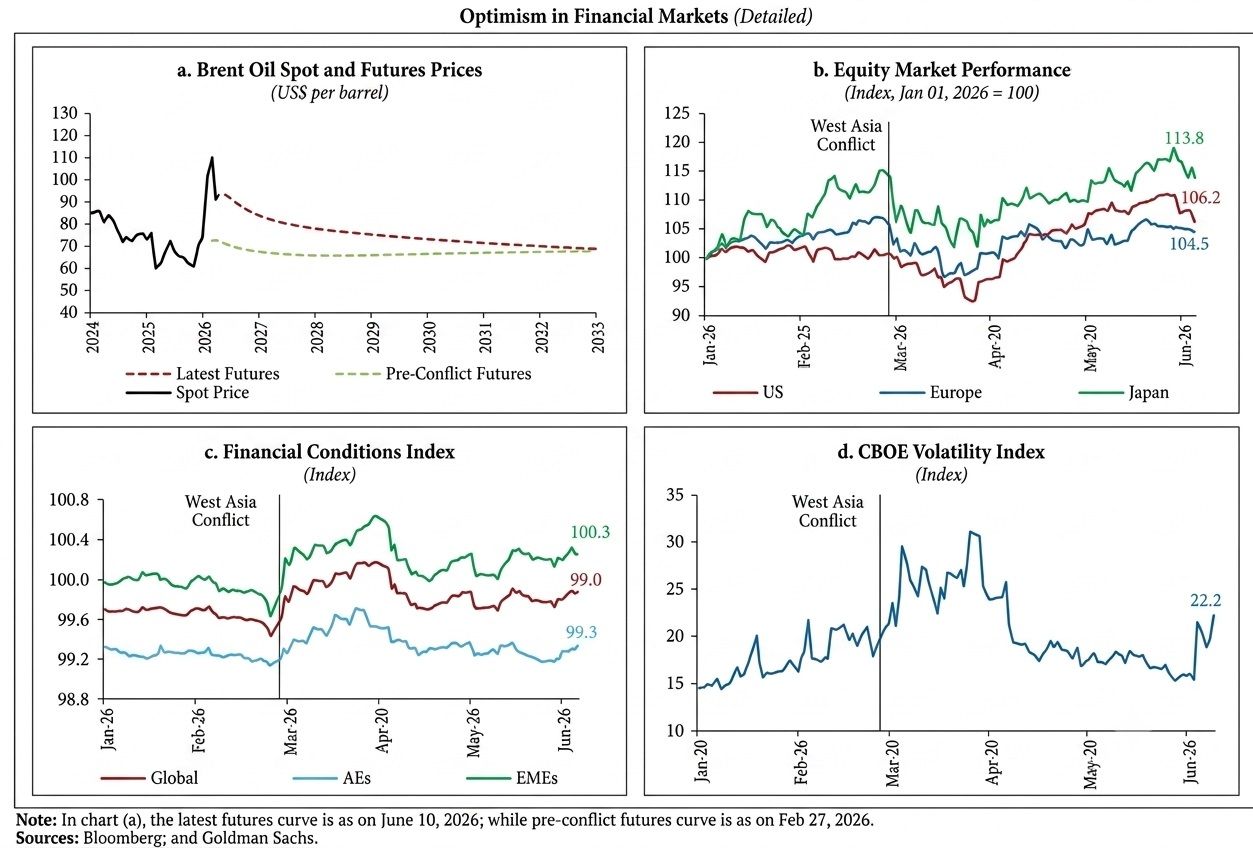
While India’s domestic fundamentals have strengthened, the RBI cautions that the global financial environment remains “exceptionally fragile”. Global markets have absorbed repeated shocks with surprising resilience. The initial panic following the West Asia conflict faded quickly as oil prices rose less than feared, corporate earnings stayed robust and optimism around AI investments continued to support equities. However, the RBI warns that this apparent stability masks deeper structural vulnerabilities. Persistent supply-chain disruptions could reignite inflation, tighten financial conditions and revive uncertainty over monetary policy, keeping global financial stability risks elevated.
The report identifies four key threats: rising sovereign debt, fragile government bond markets, stretched equity valuations and growing leverage among non-bank financial intermediaries. Government bond yields across advanced economies have climbed to their highest levels in nearly two decades as investors reassess inflation risks and fiscal sustainability.
Public debt continues to rise as governments face slower growth and higher borrowing costs. OECD countries’ refinancing needs hit a record $13.5 trillion in 2025 — nearly 80% of total borrowing — and are expected to increase further, raising concerns over debt sustainability.
The RBI also highlights the expanding role of hedge funds in sovereign bond markets, with gross notional exposure to government bonds and interest-rate derivatives exceeding $18 trillion. Meanwhile, foreign holdings of US equities have jumped from $7.5 trillion in 2020 to $21 trillion in 2026, while AI-linked technology stocks increasingly dominate market gains, raising the risk of a sharp correction spilling over into global financial markets.
Banks Anchor Stability
The RBI’s confidence in India’s resilience rests largely on the remarkable transformation of its banking sector over the past several years.
Scheduled commercial banks remain well-capitalised, highly liquid and consistently profitable, with asset quality improving further during FY26. The clean-up of legacy stressed assets, stronger underwriting standards and tighter regulatory oversight have significantly strengthened bank balance sheets, enabling lenders to continue supporting economic activity despite external uncertainty.
Capital adequacy remains comfortably above minimum regulatory requirements, while liquidity buffers provide additional protection against sudden funding stress. Stable profitability has also enhanced banks’ ability to absorb future credit losses without impairing their lending capacity.
Most importantly, the RBI’s macro stress tests show that the banking system would remain resilient even under severe hypothetical scenarios involving weaker economic growth, higher inflation and adverse financial-market conditions. Aggregate capital ratios are projected to remain comfortably above regulatory thresholds, indicating that Indian banks possess sufficient financial strength to absorb significant macroeconomic shocks without threatening systemic stability.
Financial Risks Evolve
The RBI’s assessment extends beyond banks, pointing to a broader strengthening of India’s financial ecosystem even as new risks emerge.
The NBFC sector, now a key source of credit for households and small businesses, remains financially sound despite tighter regulation and slower loan growth. According to the report, NBFCs continue to benefit from strong capitalisation, healthy profitability and improving asset quality, with aggregate capital levels comfortably above regulatory requirements.
The insurance sector has also become more resilient. Life insurers continue to maintain solvency ratios above the prescribed regulatory threshold, while general insurers have strengthened their balance sheets through better underwriting discipline and capital management.
Mutual funds and financial market infrastructure have similarly demonstrated resilience. Clearing corporations — the backbone of India’s securities markets — remain well capitalised and liquid, with RBI stress tests confirming their ability to withstand multiple participant defaults.
However, the central bank cautions that financial stability cannot be assessed solely through capital ratios. As India’s financial system deepens, interlinkages among banks, NBFCs, mutual funds, insurers and capital markets have grown more complex. While these connections improve credit transmission and market efficiency, they also create channels through which stress in one segment can quickly spread across the financial system. Monitoring these interconnected exposures is expected to become a key supervisory priority.
The report also flags emerging risks in retail lending. Although consumer credit growth has moderated following regulatory tightening, gold loans have become one of the fastest-growing retail credit segments amid elevated bullion prices. At the same time, the rapid expansion of unsecured digital lending continues to warrant close regulatory scrutiny. The RBI stresses that lenders must maintain prudent underwriting standards to prevent excessive leverage and preserve the financial system’s resilience.
Vigilance Remains Key
Despite expressing confidence in India’s financial resilience, the RBI cautions that evolving global risks require constant vigilance. The central bank says financial vulnerabilities are becoming more complex, demanding regulators look beyond traditional banking indicators and prepare for emerging threats.
Among the biggest risks are elevated sovereign debt, persistent fiscal deficits and tighter financial conditions. Rising government borrowing has pushed bond yields higher across advanced economies, increasing refinancing risks and raising concerns over fiscal sustainability. The RBI also warns that the growing concentration of global investor capital in a handful of AI-linked technology stocks could trigger widespread market corrections, affecting capital flows to emerging economies such as India.
The report further highlights risks from leveraged non-bank financial intermediaries, particularly hedge funds with large sovereign bond exposures. During periods of stress, the unwinding of these positions could amplify market volatility and spread financial contagion.
To safeguard stability, the RBI says India must continue strengthening macro-financial resilience through prudent monetary policy, fiscal consolidation, robust supervision and timely regulatory intervention. Governor Malhotra stresses that the goal is not only to respond to crises but to build enduring resilience.
(Cover photo by Gaurav Sharma on Unsplash)