
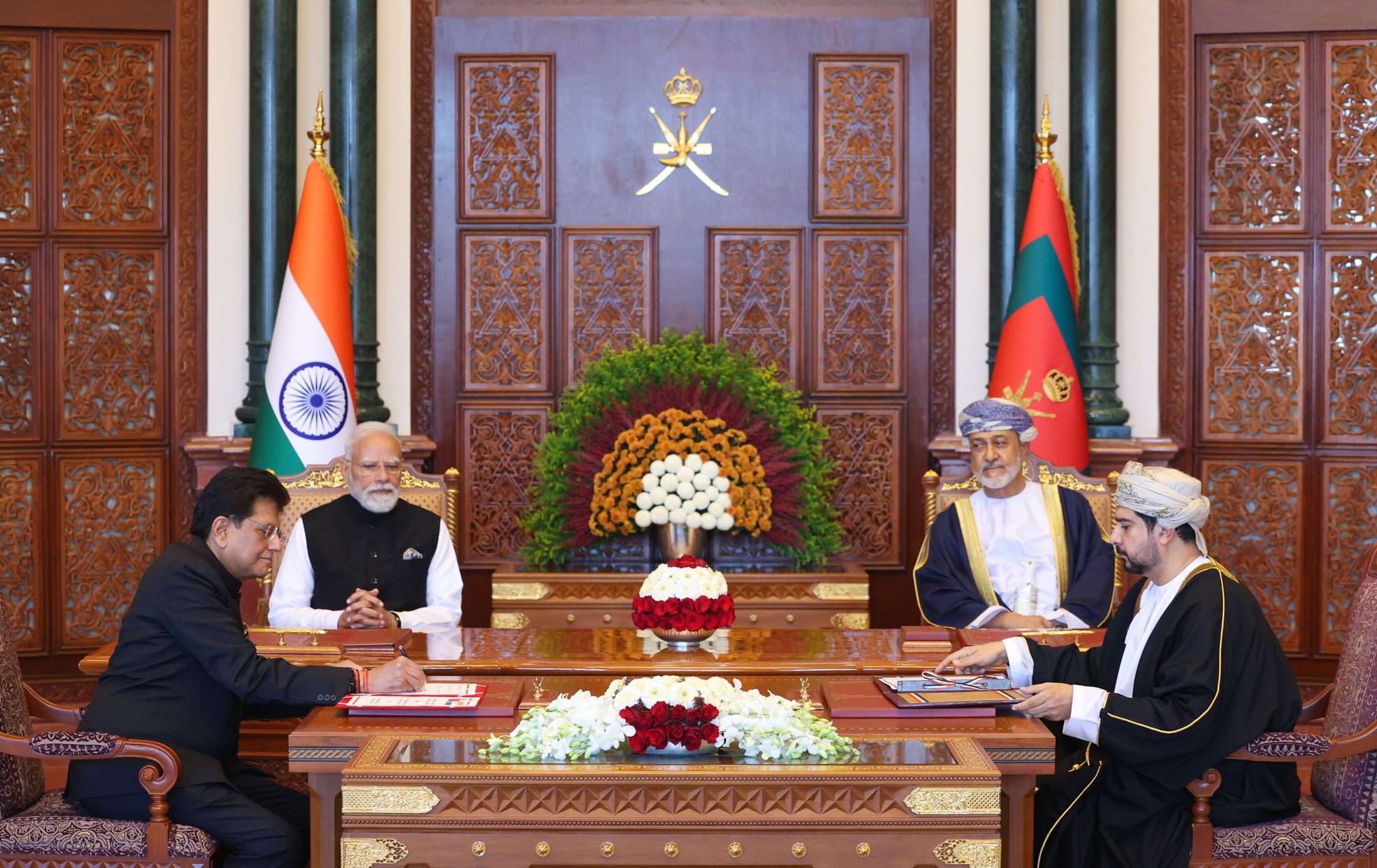

New Delhi: India and Oman have formalized a Comprehensive Economic Partnership Agreement (CEPA), signalling a strategic deepening of economic ties between New Delhi and the Gulf region. Signed by Commerce and Industry Minister Piyush Goyal and Oman’s Minister of Commerce, Industry and Investment Promotion Qais bin Mohammed Al Yousef, the agreement positions India to strengthen trade with a non-competing, strategically located economy.
Coming shortly after India’s free trade pact with the United Kingdom, the deal underscores New Delhi’s broader push to diversify partnerships with developed and strategically significant markets.
The CEPA delivers near-universal market access for Indian goods in Oman. Muscat has committed to zero-duty access on 98.08% of its tariff lines, covering 99.38% of India’s current exports to Oman, with immediate tariff elimination on 97.96% of lines. Key labour-intensive sectors such as gems and jewellery, textiles, leather, footwear, engineering goods, pharmaceuticals, medical devices, automobiles, plastics, furniture and a wide range of agricultural products will see full tariff elimination, substantially improving price competitiveness for Indian exporters.
In return, India has offered tariff liberalization on 77.79% of its tariff lines, accounting for 94.81% of imports from Oman by value. Sensitive sectors have been carefully ring-fenced, with products such as dairy, tea, coffee, rubber, tobacco, precious metal bullion and select labour-intensive goods placed in the exclusion list, while certain Omani export interests are accommodated through tariff-rate quotas.
Beyond goods, the CEPA places strong emphasis on services and mobility, areas where India holds a comparative advantage. Oman’s global services imports stand at $12.52 billion, while India’s share is only 5.31%, signalling substantial headroom for expansion. Under the agreement, Oman has undertaken wide-ranging commitments across computer-related services, professional and business services, audio-visual services, R&D, education and healthcare.
Enhanced Mobility Framework
A standout feature is the enhanced mobility framework: Oman has raised the quota for intra-corporate transferees from 20% to 50%, extended the stay for contractual service suppliers from 90 days to two years with a possible two-year extension, and liberalized entry conditions for skilled professionals in sectors such as accountancy, taxation, architecture and medical services.
The pact also allows 100% foreign direct investment by Indian companies in major services sectors in Oman, opening the door for a deeper commercial footprint. In a first-of-its-kind commitment, Oman has extended comprehensive market access for traditional medicine across all modes of supply, creating new opportunities for India’s AYUSH and wellness industries in the Gulf. Provisions addressing non-tariff barriers further aim to translate tariff concessions into real market access.
The agreement builds on an already substantial economic relationship. Bilateral trade exceeds $10 billion annually, Indian companies operate more than 6,000 establishments in Oman, and around 700,000 Indian nationals live and work there, remitting close to $2 billion each year. Notably, this is Oman’s first bilateral trade agreement since its 2006 pact with the United States.
With the CEPA, India secures one of its most comprehensive trade arrangements in the region, positioning Oman as a gateway to the wider Middle East and Africa. The deal is expected to accelerate trade growth, strengthen supply chains, expand services exports and generate employment, while reinforcing India’s broader push for balanced, high-quality trade agreements that safeguard domestic interests and amplify global economic engagement.