
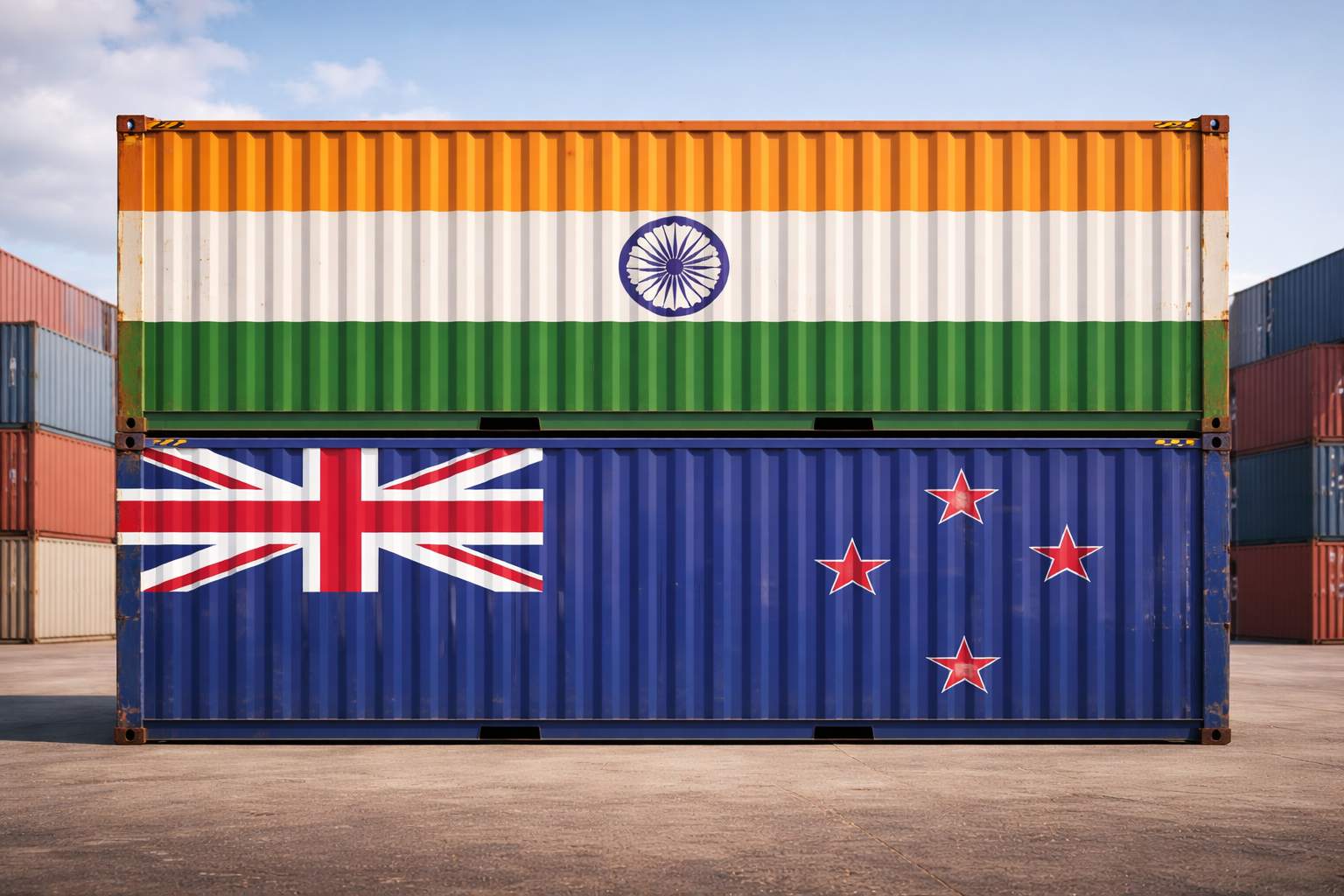

New Delhi: India and New Zealand on Monday announced the conclusion of a comprehensive Free Trade Agreement (FTA), marking one of India’s fastest trade deals with a developed country.
The agreement provides zero-duty market access on 100% of India’s exports to New Zealand, covering key labour-intensive sectors such as textiles, apparel, leather, footwear, engineering goods, marine products, gems and jewellery, pharmaceuticals and agricultural produce. In return, India has offered tariff liberalization on around 70% of tariff lines, covering nearly 95% of current bilateral trade, while excluding sensitive items to protect domestic farmers and industry.
Negotiations for the FTA were launched on March 16 this year, and concluded within a year after five formal rounds of talks, making it among India’s quickest trade agreements with a developed partner.
Calling it a “new-generation trade agreement”, Commerce and Industry Minister Piyush Goyal said the pact places people, jobs and productivity at its core, while strengthening India’s integration into global value chains and the Indo-Pacific economic architecture.
Services, mobility & investment push
The pact delivers New Zealand’s most ambitious services offer to India, covering 118 services sectors and providing Most-Favoured Nation (MFN) commitments in about 139 sub-sectors. These include IT and IT-enabled services, professional services, telecom, construction, tourism, education and audio-visual services, opening up new opportunities for Indian service providers.
A major highlight is enhanced mobility for Indian students and professionals. The agreement allows post-study work rights of up to three years for STEM graduates and four years for doctoral scholars, with no numerical caps. It also introduces a ‘temporary employment entry’ visa with a quota of 5,000 skilled professionals, along with 1,000 work and holiday visas, covering sectors such as IT, healthcare, engineering, education and traditional Indian professions.
New Zealand has also committed to facilitating investments of $20 billion in India over 15 years, supporting manufacturing, infrastructure, services and innovation under the ‘Make in India’ programme.
Agriculture, manufacturing & safeguards
The FTA establishes agricultural productivity partnerships through Centres of Excellence for apples, kiwifruit and honey, aimed at boosting productivity, technology transfer and farmer incomes. Market access for these products, however, will be subject to quotas and minimum import prices, ensuring safeguards for Indian producers.
Sensitive agricultural products such as dairy, coffee, sugar, edible oils, onions and spices have been excluded from tariff concessions. At the same time, India’s manufacturing sector will benefit from duty-free inputs such as wooden logs, coking coal and metal scrap.
Bilateral merchandise trade between the two countries stood at $1.3 billion in FY25, while total trade in goods and services was about $2.4 billion, led by travel, IT and business services. The FTA is expected to provide a stable and predictable framework to scale up this engagement significantly.