
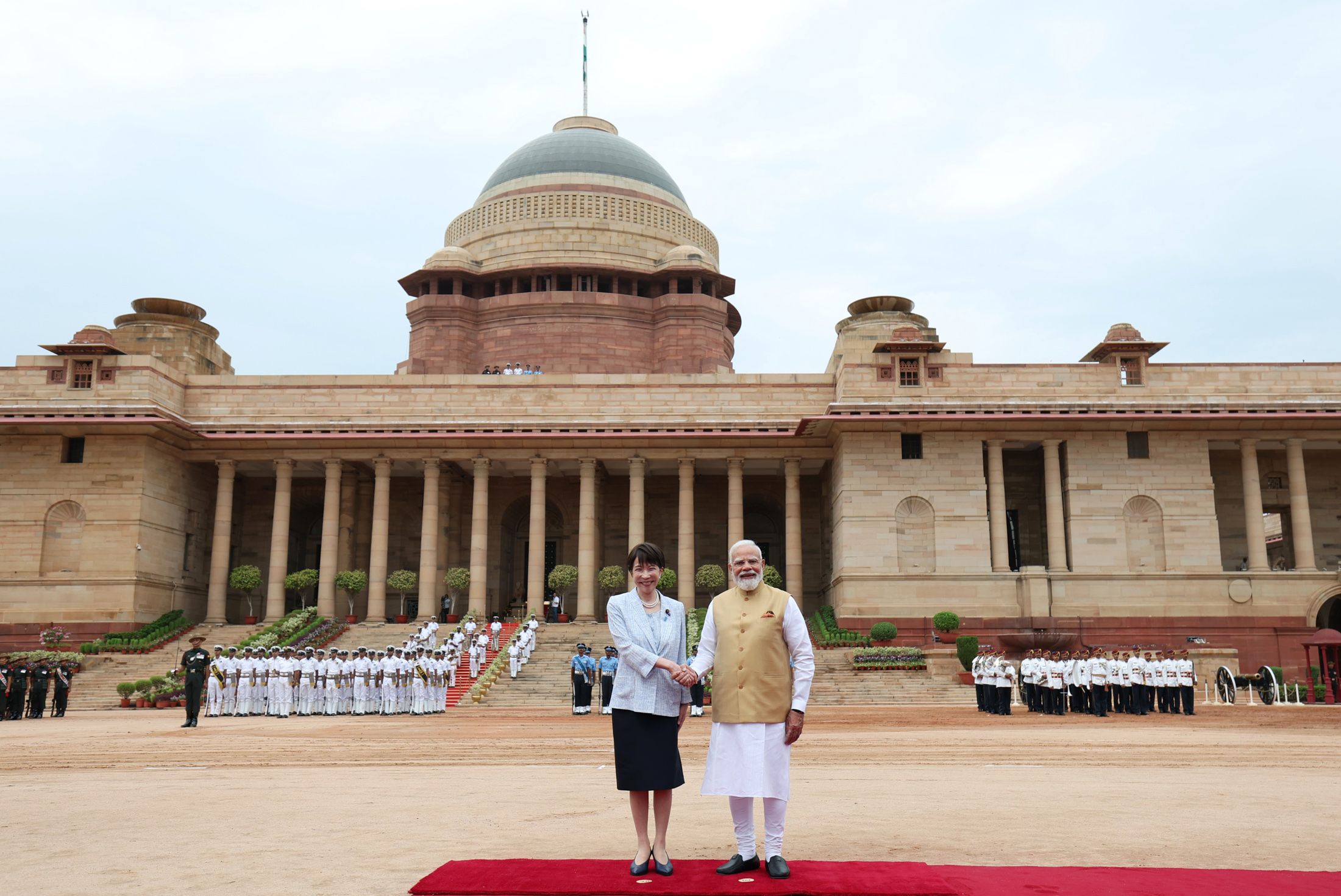

New Delhi: India and Japan on Thursday unveiled an expansive new agenda for their Special Strategic and Global Partnership, signing a raft of agreements spanning defence technology, AI, economic security, healthcare and energy resilience, while setting ambitious investment targets aimed at positioning the two countries as trusted partners in an increasingly fragmented global economy.
Prime Minister Narendra Modi and his Japanese counterpart Sanae Takaichi used the annual India-Japan Summit to announce a comprehensive package of initiatives designed to deepen cooperation in strategic technologies, diversify critical supply chains and expand bilateral investment. The leaders also agreed to review the 15-year-old India-Japan Comprehensive Economic Partnership Agreement (CEPA) to make it more contemporary and broaden trade between the two countries.
The summit came at a time when geopolitical tensions, supply chain disruptions and concerns over economic coercion are prompting countries to forge closer partnerships with trusted allies. Against that backdrop, Modi described India-Japan ties as a model relationship built on enduring confidence.
“In today’s environment of global uncertainty and upheaval, mutual trust is our greatest strategic asset. The India-Japan partnership stands the test of this principle in every respect,” he said, adding that Takaichi’s visit marked “a new chapter in our Special Strategic and Global Partnership”.
The two leaders also underlined their shared commitment to a free, open and rules-based Indo-Pacific, saying their cooperation would contribute to peace, stability and prosperity across the region.
Defence Cooperation Deepens
Among the summit’s most significant announcements was the signing of the first-ever India-Japan defence co-development project for the Unified Complex Radio Antenna (UNICORN), a naval communications system expected to enhance stealth capabilities. The agreement follows Japan’s recent easing of restrictions on defence exports under Takaichi’s government and marks a milestone in bilateral defence collaboration.
“We will jointly develop defence technologies that will strengthen regional peace, maritime security and a rules-based order,” Modi said.
The two countries also broadened cooperation in defence technology and aerospace, reflecting their growing convergence on regional security challenges in the Indo-Pacific.
Technology emerged as another central pillar of the partnership. India and Japan issued a Joint Statement on AI and announced collaborations between leading AI institutions from both countries.
Modi said the combination of Japanese manufacturing precision and India’s software expertise could create globally competitive AI solutions. “The convergence of Japan’s precision technologies and India’s software capabilities will provide new momentum and strength to global AI development,” he said.
Economic Security Focus
Economic security dominated much of the summit discussions as both countries sought to reduce vulnerabilities arising from concentrated global supply chains.
In their joint statement, the leaders expressed concern over economic coercion, arbitrary export restrictions and non-market practices capable of disrupting supplies of critical minerals and industrial inputs. While China was not mentioned directly, the language reflected growing international concern over excessive dependence on single-country supply chains.
The two countries adopted a Joint Roadmap on Economic Security to strengthen cooperation in semiconductors, critical minerals, quantum technologies and advanced materials while promoting diversified and resilient supply chains.
The roadmap is expected to encourage closer collaboration between governments and industry in securing strategic resources essential for emerging technologies and clean energy transitions.
Investment Momentum
The summit also sought to inject fresh momentum into economic ties, which remain below potential despite decades of close political relations.
Modi said more than 100 business agreements signed during the past year are expected to bring over $10 billion in fresh Japanese investment into India.
He reaffirmed the target agreed during last year’s summit in Tokyo of attracting 10 trillion yen in Japanese investment over the next decade while doubling the number of Japanese companies operating in India.
“Our objective is clear — to attract 10 trillion yen in Japanese investment into India over the next ten years and to double the number of Japanese companies operating in India,” Modi said.
Speaking later at the India-Japan Business Forum, Modi pitched India as the world’s fastest-growing major economy and urged Japanese businesses to participate more actively in the country’s next phase of industrial expansion.
“When Japan’s expertise and investment come together with India’s speed and scale, the entire world stands to benefit,” he said.
Seeking to reassure investors, Modi highlighted recent reforms in taxation, governance and ease of doing business, saying India had opened more sectors to private participation while expanding incentive programmes for strategic industries.
He also announced that the Prime Minister’s Office would organise a dedicated Japan Business Week, during which senior officials would engage directly with Japanese companies to address regulatory concerns and facilitate investments.
Energy, Healthcare Expand
The summit also produced a roadmap on energy resilience, covering cooperation on strategic petroleum reserves, coordination with oil-producing countries and emergency response mechanisms to cushion future supply disruptions.
The two countries agreed to deepen collaboration in batteries, green hydrogen and nuclear energy, while launching the India-Japan Bio-gas Initiative that will support the establishment of 1,000 biogas and organic fertiliser plants across India.
Healthcare emerged as another important area of cooperation, with agreements covering pharmaceuticals, biotechnology and medical devices aimed at combining India’s manufacturing scale with Japan’s technological strengths to improve affordable healthcare and global health security.
The leaders also launched the India-Japan Next Generation Mobility Partnership Framework, extending collaboration beyond automobiles into shipbuilding, aviation and logistics.
People-to-people ties featured prominently in the discussions, with both sides agreeing to expand talent mobility, skilling programmes, technical internships, research partnerships and start-up collaboration. The initiatives are expected to gain additional momentum as India and Japan prepare to celebrate the 75th anniversary of diplomatic relations next year.