
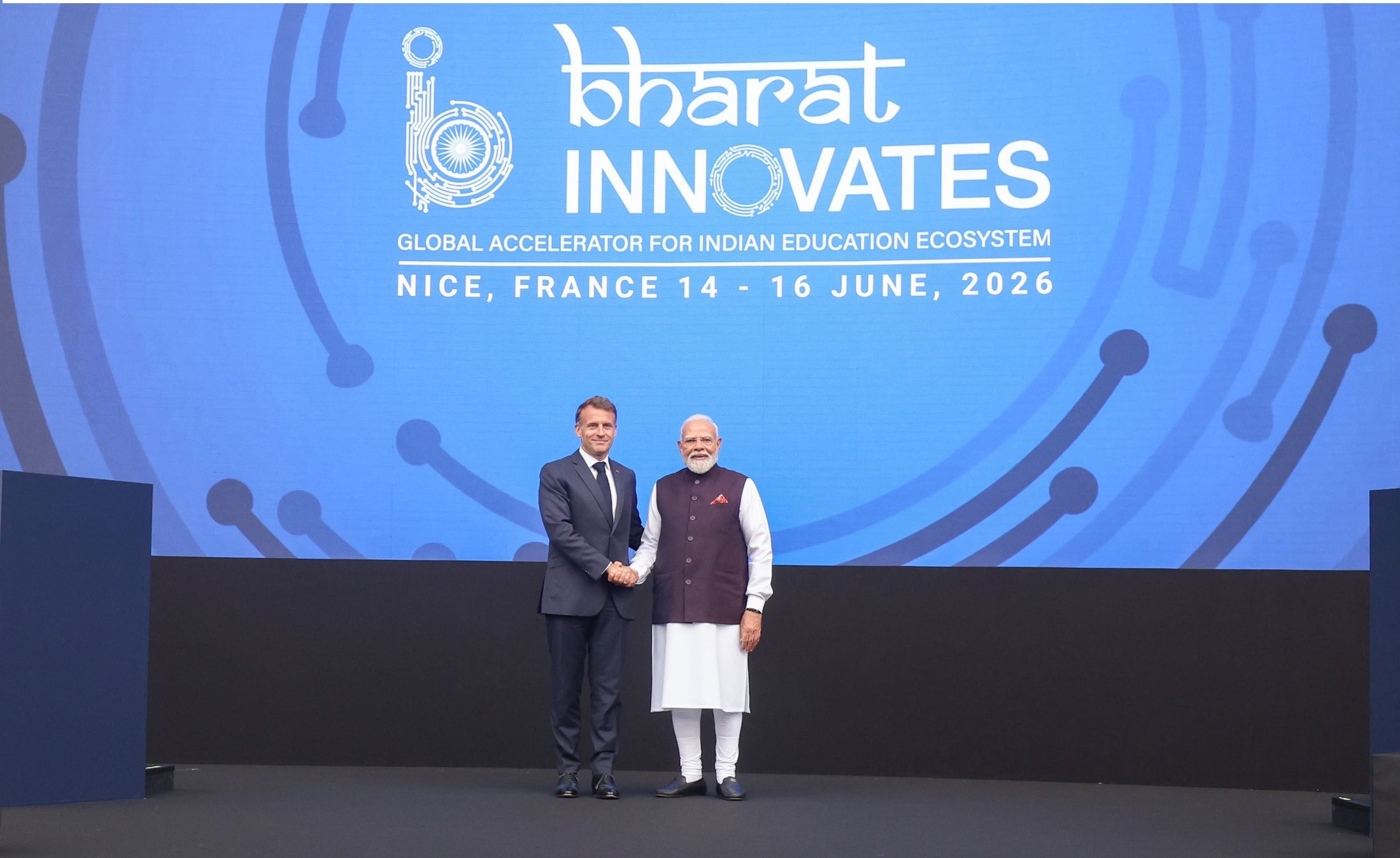
New Delhi: Prime Minister Narendra Modi and French President Emmanuel Macron on Sunday used their meeting at Villa Kerylos in Nice to pivot the India-France Special Global Strategic Partnership towards emerging technologies, defence manufacturing and economic resilience, unveiling a broad package of agreements spanning artificial intelligence, trade, space, railways, education and critical supply chains.
The most significant outcomes were the adoption of the India-France Innovation Roadmap 2030 and the creation of a Joint India-France AI Working Group focused on AI governance, signalling a long-term commitment to collaboration in frontier technologies.
Defence cooperation was expanded with a renewed emphasis on co-design, co-development and co-production of advanced platforms, while a General Security Agreement on the exchange of classified information added a new strategic dimension.
PM Modi said, “Whether it is the International Solar Alliance, dialogue related to AI, or our cooperation spanning from security to sustainability, our two nations have consistently worked together to provide solutions to challenges concerning humanity.”
Economic ties received a major boost with the establishment of a high-level mechanism to double bilateral trade within five years and the launch of an Economic Security Dialogue aimed at strengthening resilient supply chains, particularly for critical minerals. Both sides also backed early conclusion of the India-EU Free Trade Agreement.
Macron captured the partnership’s economic ambition, declaring, “The question is not whether India innovates, but who will innovate with India.” PM Modi echoed that vision, saying, “This relationship has connection, conviction, innovation, inspiration, shared values and shared vision.”
Space cooperation was broadened through a fresh ISRO-CNES agreement on microgravity research and human spaceflight, alongside plans to increase private-sector participation. Civil nuclear cooperation gained momentum with discussions on opportunities created by India’s SHANTI Act, including collaboration on small and advanced modular reactors.
Innovation and startup ecosystems featured prominently. Ten additional Indian startups will be incubated at Station F in Paris, a Centre of Digital Sciences will be established between India's Department of Science and Technology and France's INRIA, and 19 institutional partnerships were signed across the innovation landscape. Expansion of UPI services in France and the launch of Bharat Innovates in Nice underscored growing cooperation in fintech and deep technology.
Education and talent mobility formed another key pillar. The two countries agreed to establish a National Centre of Excellence for Skilling in Aeronautics at NSTI Kanpur, create an ICCR India Chair on AI, Innovation and Culture at Université Paris-Saclay, and work towards greater recognition of educational qualifications. Modi invited French universities to establish campuses in India under the National Education Policy, while Macron's government operationalised visa-free airport transit for Indian nationals.
Infrastructure and sectoral cooperation also advanced, with a declaration on railway and high-speed rail development and fresh engagement in aviation, SMEs and healthcare, including a data-sharing initiative between ICMR and France’s Health Data Hub.
The leaders exchanged views on West Asia, Ukraine and the global strategic landscape ahead of the G7 Summit at Evian, reaffirming that the bilateral partnership would serve as a pillar of international stability and prosperity.
“We seek partnership. We seek co-development. We seek joint research. We seek shared manufacturing. And we seek long-term collaboration. I earnestly invite every investor, every university, every research institution, and every entrepreneur present here today. Come to India. Work together with us. Design in India. Develop in India. And create solutions for the world,” PM Modi said.