


New Delhi: Marking a significant milestone in India’s global trade and investment strategy, the India-European Free Trade Association (EFTA) Trade and Economic Partnership Agreement (TEPA) is set to come into effect on October 1.
Signed on March 10 last year in New Delhi, TEPA represents a modern, ambitious and forward-looking free trade agreement (FTA), uniquely incorporating legally-binding commitments on foreign direct investment (FDI) and job creation for the first time in any FTA signed by India.
TEPA is expected to serve as a catalyst for enhancing bilateral trade, promoting industrial collaboration and strengthening economic ties between India and the four EFTA member states: Switzerland, Norway, Iceland and Liechtenstein.
Under Article 7.1 of TEPA, the EFTA States have committed to aim for an infusion of $100 billion in FDI into India over 15 years, with $50 billion targeted within the first 10 years, and an additional $50 billion in the subsequent five years.
In parallel, the agreement envisions the generation of one million direct jobs in India as a result of these long-term investments. The agreement notably excludes foreign portfolio investment (FPI), emphasising sustainable, productivity-driven capital inflows.
These historic commitments signal deepening trust in India’s economic potential and underline EFTA’s interest in playing a pivotal role in India’s development journey.
Market Access
The TEPA agreement spans 14 comprehensive chapters, covering a wide range of disciplines including market access for goods and services, investment promotion, rules of origin, trade facilitation, intellectual property rights (IPR), technical barriers to trade, and sustainable development.
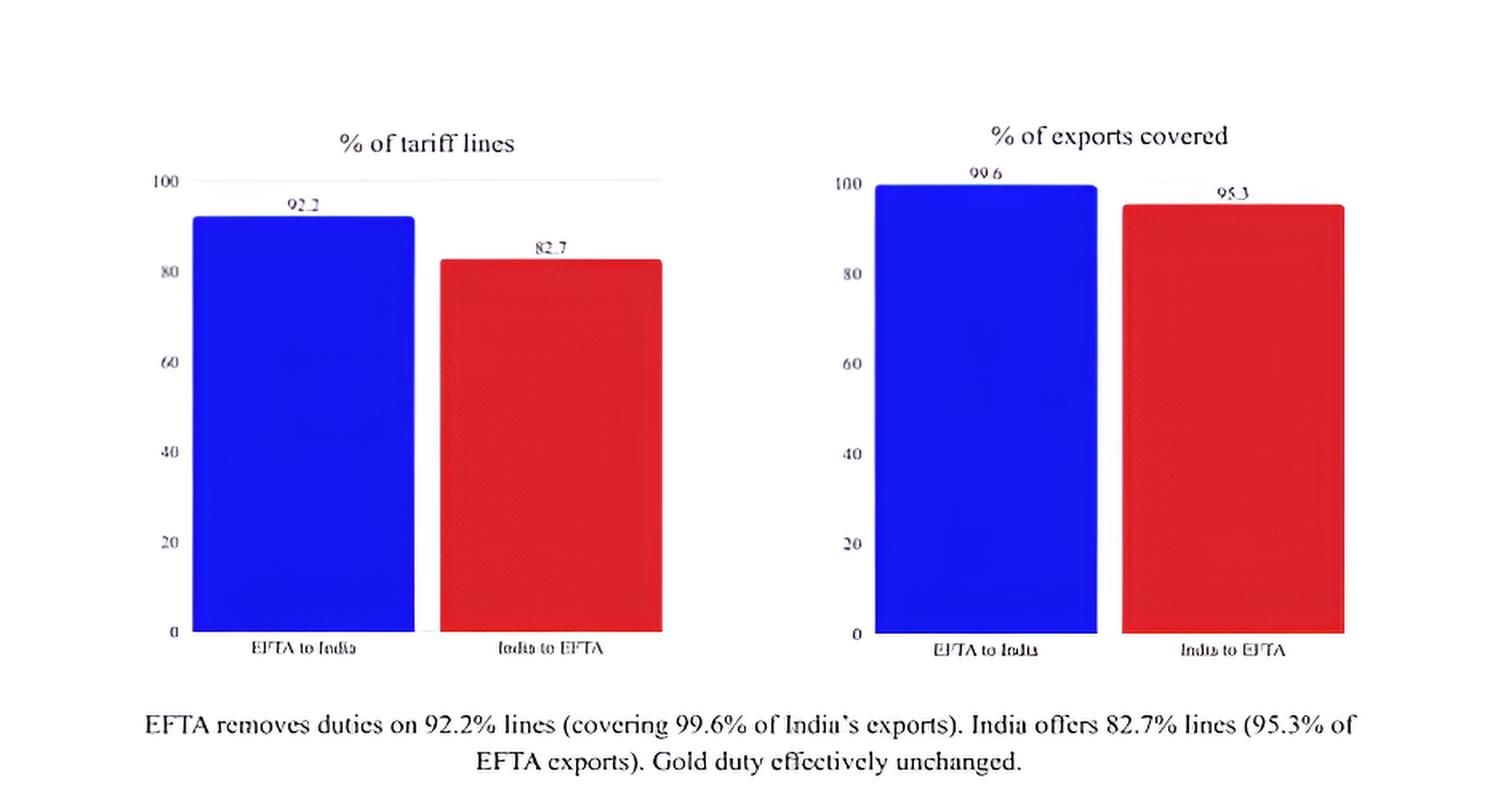
On market access, EFTA has offered tariff elimination or concessions on 92.2% of tariff lines, covering 99.6% of India’s exports. This includes 100% of non-agricultural products and significant tariff relief on processed agricultural products (PAPs). In return, India has offered concessions on 82.7% of its tariff lines, which cover 95.3% of EFTA exports, most of which comprise gold imports—with no change to the effective duty on gold, preserving India’s interests.
Importantly, India has safeguarded sensitive sectors such as pharmaceuticals, medical devices, dairy, soya, coal, processed foods, and other agricultural products, including sectors supported by the Production Linked Incentive (PLI) schemes.
Boost to Services Trade
TEPA significantly enhances services trade and professional mobility. India has offered commitments in 105 sub-sectors, while EFTA countries have made strong offers as well — Switzerland (128), Norway (114), Liechtenstein (107) and Iceland (110). The agreement also facilitates Mutual Recognition Agreements (MRAs) in professional fields like nursing, chartered accountancy, and architecture, boosting opportunities for Indian professionals in EFTA countries.
Stronger access for Indian service providers will be enabled via:
• Mode 1: Cross-border digital delivery of services
• Mode 3: Commercial presence in EFTA markets
• Mode 4: Easier entry and temporary stay for key personnel
Sectors set to benefit include IT services, education, business consulting, audio-visual services, and cultural and recreational services.
Robust IPR Framework with Balanced Protections: TEPA incorporates a high-standard Intellectual Property Rights (IPR) chapter, especially in collaboration with Switzerland, known for its strong IPR regime. India has ensured that its interests, particularly concerning generic medicines and the prevention of patent ever-greening, are fully protected. The IPR provisions remain aligned with the WTO's TRIPS Agreement, ensuring a balanced framework.
Commitment to Sustainable and Inclusive Development: Aligned with India’s vision of inclusive and green growth, TEPA underscores commitments to sustainable development, environmental protection, social progress and responsible trade. It aims to simplify trade procedures, ensure transparency and harmonise standards, creating a more efficient and predictable trade environment.
Opportunities in Technology, Skills and R&D: TEPA is also expected to open avenues for technology collaboration, vocational training, and capacity-building. This includes access to advanced technologies in precision engineering, health sciences, renewable energy, and innovation-driven R&D. These collaborations will support India’s young workforce, creating meaningful employment opportunities and skilling platforms over the next 15 years.
Sector-Wise Gains and Export Boost: With the EFTA offer covering 92% of tariff lines, Indian exporters—particularly in sectors like machinery, organic chemicals, textiles, garments, and processed foods—stand to gain significantly. TEPA will help Indian businesses reduce compliance costs, improve competitiveness, and gain faster, more secure access to the EFTA market, which represents a high-income, innovation-driven bloc.
Among the EFTA countries, Switzerland is India’s largest trading partner, followed by Norway. TEPA is set to deepen these trade relationships, providing a structured platform for predictable, rules-based economic engagement.
Strategic Significance for India's Global Trade Agenda: EFTA represents one of the three key economic blocs in Europe, alongside the European Union (EU) and the United Kingdom (UK). By operationalising TEPA, India strengthens its strategic foothold in the European region, diversifying its trade partnerships and advancing its “Make in India for the World” vision.
With the agreement entering into force, India and EFTA are poised to begin a new chapter in economic cooperation — one that promises mutual growth, sustainable development, and long-term strategic alignment.