

New Delhi: India and the European Union edging closer to finalising a long-awaited Free Trade Agreement (FTA) could reshape not just bilateral commerce but also the broader geo-political and economic balance.
Set against record trade volumes of$136.53 billion in goods during 2024-25, the momentum reflects more than numbers. It signals a strategic bet by both sides on deeper integration in services, technology, climate action and defense. With services trade also crossing$51 billion in 2023, the deal is increasingly being seen as a framework to future-proof economic ties in an era of shifting global alignments.
Official data underline the scale and balance of the relationship: India exported goods worth $75.85 billion to the EU in 2024-25, while imports stood at $60.68 billion, making the bloc not just a vital market but also a key supplier of high-value products. Beyond goods, the $51.45 billion services trade in 2023 — driven by IT, professional services and financial exchanges — highlights how the partnership is steadily shifting toward knowledge-intensive sectors. This diversification signals that the India-EU economic corridor is no longer confined to traditional trade flows but is evolving into a platform for long-term strategic interdependence.
‘Early Harvest’ Deal
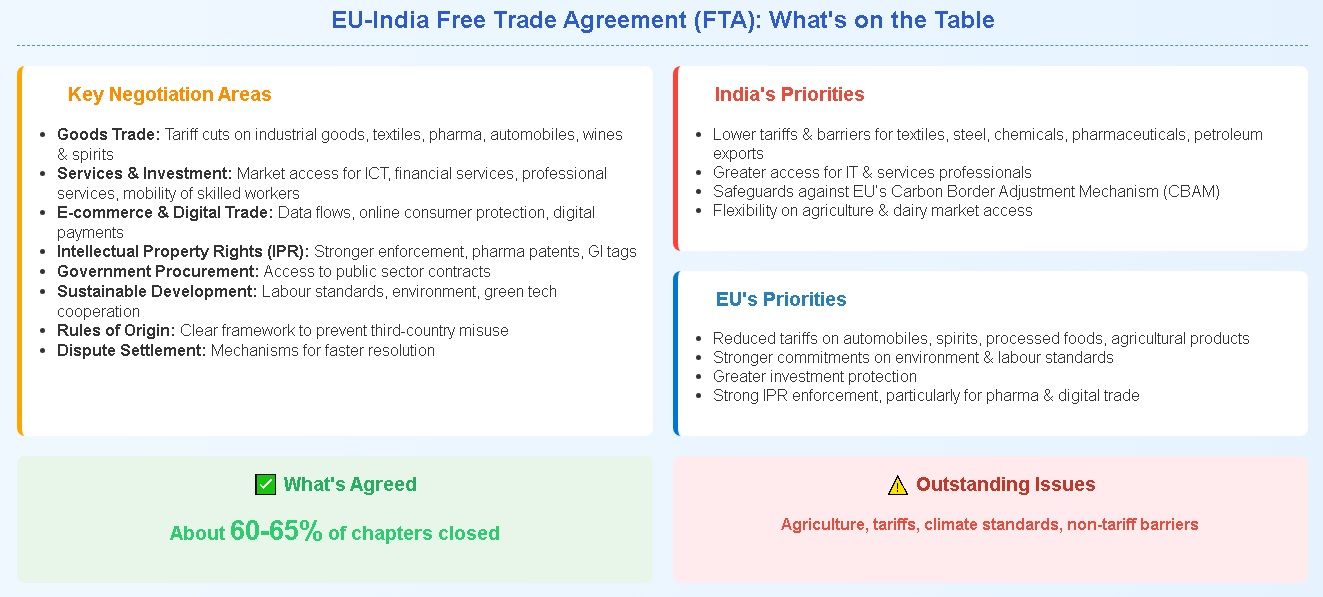
Negotiations have entered a decisive stage. During the 13th round of talks held in New Delhi, negotiators confirmed that nearly two-thirds of the agreement’s chapters have been finalized. To maintain momentum, both sides are considering an “early harvest” agreement that could unlock partial benefits before the full FTA is concluded.
Commerce and industry minister Piyush Goyal described the process as a “robust, fair, equitable, balanced and mutually beneficial” effort, stressing that the objective is to deliver a win-win outcome that strengthens both economic and social ties.
From Brussels, the European Commission has reinforced the significance of the deal, pointing out that the EU is already India’s largest trading partner. A recent statement from the Commission noted, “Europe is already India’s biggest trading partner, and we are committed to finalising our FTA by the end of the year.”
This alignment of political will on both sides is driving expectations that a breakthrough may finally be within reach after years of stalled negotiations.
Key Challenges
Yet, several contentious issues remain on the table. The EU is pressing for reduced tariffs in sectors such as automobiles, wines, spirits and agricultural products, while India is seeking broader market access for textiles, pharmaceuticals, steel and petroleum goods.
New Delhi is also calling for safeguards against non-tariff barriers and greater flexibility in meeting environmental rules, particularly the EU’s Carbon Border Adjustment Mechanism (CBAM), which could impact Indian exporters.
The strategic timing of the FTA is equally important. With global trade under stress from supply chain disruptions, rising protectionism and shifting geopolitical alignments, including the impact of US policies, both India and the EU see this agreement as a hedge against uncertainty.
For India, the pact promises stronger integration into global value chains, greater access to European markets, cheaper inputs for domestic industries, increased investment in technology and infrastructure, and a framework to align more effectively with international standards.
As for the EU, the deal provides improved access to one of the world’s fastest-growing markets, offering significant opportunities for European machinery, processed foods, premium consumer goods and high-value exports. It also strengthens collaboration in green energy, innovation, climate technology and supply chain resilience.
Deal ‘By 2025’, But Hurdles Remain
Despite optimism, both sides acknowledge that “clear areas of disagreement” persist. At a press conference, European Commission Vice-President Kaja Kallas underlined the stakes when she remarked, “The question is whether we leave this void to be filled by somebody else or we try to fill it ourselves.”
Her statement reflects the urgency of finalising a pact that would secure Europe’s position in a market where competition from other global players is intensifying.
If negotiations continue on schedule, the India-EU FTA could be signed before the end of 2025, with an early harvest package delivering quicker benefits for exporters and investors. However, unresolved issues in agriculture, tariffs, climate provisions and trade defense measures could still delay the final closure.
What remains clear is that the deal is closer than ever to becoming a reality. With bilateral trade already at record levels, both India and the EU are racing to convert negotiations into a landmark agreement that could redefine their economic and strategic relationship for the next decade.