

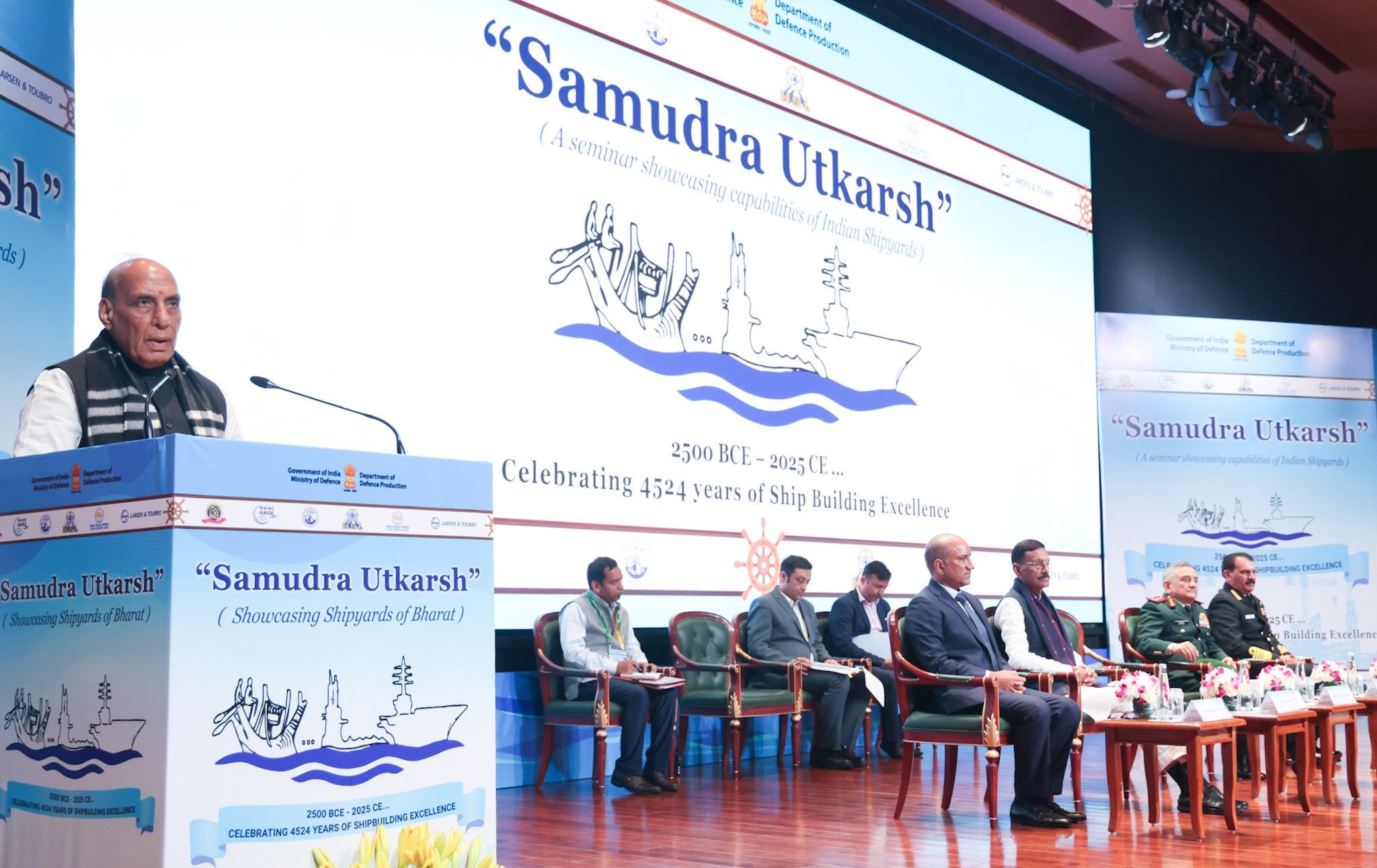
New Delhi: India is stepping into a “golden era of defence innovation” powered by startups and young entrepreneurs who are merging “economic strength, strategic thinking and technological advancements”, defence minister Rajnath Singh said on Tuesday while addressing the fourth edition of the Indian Navy’s Swavlamban seminar.
Calling for India to be “proactive, ahead of the curve and future-ready” amid shifting geopolitical realities, he emphasized that innovators are helping the country emerge as “a builder, creator and leader… and not merely a buyer”. He said the nationwide wave of indigenization was being driven not just by favourable policies but by the “hard work of all stakeholders”, enabling India to move rapidly from a defence importer to an exporter. “If India is rising as a maritime power today, it is due to the contribution of our innovators along with the Navy,” he said.
The minister urged private industry to adopt a profit-plus approach that adds nationalism and a sense of duty to commercial gains. “A profit-plus approach encompasses monetary profit, nationalism, a sense of duty and strategic responsibility. Our goal should not be limited to economic activity; it should be treated as a national mission,” he said, pushing the private sector to boost its contribution to defence manufacturing to 50% or more in the years ahead.
Domestic Supply Chains
Warning of the long-term financial burden created by dependence on foreign equipment, Singh underlined the urgency of building domestic supply chains. “If we strengthen local manufacturing of components and subsystems, our indigenous content will increase rapidly. This will not only enhance capability, but ensure cost efficiency, reliability, and strategic independence,” he said, adding that future defence capability would rest on innovation, indigenous design, advanced manufacturing and strategic autonomy.
He called on industry to alert the government to emerging disruptive technologies and assured full support in finding solutions. “This is not the time to retreat, but to forge a path forward,” he added.
Navy chief Admiral Dinesh K Tripathi said participation in Swavlamban has grown dramatically — from 800 attendees in its first edition to 3,000 last year — and credited the initiative with helping the Navy secure the largest share of iDEX challenges among the armed forces. He noted that the products developed by startups and MSMEs were now being procured not only by the Navy but also by the Army, Air Force, Coast Guard and Central Armed Police Forces, reflecting a whole-of-defence innovation model.
New Partnerships
During the event, the Navy signed an MoU with IIT Madras and Apollo Micro Systems to jointly develop state-of-the-art armament systems, combining academic R&D, naval domain expertise and advanced manufacturing capability.
The defence minister also launched SARATHI (System for Armament Review, Analysis, Tracking, Handling and Indigenization), an end-to-end digital tool for life-cycle management of naval ammunition, developed by the Centre for Development of Advanced Computing, Chennai.
Additionally, the Navy unveiled Innovathon, a hackathon designed for students, researchers and developers to solve real maritime-domain challenges, including swarm algorithms, secure cross-platform network traffic encryption and satellite-aware maritime route intelligence.