
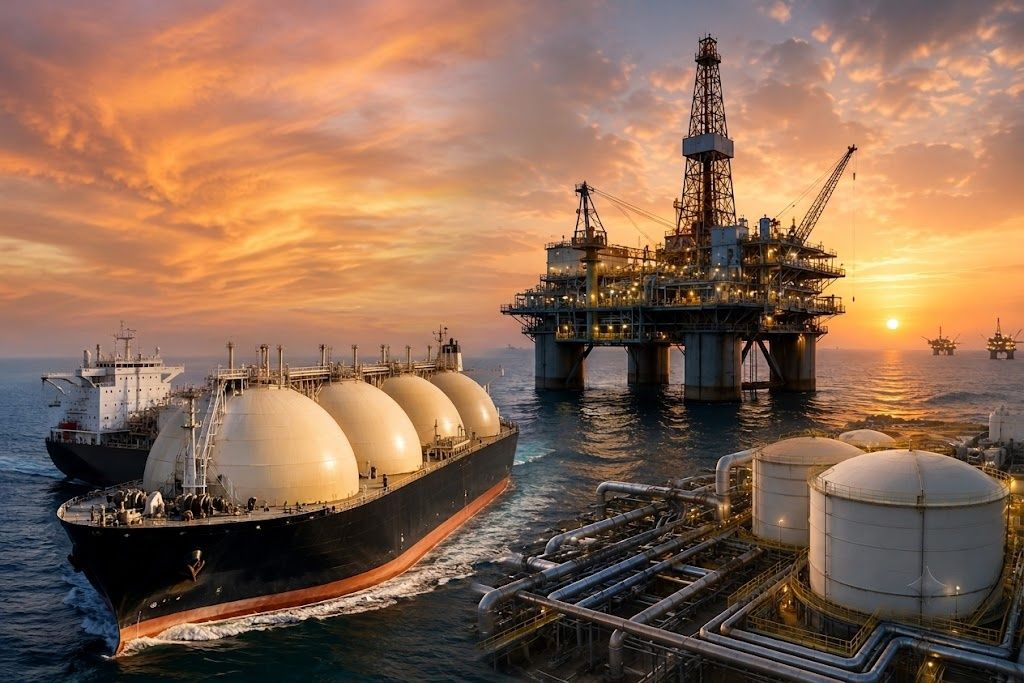

As of August 4, 2026, India is aggressively recalibrating its energy strategy to insulate itself from global supply chain volatility. By combining a significant push for domestic offshore exploration with a diversified portfolio of international gas imports, the government aims to ensure long-term stability for the world's fastest-growing major economy.
The Samudra Manthan Initiative and Offshore Exploration
A pivotal component of this strategy is the recently highlighted Samudra Manthan Scheme. This National Offshore Exploration Scheme is designed to drastically increase India’s domestic production capabilities. The initiative seeks to reduce the country's heavy reliance on energy imports by unlocking the potential of offshore reserves.
Industry leaders have signaled strong support for this move. On August 1, 2026, Pranav Adani noted that the 'Samudra Manthan' initiative is expected to foster deep industry collaboration, which is essential for reinforcing national energy security. By incentivizing exploration in previously untapped maritime blocks, the government hopes to create a more resilient domestic energy base that can withstand fluctuations in the international market.
Diversifying Global Gas Portfolios
While domestic exploration scales up, India is simultaneously securing its immediate needs through long-term international agreements. Central to this is the partnership with the United States and Mozambique. Union Minister Hardeep Puri stated in June 2026 that gas from Mozambique would be a critical factor in boosting India’s energy security, especially in the face of ongoing global volatility.
This follows a trajectory of strengthening ties with the U.S. market. India has moved to boost both oil and Liquefied Natural Gas (LNG) imports from the United States. This diversification was further cemented by a landmark deal, where India signed its first long-term U.S. Liquefied Petroleum Gas (LPG) import agreement. These multi-year contracts provide a price and supply buffer that spot-market purchases cannot offer.
Coal Gasification as a Strategic Alternative
Beyond liquid and gaseous imports, the Indian government is looking at its vast coal reserves as a source of cleaner energy. In May 2026, the Cabinet approved a ₹37,500 crore coal gasification scheme. This massive financial outlay is intended to convert coal into gas, which can then be used as a feedstock for various industries or as fuel.
G. Kishan Reddy, emphasized that coal gasification will play a dual role: boosting energy security while simultaneously cutting down on expensive imports. By utilizing indigenous coal more efficiently, India aims to create a 'gas-based economy' that leverages both imported LNG and domestically produced synthetic gas.
Details on other specific import partners, such as those in the Middle East or West Africa, have not been reported in the latest briefings as of today. However, the current multi-pronged approach, spanning from the deep waters of the Indian Ocean to the shale fields of the U.S., reflects a sophisticated shift toward total energy independence.