
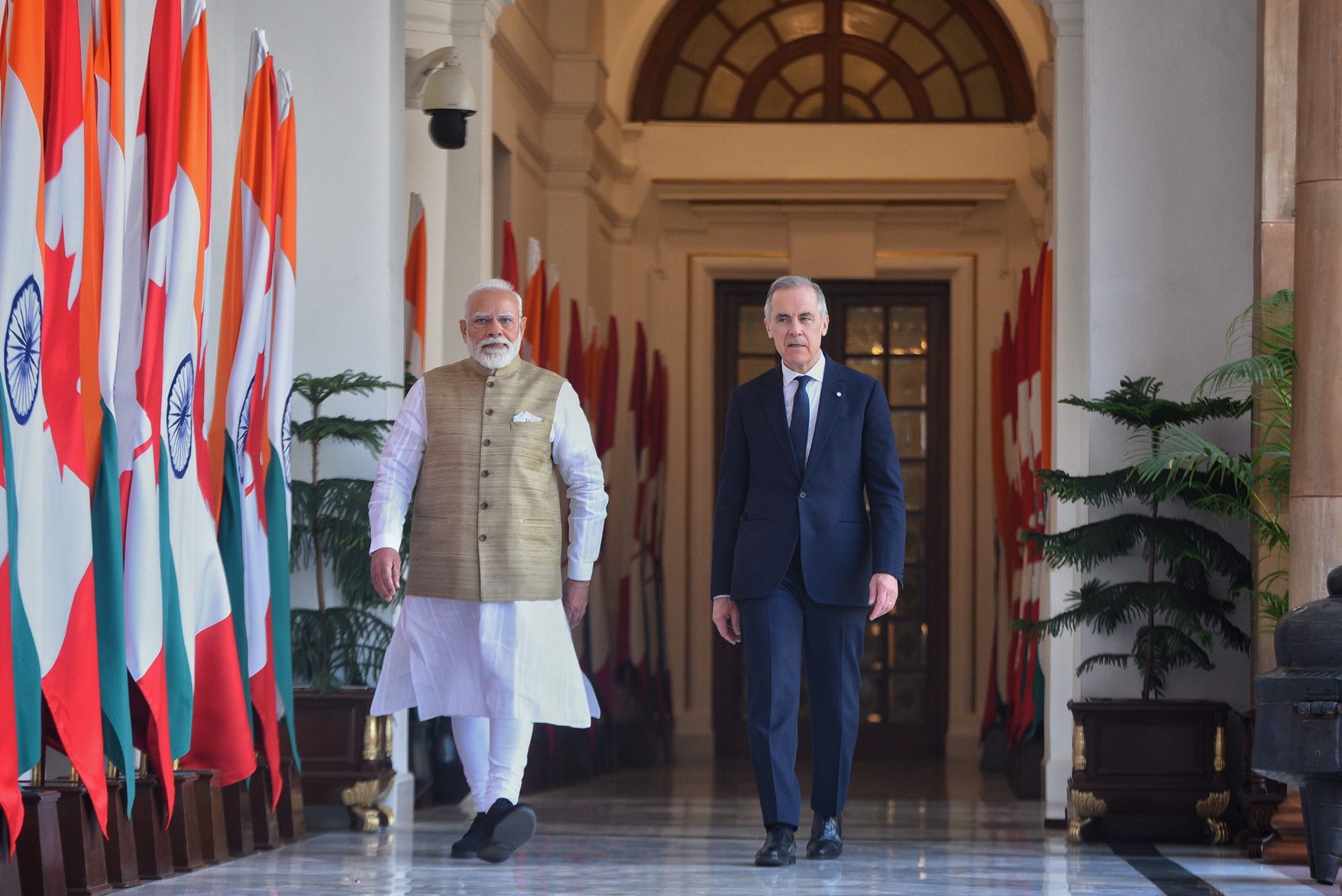

New Delhi: Canadian Prime Minister Mark Carney’s official visit to India from February 27 to March 2 — his first since assuming office and the first bilateral visit by a Canadian PM in eight years — marked a decisive reset in India–Canada relations. After a prolonged period of diplomatic strain, the trip formally relaunched ties with renewed emphasis on strategic trust, economic partnership and shared global priorities.
Accompanied by senior ministers, provincial premiers and leading business executives, Carney’s delegation reflected the economic and geopolitical weight of the engagement. The two sides advanced defence cooperation, concluded a multi-billion-dollar uranium supply agreement and deepened collaboration on critical minerals — sectors central to energy security and supply-chain resilience.
Coinciding with 79 years of diplomatic relations, the visit signalled a pivot from diplomatic freeze to a forward-looking roadmap spanning energy, trade, technology, security and talent mobility. Both sides confirmed the return of diplomatic representatives to their respective missions and acknowledged normalization steps. They also cited sustained ministerial engagement following meetings at the G7 Summit in Kananaskis and the G20 Summit in Johannesburg, indicating that political groundwork for the reset had been underway for months.
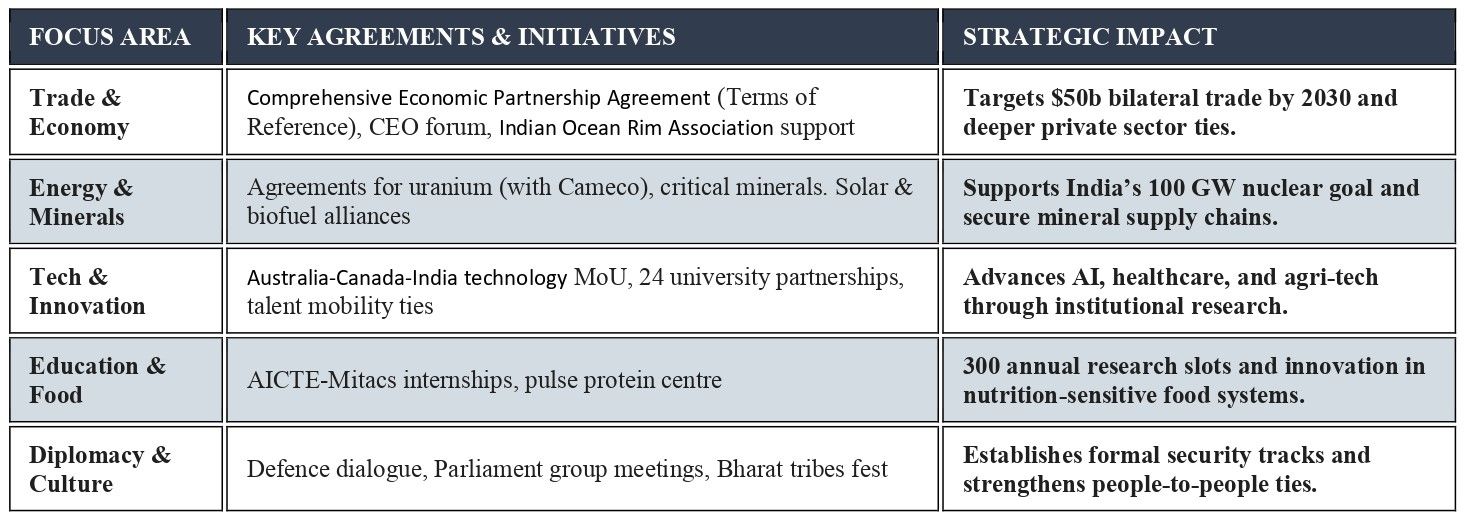
At the core of the renewed partnership is the resumption of negotiations for a Comprehensive Economic Partnership Agreement (CEPA). The two leaders finalized and signed the Terms of Reference and formally launched negotiations, setting an end-2026 deadline. They set a trade target of CA$70 billion (approximately Rs 4.65 lakh crore) in bilateral trade by 2030, positioning CEPA as the economic anchor of the relationship.
The ministerial dialogue on trade and investment was revived, alongside four reciprocal ministerial-led trade missions — two to Canada and two to India — to build commercial momentum. The India-Canada CEO forum has been reconstituted to provide structured industry input into CEPA talks and supply-chain cooperation.
Clean Energy Pact
Energy emerged as the most concrete pillar of the reset through an India-Canada Strategic Energy Partnership. A CA$2.6 billion agreement between Cameco and India’s Department of Atomic Energy secures long-term uranium supply, strengthening India’s civil nuclear generation and clean energy transition.
Canada outlined plans to become a major LNG supplier, targeting 50 million tonnes per year by 2030 and up to 100 million tonnes by 2040. India — the world’s third-largest oil consumer and fourth-largest LNG importer — signalled its intent to source LNG from Canada.
The discussions also covered expanded trade in crude oil, refined petroleum products, LPG and potash. Canada has become an important supplier of heavy oil, and India, projected to drive much of global energy demand growth over the next two decades, is expected to play a central role in expanding this trade.
An MoU on ‘critical minerals cooperation’ was signed to secure resilient supply chains for clean energy and advanced manufacturing. India endorsed the G7 Critical Minerals Action Plan and agreed to explore cooperation on mineral stockpiling. Clean energy collaboration was further institutionalized through an MoU covering solar, wind, bioenergy, small hydro and energy storage. Canada plans to double electricity supply by 2050, while India brings scale in grid-level storage and distributed solar. A Renewable Energy and Storage Summit is scheduled this year.
On global platforms, Canada announced its intention to pursue membership in the International Solar Alliance and upgraded its participation in the Global Biofuels Alliance to full member status, aligning more closely with India-led climate initiatives.
Agri-food Research, Nutrition Security
In agriculture, the two countries proposed establishing a Canada-India Pulse Protein Centre of Excellence at NIFTEM Kundli. Leveraging Saskatchewan’s leadership in pulse production and India’s position as the world’s largest producer and consumer, the initiative will advance agri-food research, fortified food development and nutrition security.
Education and talent mobility formed another pillar of the reset. An MoU between India’s AICTE and Canada’s MITACS will expand the Globalink Research Internship program to enable around 300 Indian undergraduates annually to undertake research placements in Canada. Under Canada’s Indo-Pacific Scholarships and Fellowships program, more than 85 Canadian graduate students and researchers from 11 institutions will collaborate in India in fields such as clean hydrogen, AI and climate resilience. Twenty-four education-related MoUs were concluded during the visit.
Technology cooperation was strengthened through the relaunch of the Joint Science and Technology Cooperation Committee. The two sides agreed to collaborate on AI applications in space, distance medicine and electric grid management, and advanced trilateral cooperation under the Australia-Canada-India Technology and Innovation Partnership, focusing on AI, semiconductors, high-performance computing and cybersecurity.
Security cooperation was formalized through a shared workplan under the National Security Advisors’ dialogue, covering violent extremism, terrorism, organized crime, narcotics trafficking, cybercrime and financial fraud. Law enforcement liaison mechanisms will be established, and the next Joint Working Group on Counterterrorism will convene soon.
Defence ties will be institutionalized through a new India-Canada Defence Dialogue. Canada has appointed a Defence Attaché to India, while India has accredited its Defence Attaché in Washington, D.C., to Canada. A Maritime Security Partnership covering defence materials cooperation, supply-chain resilience and joint training was also announced.
In finance, the two sides launched a Finance Ministers’ Economic and Financial Dialogue, initially focusing on instant payments interoperability and cross-border remittances. India’s National Payments Corporation and Payments Canada will participate to facilitate trade, tourism, education flows and SME growth.