

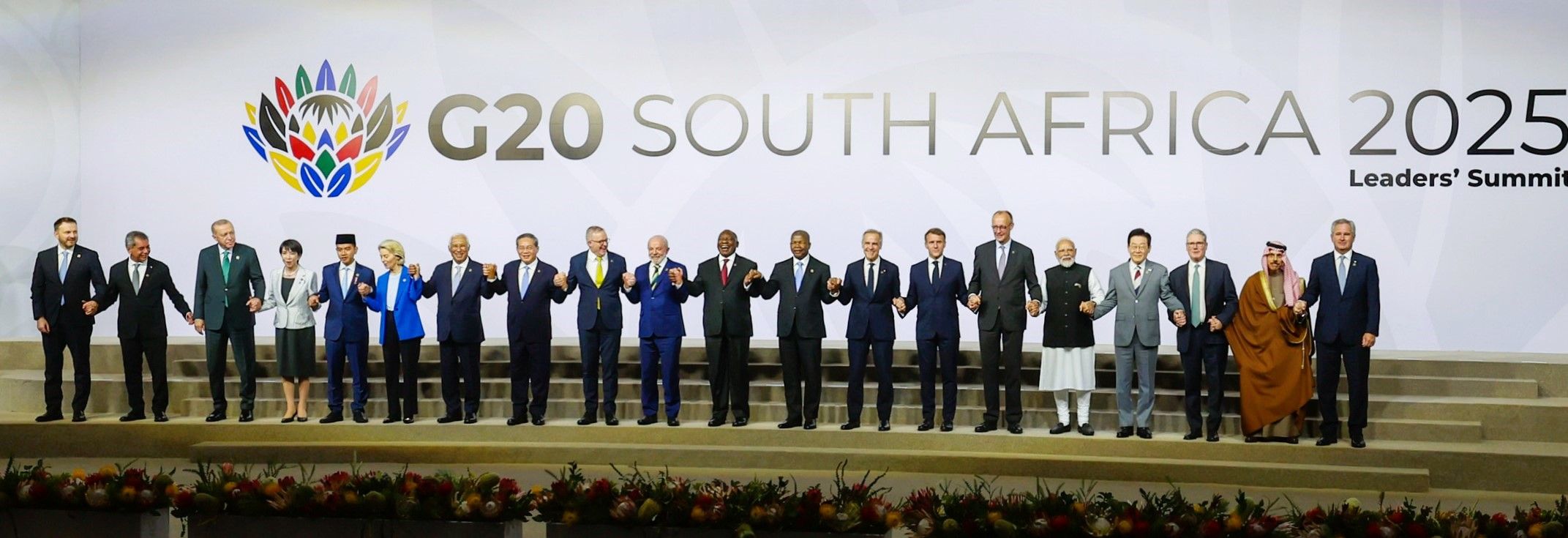
New Delhi: Prime Minister Narendra Modi’s arrival at the G20 Leaders’ Summit in Johannesburg on Saturday signalled a strong call for a “global reset”, with India unveiling a set of proposals aimed at confronting the drug-terror financing nexus, boosting health emergency preparedness, and rapidly expanding skills development across Africa.
PM Modi was received by South African President Cyril Ramaphosa, who is hosting the first G20 Summit on African soil. The ministry of external affairs posted on X that the two leaders were “working together for an inclusive, just and sustainable world”.
Speaking at the opening session on inclusive and sustainable growth, PM Modi congratulated South Africa for the “excellent organization and successful presidency” of the summit. He noted that under President Ramaphosa’s leadership, “commendable work has been done on issues such as skilled migration, tourism, food security, AI, the digital economy, innovation, and women’s empowerment,” adding that the “historic initiatives taken at the New Delhi G20 Summit have been furthered here”.
Calling for a course correction in global development priorities, the PM said the growth indicators that guided global economics for decades “have deprived large populations of resources” and “encouraged the over-exploitation of nature”.
With Africa hosting the summit for the first time, he argued that “we must rethink the parameters of development” and cited India’s civilizational approach of “integral humanism”, stressing that progress must be built on viewing “humans, society and nature as an integrated whole”.
Proposing a “global traditional knowledge repository” under the G20, PM Modi said that many communities have preserved lifestyles that represent “sustainability, cultural wisdom, social cohesion, and a deep respect for nature”. He suggested that the ‘Indian knowledge systems’ initiative could serve as the foundation of this global archive.
Skills Initiative
As part of a broader focus on Africa’s advancement, he announced the G20-Africa skills multiplier initiative, driven by a “train-the-trainers” model and supported by all member countries. “Our collective goal is to develop one million certified trainers in Africa over the next decade,” he said, adding that the programme would have a “multiplier effect” by empowering millions of young Africans to enter skilled sectors.
The PM also pressed for global readiness in the face of future pandemics and emergencies, proposing a G20 global healthcare response team — a contingent of medical professionals from member nations who could be rapidly deployed to crisis zones. “It is our collective responsibility to deal with health emergencies and natural disasters,” he told leaders, emphasising that “we are stronger when we work together”.
On security, the PM sounded the alarm over the spread of synthetic narcotics. “Extremely lethal drugs, especially fentanyl, are spreading rapidly,” he warned, describing narcotics trafficking as a growing threat to “public health, social stability and global security” and a major source of terror financing. To counter this, he urged leaders to adopt a G20 initiative on countering the drug-terror nexus to bring financial, security and governance tools together and “weaken the wretched drug-terror economy”.
Underscoring India’s deep partnership with the continent, PM Modi reminded the grouping that the African Union’s membership at the New Delhi summit had been a “major initiative” and called for the voice of the Global South to be amplified across international institutions.
On the sidelines of the summit, the PM met his British counterpart Keir Starmer, describing the engagement as “wonderful” and noting that 2024 had infused “new energy” into India-UK relations. He also held what he called a “very productive” conversation with UN Secretary-General António Guterres on multilateral cooperation and global challenges.