

New Delhi: India’s inflation outlook is facing a fresh challenge as rising petrol and diesel prices begin to cascade through the economy, increasing transport costs and threatening to push up prices across food and manufactured goods.
Crisil’s latest report From Pumps to Prices: How Higher Fuel Prices Can Escalate Inflation in India highlights that retail petrol and diesel prices have already risen by around Rs 7.5 per litre since May 15, with further increases likely if crude oil prices remain elevated. The report estimates that the direct impact on Consumer Price Index (CPI) inflation could reach 36 basis points, rising to 48 basis points if cumulative fuel price hikes move closer to Rs 10 per litre.
The report warns that the inflationary effect will extend well beyond fuel stations. “The broader effect will reverberate across the economy through higher transport costs, pushing up both food and core inflation,” it says. While the immediate impact will be visible in fuel-linked inflation measures, the larger concern is the second-round transmission of costs through supply chains and consumer markets.
India’s logistics ecosystem remains heavily dependent on roads, making the economy particularly vulnerable to fuel-driven cost pressures. According to the report, freight transport accounts for 54% of the country’s logistics costs, while road transport represents nearly 71% of total freight movement. Fuel, in turn, constitutes about 42% of road transport costs.
“The increase in retail fuel prices will directly impact these freight costs structures and feed into prices across supply chains in coming months,” says the Crisil report. This transmission mechanism could prove especially potent at a time when businesses are already grappling with elevated input costs.
Food Price Risks
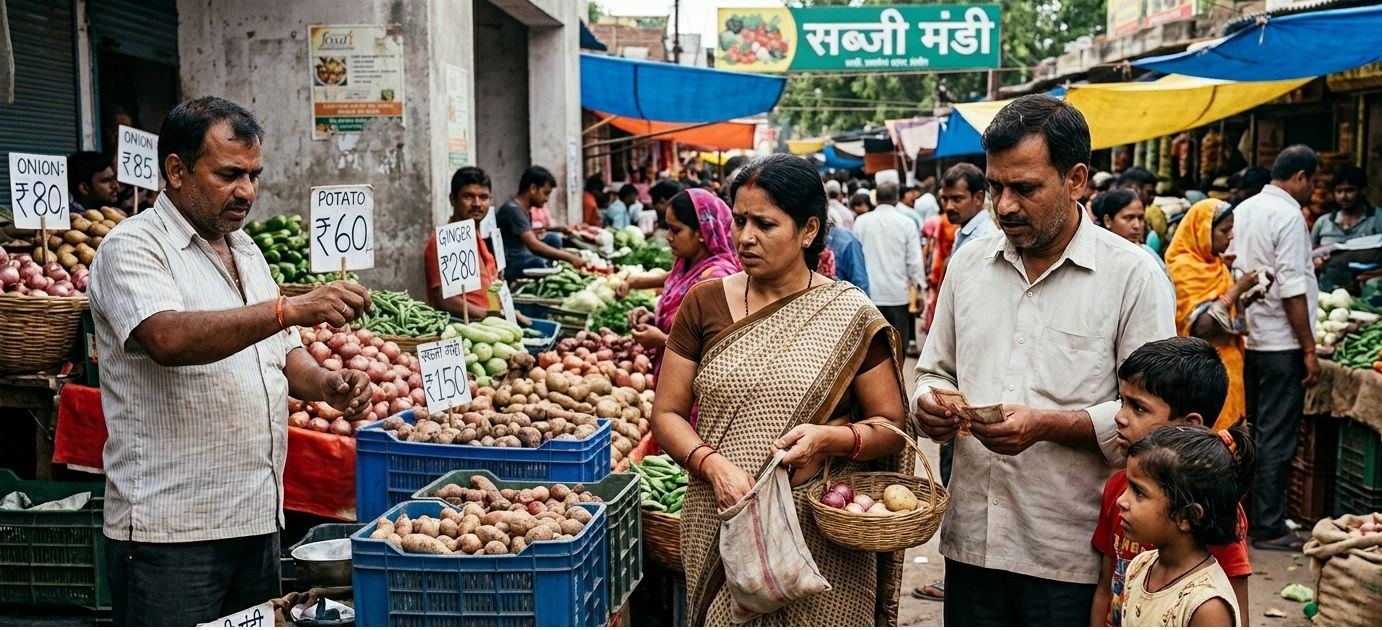
Food inflation is expected to emerge as one of the earliest casualties of rising transport expenses. The report notes that a combination of a favourable base effect fading away and increasing freight costs could accelerate price increases across several essential food categories.
“The confluence of a low base and rising transport costs will quicken the pace of food inflation. Supply and Use Tables suggest transport costs contribute more to the prices of dairy products, tea, coffee, fruits, pulses, spices, eggs, meat and fish. These categories are more vulnerable to increases in fuel and transportation costs,” says the report.
The findings suggest that consumers may soon experience higher prices for everyday staples, particularly products that rely on extensive transportation networks between production centres and consumption markets. This could complicate the inflation management exercise at a time when household budgets are only beginning to stabilise after previous bouts of food price volatility.
The report, however, points to one mitigating factor. The goods and services tax (GST) rationalisation announced in September 2025 reduced tax rates on a range of mass-consumption products, including electronics, automobiles, clothing, fast-moving consumer goods and processed foods. According to the report, the inflation-lowering impact of these measures should continue for at least a year, providing some cushion against rising energy costs, though not enough to fully offset them.
Policy Watch Ahead
The implications are equally significant for manufacturers and policymakers. Higher crude prices increase the cost of petroleum products and gas, while rising fuel prices simultaneously inflate transportation expenses. This creates a dual cost burden for producers across sectors.
The Crisil report identifies clothing, electronic products, wood products and housing-related construction materials such as cement and ceramics as particularly transport-intensive categories that may witness stronger price pressures. Mining products, including iron ore and coal, as well as chemical products, are also vulnerable to rising freight costs.
“Given broadly steady demand conditions so far, manufacturers are increasingly likely to pass on higher costs to consumers to protect profit margins. Alternatively, they can also resort to ‘shrinkflation’ — reducing volumes for a product at the existing price,” says the report.
For the Reserve Bank of India (RBI), the emerging challenge lies in ensuring that temporary supply-side pressures do not become entrenched in inflation expectations. Crisil expects the central bank’s Monetary Policy Committee to largely look through the initial supply-side impact, but remain alert to broader spillovers.
With crude oil averaging about $112 per barrel during the first two months of the current fiscal against Crisil’s full-year base-case assumption of $95 per barrel, the risk calculus has shifted noticeably. Add concerns around a potentially below-normal monsoon and evolving El Niño conditions, and the inflation outlook appears considerably more uncertain than it did just a few months ago.
The immediate fuel price increase may appear modest. The larger risk, however, lies in its ability to quietly seep into transport networks, manufacturing chains and food markets. That process has already begun, and if crude prices remain elevated, India's inflation battle could become significantly more difficult in the months ahead.