

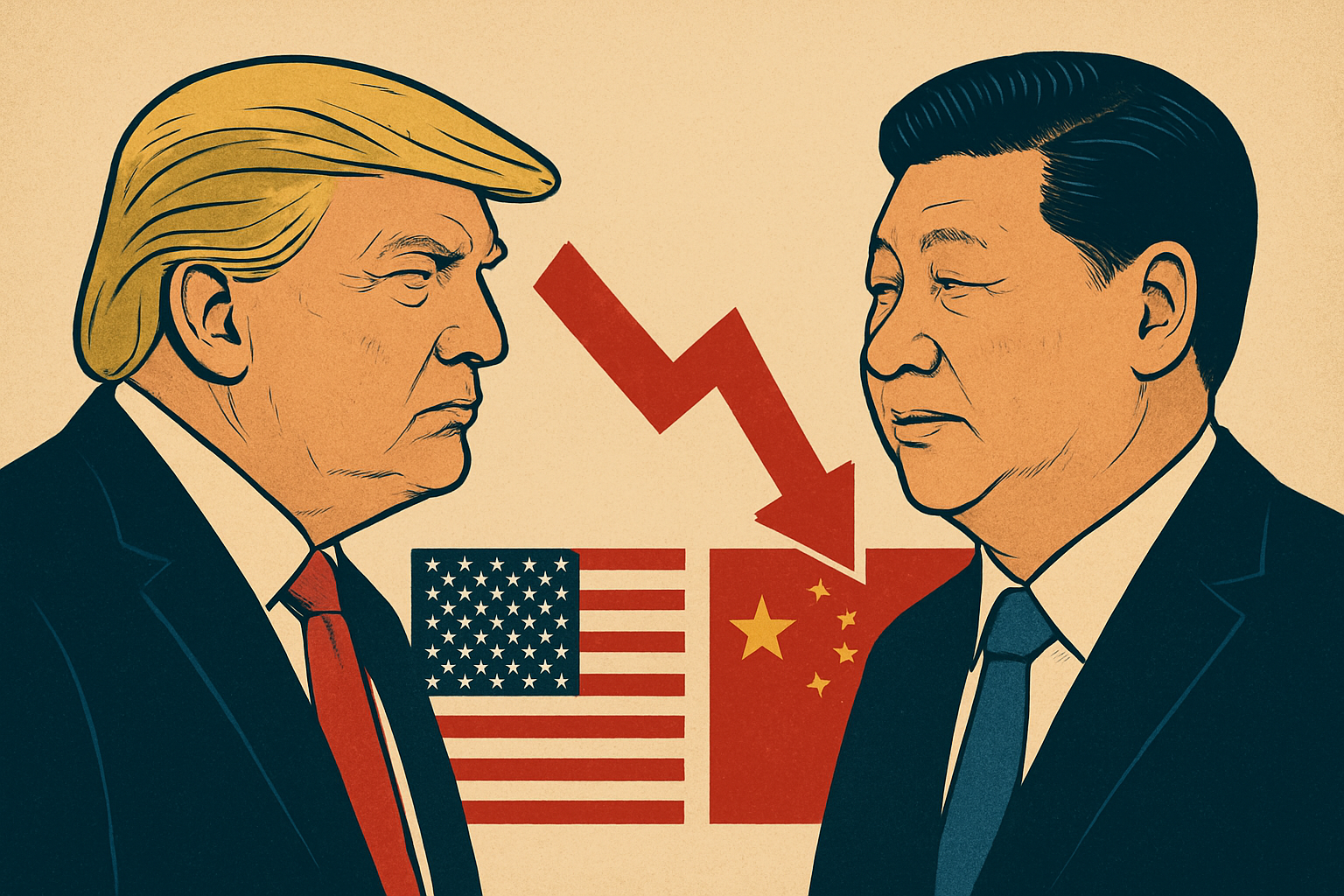
New Delhi: The United States and China have once again plunged into a heated trade confrontation after Washington announced a new 100% tariff on Chinese imports, set to take effect on November 1, 2025.
The decision, revealed directly by President Donald Trump through his Truth Social account, marks the sharpest escalation in US-China economic relations since the original trade war of the late 2010s. “Starting November 1st, 2025 (or sooner), the United States of America will impose a tariff of 100% on China, over and above any tariff that they are currently paying,” Trump declared.
The latest measure came as a response to Beijing's abrupt decision to restrict exports of rare earth minerals — materials essential for electronics, renewable energy systems and advanced weaponry. According to Trump, China’s move was “shocking … out of the blue", and demonstrated what he called a “very hostile attitude” toward the United States. In the same post, he questioned whether an upcoming meeting with Chinese President Xi Jinping would even be “necessary", hinting at a possible diplomatic freeze.
Trump’s new tariff doubles existing rates on a wide range of Chinese goods, effectively cutting into the profitability of imports from China and aiming to pressure Beijing to loosen its grip on critical resources. He also threatened to introduce sweeping export restrictions on US technology and software, describing them as leverage to “protect American innovation from unfair manipulation".
This dramatic escalation has already unsettled financial markets. US indices reacted sharply, with steep declines in major manufacturing and technology stocks. Analysts fear that the tariff hike could fuel inflationary pressures, as import-dependent industries will face higher input costs. American consumers, too, are likely to feel the pinch as prices for electronics, vehicles, and household goods rise.
Trump, however, insists that the short-term economic pain is worth the long-term gain. "China has taken advantage of America for decades,” he wrote. “It’s time we stop the bleeding and bring our jobs home.” His administration has argued that the tariffs are part of a larger “economic defense strategy", designed to restore domestic manufacturing capacity and reduce reliance on China’s supply chains.
Beijing, for its part, has issued statements warning that it will “fight to the end” if forced into another trade conflict. Although Chinese officials have avoided specific countermeasures so far, observers expect retaliatory tariffs or new restrictions targeting US firms operating within China.
Behind the economic rhetoric lies a deeper geopolitical contest. The trade war reflects a struggle for technological dominance and global influence. Rare earth minerals, semiconductors, and artificial intelligence are not just commercial assets — they are strategic tools in defining 21st-century power. The US seeks to maintain control over technological exports, while China aims to protect its supply of critical materials.
Whether this standoff leads to negotiation or escalation remains uncertain. Trump has left the door open for talks but insists that any deal must “put America first.” For now, the world watches as the two largest economies edge closer to a full-scale trade confrontation that could reshape global commerce, supply chains, and the balance of power for years to come.