
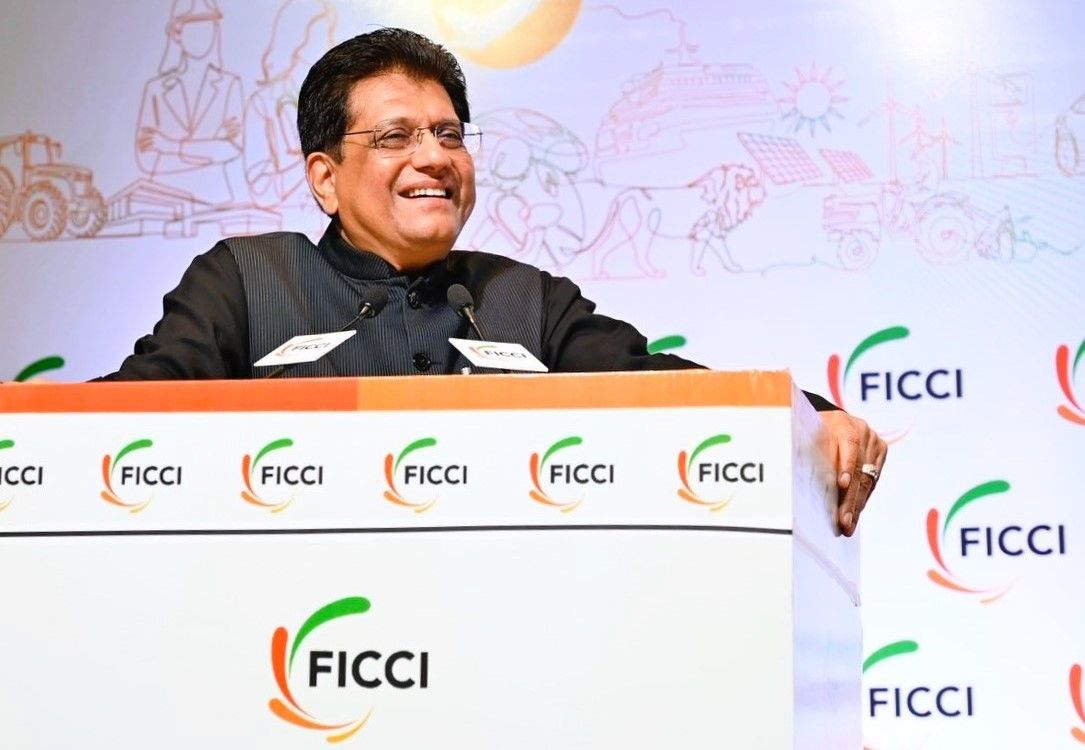

New Delhi: India is deepening its global trade engagement even as it anchors its economic policy in self-reliance, Commerce Minister Piyush Goyal said, highlighting that the country has already concluded “balanced and equitable” trade agreements with key partners while negotiating with nearly 50 more.
Addressing Ficci’s 98th AGM in New Delhi on Friday, Goyal said FTAs with Australia, the UAE, Mauritius, the United Kingdom and the four-nation EFTA bloc reflect India’s shift towards outcome-oriented trade diplomacy. Discussions are currently under way with 14 countries and blocs including the US, the EU, the GCC, New Zealand, Israel, Eurasia, Canada, South Africa and Mercosur, he added.
Goyal underscored that the idea of self-reliance has been intrinsic to India’s civilizational ethos, drawing references from the Bhagavad Gita and Mahatma Gandhi’s Swadeshi movement. He said that this legacy continues to shape India’s economic strategy.
Referring to the recently-signed EFTA pact, Goyal noted that the bloc has committed to invest $100 billion in India in innovation-led and precision manufacturing sectors, leveraging India’s cost competitiveness in research and innovation. High-quality innovation executed in India, he said, can be achieved at a fraction of the cost of Europe or the United States.
Calling on domestic industry to shed “legacy mindsets”, Goyal urged companies to adopt a forward-looking and globally competitive approach. He pointed to India’s large talent pool, rapid digital adoption and demographic strength, saying the country is well-positioned to lead in applied artificial intelligence, automation, robotics and deep-tech sectors.
The recently-announced $12 billion research, development and innovation (RDI) fund, along with continuing support for startups and deep-tech enterprises, is expected to accelerate India’s innovation momentum, he added.
Skilling is Key
Goyal stressed skilling as a national priority, arguing that India’s youthful workforce — unlike ageing populations in many advanced economies — is naturally adaptable to emerging technologies and has already embraced digital platforms at scale. This readiness, he said, strengthens India’s prospects in the global technology landscape.
Reflecting on international developments, he said that recent geopolitical and economic disruptions have underscored the importance of trusted partners and resilient supply chains. India’s widening network of FTAs and economic partnerships aims to build long-term, transparent and mutually beneficial cooperation.
Using the PESTLE framework, Goyal outlined India’s macro strengths: political stability and ‘minimum government, maximum governance’, economic policies including the National Manufacturing Mission and the ₹25,000-crore Export Promotion Mission, social support through the four Labour Codes and the Antyodaya approach, technological initiatives such as the ₹76,000-crore Semiconductor Mission and the ₹7,000-crore permanent magnet programme to reduce import dependence, legal reforms including progress on Jan Vishwas 3.0 to boost ease of doing business, and energy security reinforced through the Atomic Energy Bill 2025 that opens the nuclear sector.
Urging Ficci to play a mission-oriented role, he called for deeper industry-academia collaboration, stronger R&D investments and broader innovation-led competitiveness. Collective effort from industry, government and citizens, he said, will be crucial for India to emerge as a resilient, competitive and self-reliant economic power.