

New Delhi: In a landmark decision aimed at bridging the healthcare gap in rural and underserved regions, the Union cabinet, chaired by PM Narendra Modi, has approved the addition of 10,023 new medical seats in government medical colleges and hospitals. The move marks a significant step towards achieving universal health coverage for India’s 1.4 billion people, many of whom lack access to quality healthcare due to a shortage of trained medical professionals.
The new initiative, announced on September 24, includes 5,000 postgraduate (PG) and 5,023 undergraduate (UG) medical seats, to be created by the 2028-29 academic year. The government has allocated an investment of Rs 15,034 crore over four years (2025-29) for this expansion, with 68.5% (Rs 10,303 crore) funded by the Centre and the remaining Rs 4,731 crore to be borne by state governments.
Towards Healthcare Equity
PM Modi has emphasized the broader impact of the scheme in a social media post, stating: “Approval of Phase-III of the Centrally Sponsored Scheme will add significant PG and UG medical seats. This will improve our healthcare system and enhance medical education infrastructure. It will ensure that every part of India has availability of skilled doctors.”
The newly-approved seats are part of a broader vision to add 75,000 medical seats across India over the next five years. By leveraging existing infrastructure in government hospitals and colleges, the move is designed to be cost-effective while promoting a balanced regional distribution of the medical workforce.
Improving Access in Rural, Tribal Areas
One of the primary goals of this initiative is to increase healthcare access in rural, tribal and remote regions, where medical staff shortages are most severe. The expansion will not only produce more general practitioners but also bolster the supply of medical specialists, who are in critical demand across various disciplines.
The average investment per seat stands at Rs 1.5 crore, ensuring quality training and facilities for aspiring medical professionals. This expansion is expected to significantly boost employment in the healthcare sector, including roles for doctors, teaching faculty, paramedics, researchers and administrative staff.
Boost to Medical Education
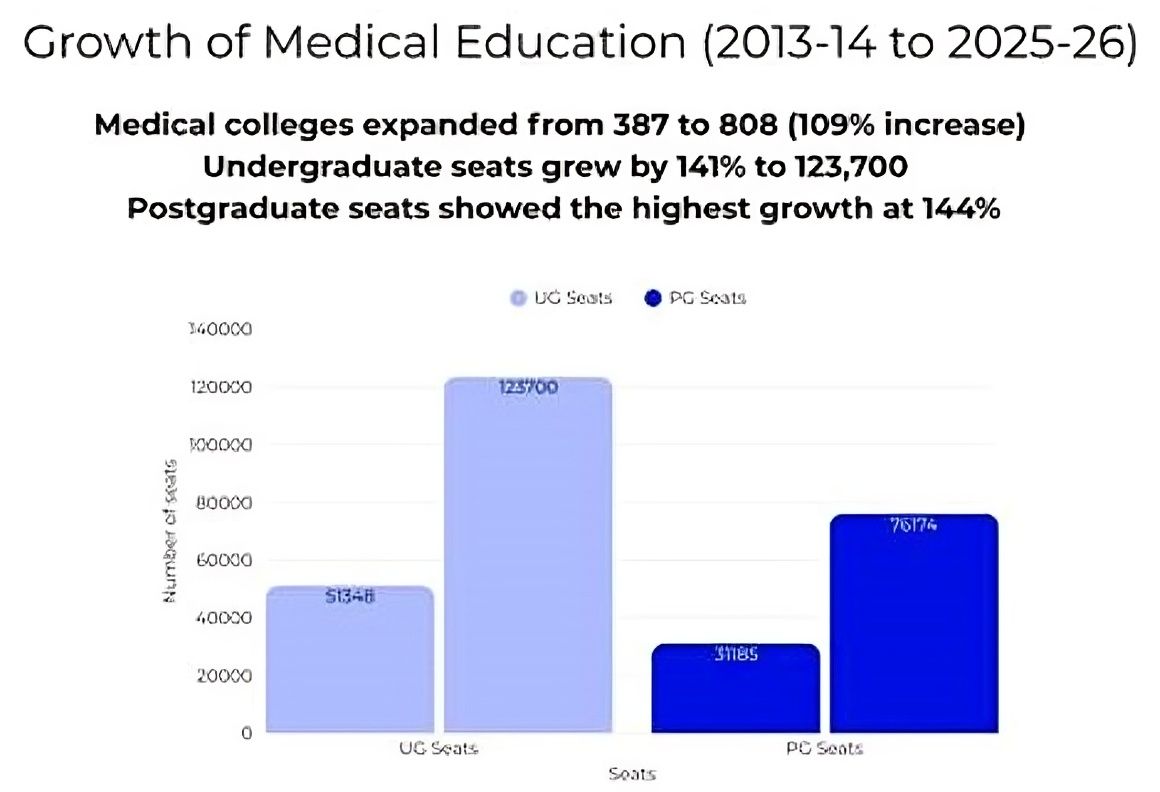
India already boasts the highest number of medical colleges globally, with 808 institutions and over 1.23 lakh MBBS seats. Over the past decade, the country has added more than 69,000 MBBS seats, marking a 127% increase. Similarly, postgraduate seats have grown by 143% with over 43,000 new PG seats added.
To support the rapid expansion, the National Medical Commission (NMC) introduced new faculty eligibility regulations in July 2025.
The key reforms include:
(1) Allowing non-teaching hospitals with 220+ beds to be designated as teaching institutions
(2) Permitting experienced government doctors without senior residency to serve as faculty, provided they complete the Basic Course in Biomedical Research (BCBR)
(3) Enabling new government colleges to start UG and PG courses simultaneously to speed up the supply of trained professionals
These regulatory changes aim to expand the faculty pool and ensure that the increase in seats does not compromise the quality of medical education.
Socio-economic, Healthcare Impact
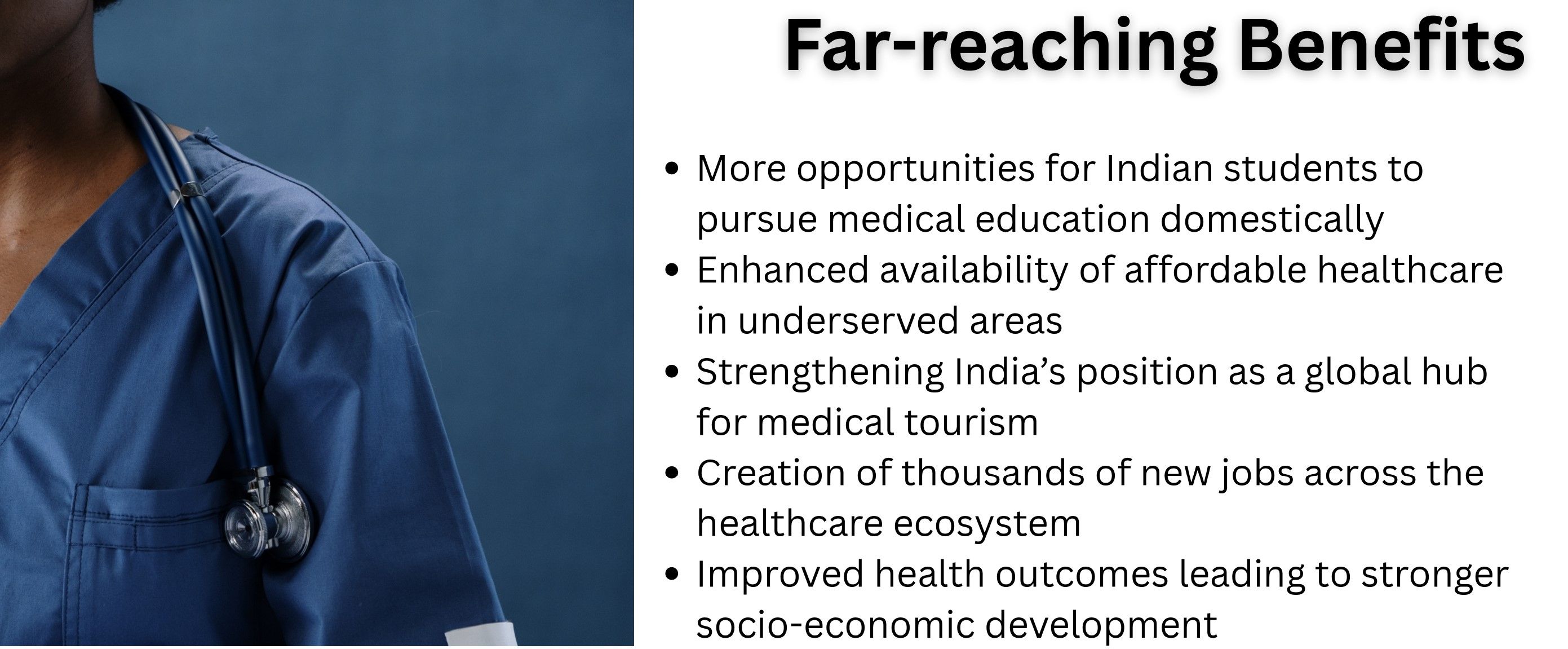
This medical seat expansion is expected to have far-reaching benefits, including:
The approval of 10,023 new medical seats underscores the Indian government’s unwavering commitment to healthcare reform and human capital development. As the nation pushes forward towards universal health coverage, this investment lays the foundation for a robust, equitable, and self-reliant healthcare system that meets both domestic and global needs.