


New Delhi: The West Asia war has begun feeding directly into India’s inflation pipeline, with soaring crude oil and commodity prices pushing wholesale inflation to a 42-month high and setting the stage for broader retail price pressures in the months ahead.
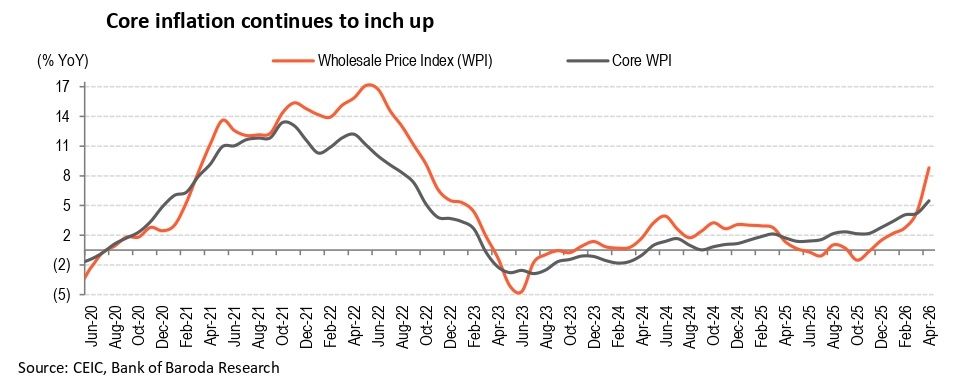
India’s factory-gate inflation, measured by the wholesale price index (WPI), recorded a massive surged to 8.3% in April from 3.88% in March as the escalating conflict around the Gulf region, disruptions near the Strait of Hormuz, and rising global energy prices sharply lifted fuel, freight and imported input costs across sectors.
The spike was led by a dramatic jump in fuel and power inflation, but the April data also revealed widening pressure across manufacturing, metals, chemicals and industrial inputs — an indication that inflation is no longer confined to global oil markets and is beginning to spread through the domestic economy.
Economists now expect these elevated wholesale costs to gradually flow into retail inflation through higher transportation charges, logistics expenses and pass-through pricing by manufacturers and consumer-facing companies.
Fuel Shock Deepens
The sharpest pressure point emerged from the fuel and power basket, where inflation soared to 24.71% in April from just 1.05% in March. Petrol inflation climbed to 32.40%, while high-speed diesel inflation rose to 25.19%. LPG prices also returned to inflationary territory at 10.92%.
The surge reflects the widening fallout of the West Asia conflict and disruptions around the Strait of Hormuz, a critical global oil transit route through which a substantial share of India’s crude imports move. Crude petroleum and natural gas inflation spiked to 67.18%, while some datasets showed crude inflation touching as high as 88.06% during the month.
In its research note, Bank of Baroda economist Sonal Badhan said, “Fuel and power inflation rose to 42-month high of 24.7% in Apr’26, as the impact of US-Iran war on international oil prices becomes more clearly visible.” She further noted that “renewed tensions in the Gulf and closure of Strait of Hormuz are also impacting oil and metal prices.”
The ministry of commerce and industry said the “positive rate of inflation in April 2026 is primarily due to an increase in prices of mineral oils, crude petroleum & natural gas, basic metals, other manufacturing and non-food articles, etc.”
Even though retail fuel prices have not yet fully reflected the global crude surge, the inflation impulse is already feeding into industrial supply chains. Aviation turbine fuel prices have risen more than 100% year-on-year, while naphtha, furnace oil and diesel costs have jumped sharply, increasing operational costs across logistics, airlines, manufacturing and construction sectors.
That transmission is critical because wholesale inflation often acts as a leading indicator for future retail inflation. Once producers exhaust their ability to absorb costs, the burden typically shifts downstream to consumers through higher prices for goods and services.
Pipeline Pressures Build
The April data showed the inflation surge broadening well beyond fuel.
Inflation in manufactured products — which account for more than 64% of the WPI basket — rose to a 43-month high of 4.62% from 3.39% in March. Core WPI inflation climbed to 5%, indicating that pricing pressures are spreading deeper into the industrial economy.
According to the Bank of Baroda note, “Within manufactured products, basic metals, machinery, textiles, chemicals, pharmaceutical products and other manufacturing led the rise.”
The metals complex has emerged as another major inflation driver. Aluminium inflation rose to 19.2%, while copper prices remained elevated at 15.3%. International commodity markets have also turned sharply volatile amid geopolitical uncertainty and supply disruptions.
For businesses, this creates a cascading cost problem. Higher crude prices increase freight and transportation expenses. Elevated metal and chemical prices raise production costs for automobiles, appliances, machinery, electronics and infrastructure sectors. A weaker rupee further amplifies imported inflation by making overseas raw materials more expensive in domestic currency terms.
The impact is unlikely to remain restricted to heavy industry. As transportation and warehousing costs rise, companies across fast-moving consumer goods, retail, pharmaceuticals and food processing sectors may eventually be forced to pass on higher input costs to consumers.
The inflationary transmission could be especially visible in sectors heavily dependent on fuel-intensive logistics networks. Freight rates have already begun firming up in several industrial corridors, while commercial LPG prices have risen despite government efforts to shield households from direct fuel price increases.
This raises the risk of a second-round inflation effect, where sustained wholesale inflation gradually pushes up consumer inflation through higher prices of packaged foods, consumer durables, mobility services and daily essentials.
Aditi Nayar, Chief Economist at ICRA, told CNBC TV18 that the sharp jump in April WPI inflation to 8.3% was much higher than ICRA’s 5% estimate, largely driven by fuel and mineral oil prices amid the West Asia conflict. She expects WPI to stay elevated in the coming months, with no clear visibility on commodity prices easing.
She also warned that if crude averages $95 per barrel in FY27, India’s current account deficit could rise above 2% of GDP, increasing pressure on the rupee and balance of payments.
CPI Risks Emerge
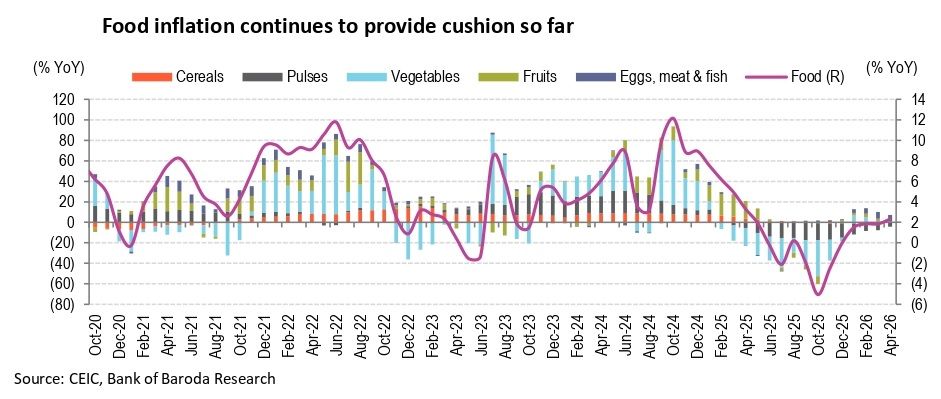
For now, food inflation remains relatively contained, offering policymakers some temporary relief. Primary food inflation stood at 1.98% in April compared with 1.9% in March. Foodgrain inflation also remained weak due to softer cereal and pulse prices. But that cushion may not hold for long.
Oil and metal prices are expected to remain elevated in the near-term, according to Badhan. “This will have further upside impact on headline WPI in the coming months.” She also cautioned that food inflation could begin “inching up depending upon the progress of the monsoon in the coming months”.
That combination — imported fuel inflation alongside potential weather-linked food pressures — could create a difficult inflation environment for the Reserve Bank of India. Retail inflation has so far remained relatively manageable because the government has absorbed part of the global energy shock and food prices have stayed broadly stable. However, sustained pressure in wholesale prices historically filters into CPI with a lag.
The concern now is less about a one-month spike and more about a structural inflation pipeline building beneath the surface of the economy.