

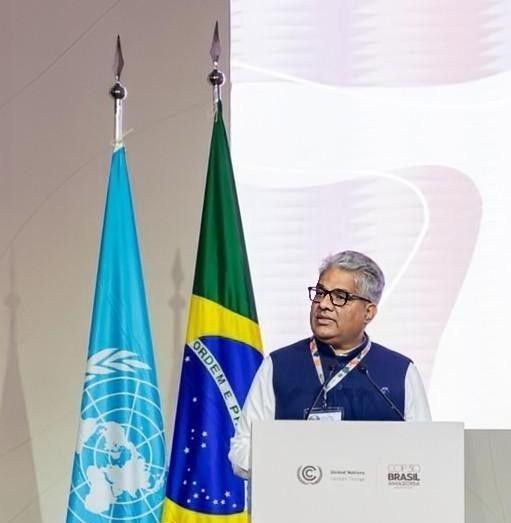
New Delhi: India positioned itself as a forceful voice for climate action at the 30th Conference of Parties (CoP30) to the UNFCCC in Belém, Brazil, on as Union minister for environment, forest and climate change Bhupender Yadav on Monday delivered a series of high-level interventions calling for an era of implementation, industrial transition and integrated climate-biodiversity solutions.
Across three key multilateral platforms, India pressed for climate finance, equitable technology access, and global conservation partnerships, while showcasing its domestic progress and international leadership.
Delivering India’s national statement at the high-level segment of CoP30, Yadav urged developed nations to honour climate commitments with urgency and scale, insisting that CoP30 should be remembered as the “COP of implementation” and “COP of delivery on promises.”
Noting that the Amazon — the host venue — symbolised the planet’s ecological wealth, he appealed for deeper climate ambition from industrialised nations and said they must reach net-zero far earlier than currently pledged.
Yadav called for climate finance to shift from billions to trillions and demanded that climate-critical technologies be made affordable, accessible and free from restrictive intellectual property barriers.
Reiterating that India has shown development and environmental stewardship can advance together, the minister highlighted that the country’s emission intensity has declined by over 36% since 2005 and that non-fossil sources now account for more than half of India’s total electric power installed capacity, totalling around 256 GW — an NDC milestone achieved five years ahead of the 2030 target.
Yadav informed that India would submit its revised nationally determined contributions (NDCs) until 2035 and also file its first biennial transparency report on time, underscoring New Delhi’s compliance-driven climate posture. He cited India’s global initiatives such as the International solar alliance, global biofuel alliance, and growing momentum under the nuclear and green hydrogen missions as examples of climate leadership.
Notably, Yadav drew attention to India’s community-led effort that planted more than two billion trees in just 16 months, calling it a testament to the “power of collective climate action.”
He closed his address with a call to make the next decade “one of implementation, resilience and shared responsibility.”
The minister’s climate diplomacy continued at the LeadIT Industry Leaders’ Roundtable, which he opened as co-chair of the leadership group for industry transition. With the world marking 10 years of the Paris Agreement, Yadav said the time for global industry to move from “goal setting to implementation” had decisively arrived. Stressing that India’s economic growth has been decoupled from emissions, he pointed out that as the world’s fourth-largest and fastest-growing major economy, India reduced the emission intensity of its GDP by 36% between 2005 and 2020.
He identified LeadIT — launched by India and Sweden in 2019 — as a model for meaningful industrial climate collaboration and said its membership has expanded to 18 countries and 27 companies. Yadav described the LeadIT-facilitated cooperation between Tata Motors and the Volvo Group to decarbonize heavy-duty transport as a demonstration of how shared ambition could translate into shared action. Announcing the admission of SKF as a new member of the platform, he emphasized that technology access and sharing would remain central to the global industrial transition. Industrial innovation under the India-Sweden Industry Transition Platform, including projects on carbon capture, AI-led process optimization and hydrogen-based industrial heating, would soon be initiated with 18 industries and research institutions, he added. He urged countries and corporates to intensify cooperation to ensure the Paris Agreement goals are met and to build a sustainable industrial future.
Big Cat Alliance
Yadav’s final address for the day at the high-level ministerial session on the International Big Cat Alliance (IBCA) pushed for a climate-biodiversity agenda where conservation directly advances climate resilience.
Calling big cat landscapes “nature-based climate solutions”, the minister argued that wildlife conservation is “climate action in its most natural form” and warned that big cat population declines weaken carbon sinks, destabilize ecosystems and reduce climate resilience.
He said India, home to five of the world’s seven big cat species, has doubled its tiger population ahead of schedule and continues to see growth in the Asiatic lion population. India, he added, has built one of the world’s most comprehensive wildlife databases and has expanded protected areas, secured corridors and enabled conservation-linked livelihoods through community partnerships.
He said 17 countries were formally associated with the alliance, with over 30 more expressing willingness to join. Yadav announced that India would host a Global Big Cats Summit in New Delhi in 2026 and invited all range countries to participate.
India also unveiled a flagship publication at CoP30 titled ‘One Earth, One Family, One Future: A Decade of Climate Action’, documenting national and state-level progress, adaptation strategies, climate finance mechanisms and the pathway to a sustainable and developed Bharat by 2047.
Across all engagements, Yadav called for unity and credibility in the global climate movement, asserting that protecting big cats, accelerating industrial transition and delivering on climate finance were part of the same mission: protecting the planet and the future of humanity.