


New Delhi: India’s campaign to reduce its dependence on imported coal is beginning to reshape the country’s energy landscape, with stronger domestic production increasingly displacing overseas purchases and reinforcing the Centre’s broader push towards energy security.
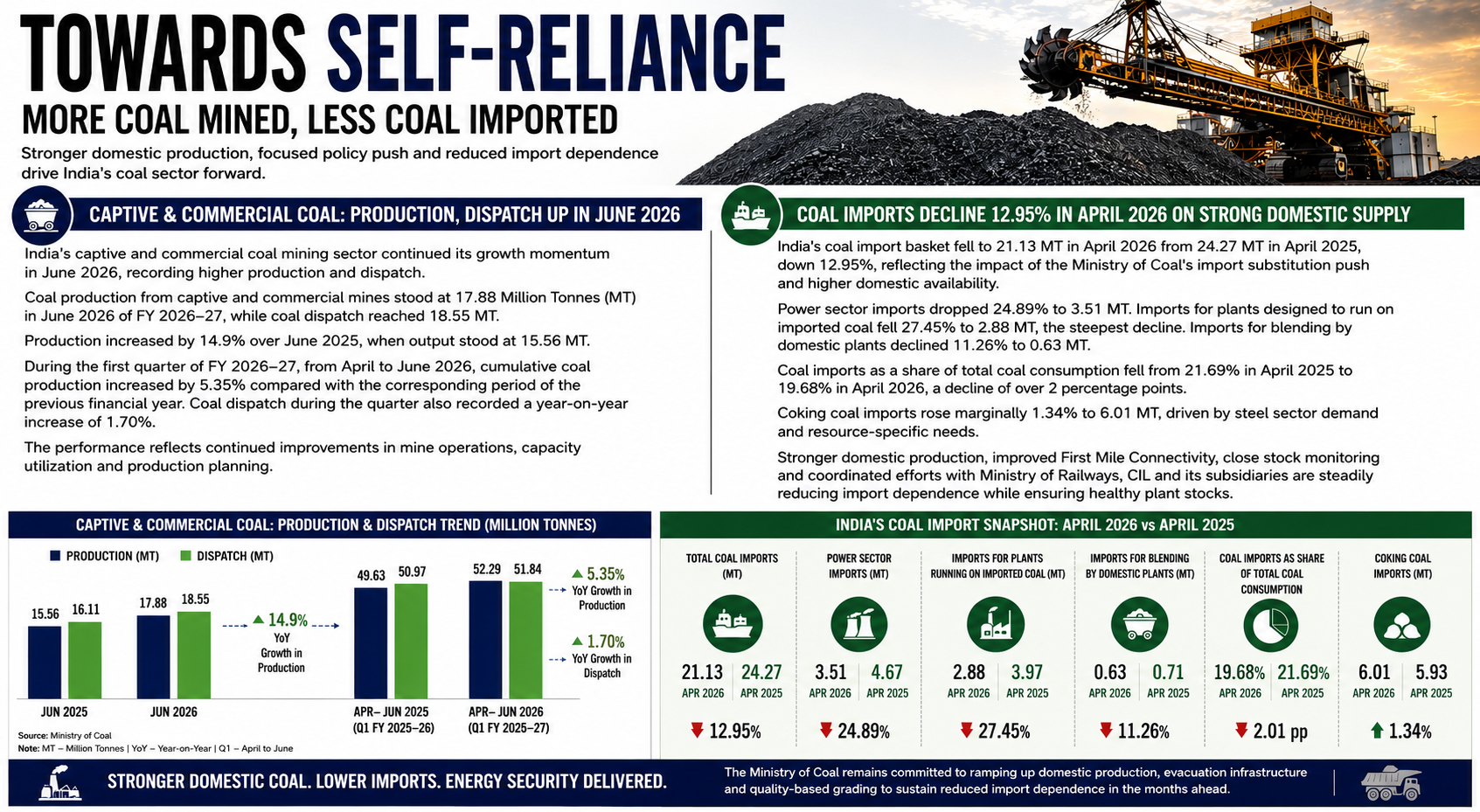
Fresh government data released on Thursday showed coal production from captive and commercial mines climbed 14.9% year-on-year to 17.88 million tonnes (MT) in June, while dispatch rose to 18.55 MT, reflecting robust demand and improved evacuation from mining regions.
The production gains came alongside a sharp fall in imports during April, suggesting policy measures aimed at expanding domestic mining, improving logistics and securing fuel supplies for power producers are steadily reducing India’s exposure to volatile international coal markets.
The twin trends are particularly significant for the world’s second-largest coal consumer, where electricity demand continues to grow alongside industrial activity and economic expansion. Lower imports not only reduce foreign exchange outflows but also cushion utilities from fluctuations in global coal prices, which have remained volatile since the energy market disruptions triggered by geopolitical conflicts and supply-chain bottlenecks over the past few years.
Output Momentum Builds
Coal production from captive and commercial mines reached 17.88 MT in June, up from 15.56 MT in the same month last year.
Dispatch during the month totalled 18.55 MT, exceeding production as coal producers continued drawing down inventories while meeting demand from power plants and industrial consumers.
The momentum was evident across the first quarter as well. Between April and June, cumulative production from captive and commercial mines increased 5.35% over the corresponding period of FY26, while dispatch rose 1.70%.
The figures indicate that newer commercial mines are gradually ramping up production while captive blocks allocated to sectors such as power, steel and cement continue improving operational efficiency.
The government has increasingly relied on commercial coal mining as a structural reform to supplement production from Coal India Ltd, which still accounts for the overwhelming share of domestic output. Expanding the role of private miners is expected to improve productivity, accelerate mine development and diversify supply sources over the longer term.
Imports Lose Ground
The improvement in domestic availability is translating directly into lower imports.
India imported 21.13 MT of coal in April, down from 24.27 MT in the same month last year, a decline of 3.14 MT or nearly 13%.
The fall reflects the government’s sustained strategy of substituting imported thermal coal with domestic production wherever technically feasible. Over the past few years, policymakers have accelerated mine auctions, streamlined clearances, strengthened railway connectivity and expanded coal evacuation infrastructure to ensure domestic supplies can reliably replace imports.
The latest numbers suggest those measures are beginning to produce tangible results.
Perhaps the clearest evidence lies in the power sector, traditionally among the largest consumers of imported thermal coal.
Power Imports Ease
Coal imports by power utilities dropped 24.89% year-on-year to 3.51 MT in April from 4.67 MT a year earlier.
Imported coal-based (ICB) generating stations recorded the steepest decline, with imports falling 27.45% to 2.88 MT from 3.97 MT.
Domestic coal-based (DCB) plants, which import limited quantities for blending with domestic fuel, also reduced purchases. Imports for blending declined 11.26% to 0.63 MT from 0.71 MT.
Together, the reductions underscore improved availability of domestic coal linkages and stronger coordination between coal producers, railways and power utilities.
The result is a gradual reduction in India’s reliance on imported fuel. Imported coal accounted for 19.68% of total coal consumption in April, compared with 21.69% in the corresponding month last year.
That decline may appear modest, but for one of the world’s largest coal-consuming economies, even a two-percentage-point shift represents millions of tonnes of demand moving from international suppliers to domestic producers.
Coking Coal Constraint
One segment, however, remains largely insulated from the government’s import-substitution drive. Coking coal imports increased 1.34% to 6.01 MT from 5.93 MT in April, reflecting continued expansion in domestic steel production.
Unlike thermal coal, India has limited reserves of high-quality metallurgical coal suitable for blast furnace steelmaking. As a result, steel producers remain dependent on imported coking coal despite ongoing efforts to improve domestic exploration and beneficiation.
The contrast highlights the different dynamics within India’s coal market. While thermal coal imports are likely to continue declining as domestic production expands, coking coal imports are expected to remain structurally high until viable domestic alternatives emerge or steelmaking technologies evolve further.
Market Impact Ahead
The latest data reinforce the government’s confidence that higher domestic production can keep pace with rising electricity demand without a corresponding increase in imports.
The Ministry of Coal attributed the decline in overseas purchases to higher domestic production and offtake, expansion of First Mile Connectivity projects, close monitoring of thermal power plant inventories and coordinated efforts involving the Ministry of Railways, Coal India Ltd and its subsidiaries to ensure uninterrupted supplies.
For listed companies, the trend carries different implications. Coal India and commercial mine operators stand to benefit from stronger domestic demand and higher utilisation of existing capacity as imported thermal coal loses market share. Power producers, meanwhile, could see lower fuel procurement risks and reduced exposure to swings in international coal prices, particularly during periods of geopolitical uncertainty.
The broader economy also stands to gain. Lower thermal coal imports can help contain the country's import bill, improve energy security and reduce vulnerability to disruptions in global supply chains or shipping routes.
However, challenges remain. Domestic production must continue rising fast enough to meet growing electricity demand, while investments in railway capacity, mine evacuation systems and coal quality management will be critical to sustaining the transition.
Even so, the latest production and import data suggest India’s long-running effort to achieve greater self-reliance in coal is beginning to move beyond policy ambition and into measurable outcomes. As captive and commercial mines expand output and imported thermal coal steadily loses market share, the country’s energy mix is becoming increasingly anchored in domestic resources — a shift that could reshape India’s fuel economics over the coming decade.