

New Delhi: The global wealthy are on the move — and in doing so, they are redrawing the map of economic power.
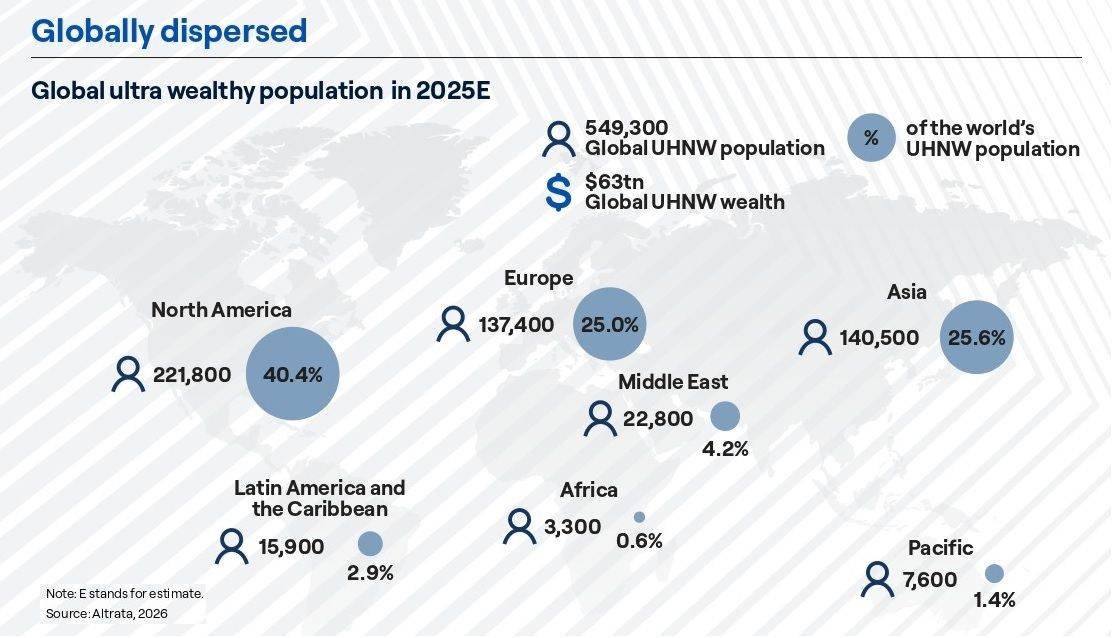
Nearly a fifth of the world’s ultra-high net worth (UHNW) individuals are now foreign-born, indicating that mobility has become a central pillar of wealth creation, preservation and strategy. By 2030, the global UHNW population is projected to reach 7,34,100 individuals, up 34% from 2025, with combined wealth swelling to $84 trillion.
These are among the headline findings of Global Citizens: Entrepreneurship, Mobility and the Ultra Wealthy, a report by Altrata, sponsored by Arton Capital. The report offers a sweeping view of how migration, entrepreneurship and geopolitical shifts are converging to reshape the global wealth landscape.
The report underscores that this transformation is not incremental but structural. The rise of a hyper-mobile wealthy class is being driven by digital innovation, urbanisation, an expanding global middle class, and unprecedented inter-generational wealth transfers. At the same time, geopolitical instability and regulatory divergence are pushing the affluent to diversify not just their portfolios but also their physical and legal presence across borders.
“Mobility is no longer a secondary consideration in wealth planning. It is a defining advantage. In a world marked by fragmentation and volatility, the ability to live, invest, and operate across jurisdictions has become a core pillar of both asset preservation and wealth creation. This shift has been building for over a decade and is now accelerating. Today, nearly a fifth of the world’s most dynamic wealth creators were born outside their chosen country of residence, and they are reshaping the global economy in profound ways,” says the report.
The scale of wealth expansion remains striking. From an estimated 5,49,300 UHNW individuals in 2025, the population is set to rise sharply, while the broader affluent base — those with over $5m — is expected to reach 7.7 million by 2030. This expansion reflects both traditional drivers such as capital markets and newer forces including technology-led entrepreneurship and globalised investment flows.
Migration, Entrepreneurship & Self-Made Elite
At the heart of this transformation lies a powerful link between migration and entrepreneurship. The report finds that foreign-born individuals are disproportionately represented among founders, innovators and high-growth entrepreneurs across major economies.
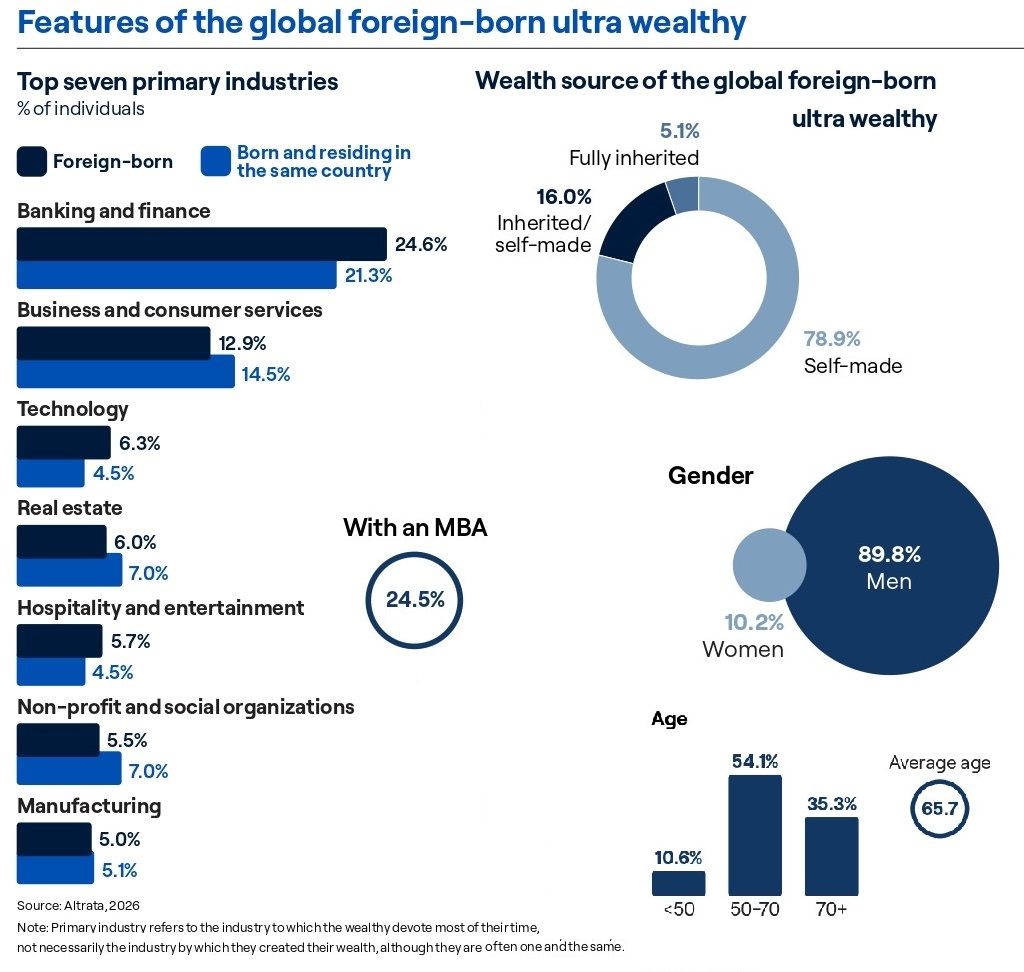
Roughly 79% of foreign-born UHNW individuals are self-made, compared with slightly lower levels across the broader ultra-wealthy population. Another 16% combine inherited wealth with self-generated fortunes, leaving just 5% who are fully reliant on inheritance. This entrepreneurial tilt is central to understanding how global wealth is being created.
Migration, the report points out, acts as both a filter and a catalyst. Individuals who move across borders tend to be more risk-tolerant, ambitious and opportunity-driven — traits closely aligned with entrepreneurial success. In markets such as the US, around half of Fortune 500 companies and unicorn start-ups have at least one first- or second-generation immigrant founder, highlighting the outsized impact of migrant entrepreneurship.
“Entrepreneurialism is not incidental to this group; it is fundamental. Some 8 in 10 are self-made, defined by a willingness to take risks, to think globally and to act decisively. Mobility is integral to their success, enabling access to markets, capital and talent that would otherwise remain out of reach. These individuals are not just building wealth; they are driving innovation, creating jobs and reshaping industries across borders,” says the report.
Sectoral distribution further reinforces this pattern. Banking and finance remains the dominant industry, accounting for about 25% of foreign-born UHNW individuals, followed by business and consumer services. Technology, though highly visible, represents a smaller share at just over 6%, though its influence on wealth creation remains disproportionately large.
Demographically, the cohort is overwhelmingly male, with women accounting for just over 10%. The average age stands at 65.7 years, slightly younger than locally born counterparts, reflecting a concentration in prime working years among migrant populations.
Mobility as Strategy: Rise of ‘Portfolio Citizenship’
If entrepreneurship is the engine of wealth creation, mobility is increasingly the strategy for preserving and expanding it. The report highlights a decisive shift in how the ultra-wealthy approach geography — not as a fixed base but as a flexible portfolio.
Nearly 20% of UHNW individuals hold commercial interests headquartered outside their primary country of residence, while more than a third have obtained higher education abroad. This growing international footprint reflects both opportunity and necessity in an era of geopolitical uncertainty.
The report identifies a clear behavioural shift: the wealthy are actively seeking multiple residencies, citizenships and jurisdictions to hedge risks and maximise flexibility. Investor visas, golden residency programmes and favourable tax regimes have become critical tools in this strategy.
“Increasingly, wealth is structured with optionality at its core. The acquisition of multiple passports and residencies is no longer a contingency plan but a fundamental component of sophisticated wealth planning. Individuals are building portfolios of access, enabling them to respond swiftly to geopolitical shifts, regulatory changes and market opportunities. In a world defined by uncertainty, this ability to choose where to live, work and invest is one of the most valuable assets,” says the report.
This evolution is being driven by a convergence of forces. Geopolitical tensions, regulatory fragmentation and shifting centres of economic power are prompting the wealthy to take greater control over their personal and financial sovereignty. At the same time, advances in digital connectivity and cross-border financial infrastructure have made it easier than ever to operate globally.
The implications are profound. Wealth is no longer tied to a single geography but is increasingly global in origin, management and deployment. Families often maintain a presence in multiple wealth hubs, balancing lifestyle, taxation, security and investment considerations.
Competing Wealth Hubs in Multipolar World
The report paints a picture of an increasingly multipolar wealth landscape, where established centres coexist with emerging hubs competing for mobile capital.
North America remains dominant, accounting for over 40% of the global UHNW population, with around 2,21,800 individuals. Its strength lies in deep capital markets, a robust corporate ecosystem, and a long-standing culture of entrepreneurship. However, shifting policy dynamics and geopolitical uncertainties are prompting some diversification of wealth away from the region.
Asia, with over a quarter of the global UHNW population, has recorded the fastest growth over the past decade. Driven by favourable demographics, expanding consumer markets and vibrant technology sectors, the region is expected to remain a key engine of wealth creation.
Europe maintains a similar share but faces structural constraints such as slower growth and ageing populations. Nevertheless, its strong institutions, high living standards and established financial markets continue to attract global wealth.
Beyond these traditional centres, emerging hubs are gaining traction. The Middle East, particularly, has positioned itself as a magnet for mobile wealth, leveraging low taxation, investor-friendly policies and strategic location. Meanwhile, cities such as Singapore are reinforcing their appeal through political stability, strong legal frameworks and sophisticated financial ecosystems.
“Global wealth is becoming increasingly diversified across regions, yet it remains concentrated in key hubs that offer a compelling mix of stability, opportunity and lifestyle. The rise of new centres alongside the enduring strength of established markets has created a level of choice that is unprecedented. This competition is intensifying as jurisdictions actively design policies to attract the ultra-wealthy and their capital,” says the report.
Foreign-born individuals play a critical role in this dynamic. They account for around 20% of the global UHNW population, with particularly high concentrations in markets such as the UK, Singapore, the UAE and Switzerland. Even among billionaires, one in five is foreign-born, underscoring the global nature of wealth creation at the highest levels.
The future of wealth, the report says, will belong to those who can navigate this complex, interconnected landscape. Mobility, entrepreneurship and strategic diversification are no longer optional but essential.
“The future will favour those who can navigate the world rather than be constrained by it. The concept of global citizenship is evolving beyond access to encompass control — control over where to live, where to invest and how to secure long-term prosperity. In this new era, the most successful individuals will be those who combine entrepreneurial drive with global mobility and strategic foresight,” says the report.
In essence, the ultra-wealthy are no longer defined solely by what they own, but by where they can go… and how quickly they can adapt.
(Cover photo by Lux Charters on Unsplash)