


New Delhi: “This is not just a victory for BNP. It is a victory for democracy. It is a victory for Bangladesh.”
With those words, Tarique Rahman hailed a landslide mandate that now places him firmly on course to become Bangladesh’s next Prime Minister. Under his leadership, Bangladesh Nationalist Party (BNP) has secured 209 of 297 declared seats in the 13th National Parliament election, comfortably crossing the two-thirds threshold and positioning itself to form the government within days.
Congratulating the people on what he described as a “democratic transition”, interim government head Muhammad Yunus, who will now hand over the baton to Rahman, said the polls represented a defining moment for the country’s democratic journey and expressed hope that the new leadership would uphold transparency, accountability and inclusive governance. His remarks underscored the broader expectation that the election marks a reset after years of political turbulence.
International reactions were swift and politically significant. Prime Minister Narendra Modi was among the first global leaders to congratulate Rahman. “This victory shows the trust of the people of Bangladesh in your leadership,” he said in a message. “I look forward to working with you to strengthen our multifaceted relations and advance our common development goals,” he added.
In a subsequent post after speaking with the BNP chief, Modi said, “Delighted to speak with Mr. Tarique Rahman. I congratulated him on the remarkable victory in the Bangladesh elections,” reaffirming India’s commitment to “the peace, progress, and prosperity of both our peoples”.
The United States, China, Nepal and Bhutan also conveyed congratulations, signalling international acceptance of the outcome even before final certification.
For India, the decisive BNP majority offers predictability following the proscription of the Awami League led by Sheikh Hasina. However, Jamaat’s surge beyond 60 seats is likely to trigger security scrutiny in New Delhi, given the party’s history of anti-India rhetoric.
The Numbers
The Bangladesh Election Commission on Friday released the unofficial results for 297 constituencies. While the BNP dominated the landscape, Bangladesh Jamaat-e-Islami emerged as the principal opposition with 68 seats — its strongest performance in history.
Smaller parties and independents divided the remaining constituencies. The National Citizen Party, an ally of Jamaat, won six seats, while independent candidates secured seven. Bangladesh Khelafat Majlish won two seats, and Islami Andolan Bangladesh, Bangladesh Jatiya Party-BJP led by Andaleeve Rahman Partho, Ganaodhikar Parishad, Ganasamhati Andolan and Khelafat Majlish won one each.
The Election Commission senior secretary Akhtar Ahmed said average voter turnout stood at 59.44% across the 297 constituencies.
In the simultaneous referendum on the July National Charter (Constitutional Reform) Order 2025, the turnout reached 60.26% across 299 constituencies. According to official figures, 68.05% voted in favour of the reforms — a strong endorsement of structural constitutional changes aimed at preventing authoritarianism, including proposals for an upper house and a two-term limit for the prime minister.
Two constituencies — Chattogram-2 and Chattogram-4 — remain pending following a court decision, while polling in Sherpur-3 had earlier been cancelled after the death of a Jamaat candidate.
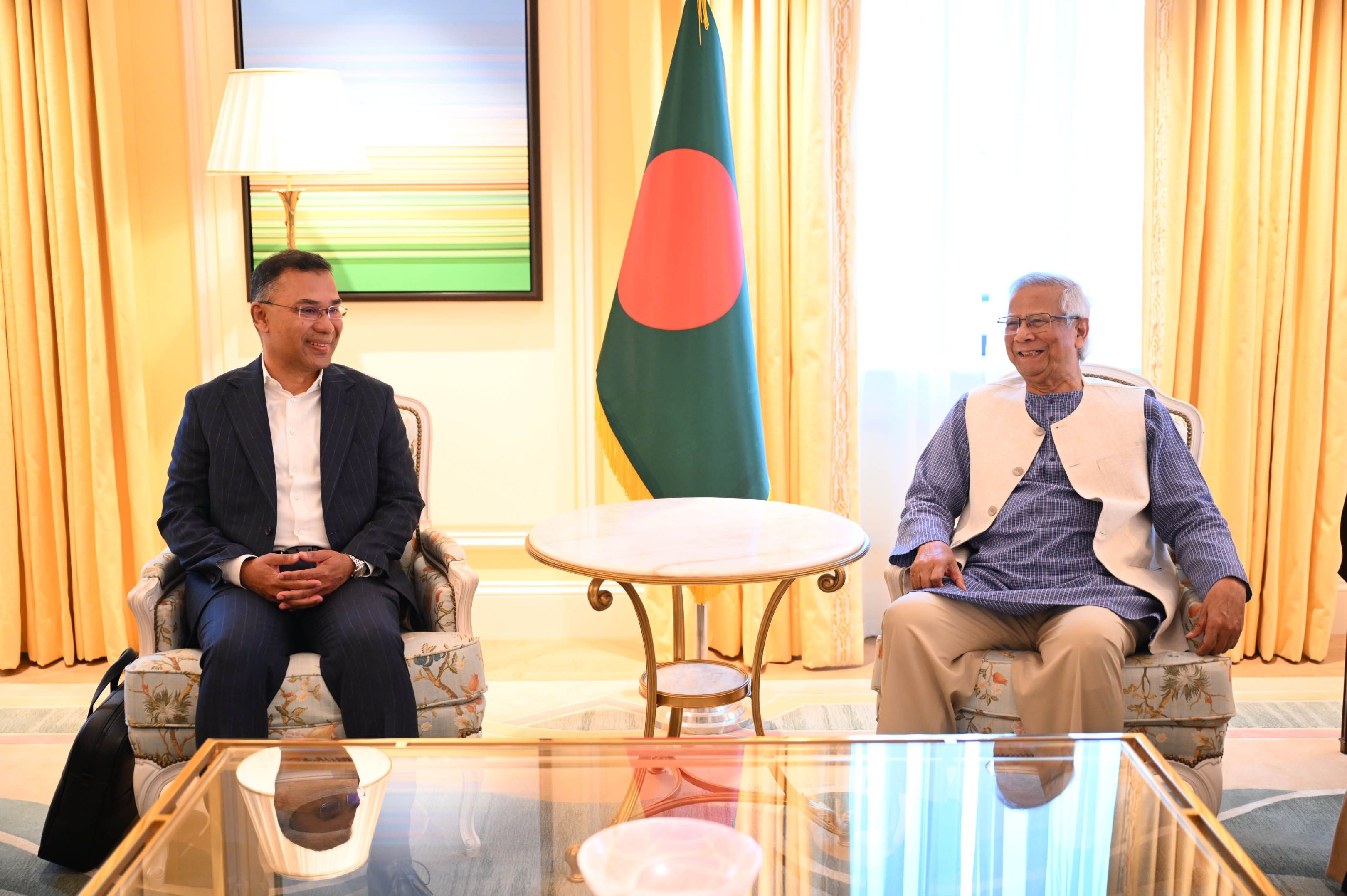
Bangladesh interim government head Muhammad Yunus (right), who will now hand over the baton to Tarique Rahman, said the polls represented a defining moment for the country’s democratic journey.
Jamaat ‘Unhappy’
Despite its record tally, Jamaat expressed dissatisfaction with the process. In a statement, the party said, “We express our sincere gratitude to you for casting your votes in large numbers throughout the day in such a positive and peaceful atmosphere. However, we are not satisfied with the process surrounding the election results.”
It cited alleged inconsistencies in unofficial announcements and what it described as administrative bias. The party urged supporters to remain patient and await further instructions from its 11-party alliance, declaring, “Our struggle for justice in pursuit of a humane Bangladesh will continue.”
The BNP rejected allegations of irregularities and framed the outcome as a democratic watershed. Party leaders said the mandate reflects public exhaustion with prolonged instability and a desire for economic revival, institutional reform and accountable governance.
Rahman’s impending premiership now carries the weight of delivering on ambitious promises, including recalibrating foreign policy, addressing border concerns with India, pursuing equitable sharing of transboundary river waters, and seeking regional re-engagement through SAARC.
The opposition benches will be stronger than in recent years. Jamaat, together with National Citizen Party lawmakers, now commands sufficient numbers to mount sustained parliamentary oversight. Meanwhile, the once-influential Jatiya Party failed to win a single seat for the first time since the restoration of parliamentary democracy, signalling a dramatic collapse in its political relevance.
'Credible' Polls
The International Crisis Group described the election as Bangladesh’s first “credible election” in 17 years. Its Senior Consultant on Myanmar and Bangladesh, Thomas Kean, said the BNP “will need to announce a strong cabinet and hit the ground running” to confront economic pressures, ensure security and sustain reform momentum. He emphasized that any allegations of irregularities must be handled transparently to consolidate faith in democratic institutions.
Minority representation featured in the outcome as well. Four BNP candidates from religious and ethnic minority communities — Gayeswar Chandra Roy, Nitai Roy Chowdhury, Saching Pru and Dipen Dewan — secured seats, while two BNP minority nominees were defeated. Both Jamaat and the National Citizen Party fielded one minority candidate each; neither succeeded.
With a commanding parliamentary majority and a reform referendum backed by over two-thirds of voters, Rahman stands at the threshold of power with both authority and expectation. The scale of the victory offers political capital; the complexity of Bangladesh’s economic, social and geopolitical challenges ensures that the real test begins now.