

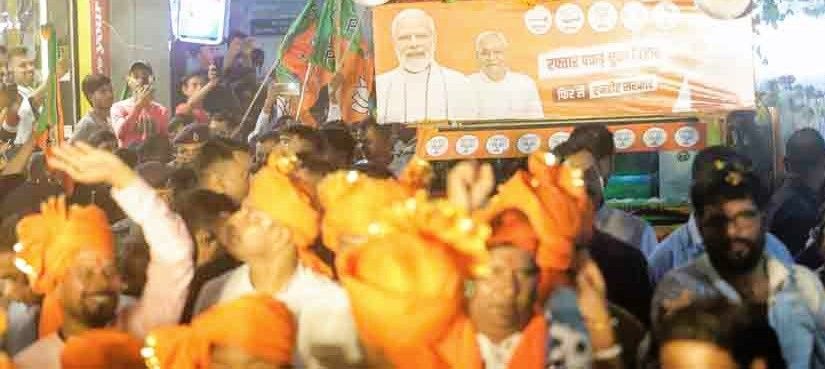
New Delhi: The Bihar election has produced one of the most remarkable political outcomes in the state’s contemporary history. The NDA not only secured a decisive victory but engineered a coalition of voters that political observers initially underestimated. Rather than relying on a single campaign plank, the NDA stitched together a multi-faceted strategy — social, developmental, emotional and organizational — which collectively delivered extraordinary electoral dividends.
Understanding what clicked for the NDA requires an examination of the evolving electoral landscape of Bihar, and the way the ruling BJP-JDU alliance recalibrated political messaging, leadership projection and welfare commitments to capture a broad base of support.
Rise of a New Social Coalition: From MY to MEY
For decades, the political geometry of Bihar revolved around the traditional “MY” (Muslim-Yadav) alliance, a bedrock of support for RJD-led formations. NDA broke this long-standing axis not by mimicking it, but by constructing an entirely different and more numerically expansive voter cluster — the MEY configuration: Mahila (Women) + EBC (Economically Backward Classes) + Yuva (Youth).
Women emerged as the silent electoral force this time too. Bihar has consistently recorded higher female voter turnout than male turnout in recent cycles, but in this election, that differential widened. The NDA’s promises of economic support, employment-linked benefits and safety resonated deeply with women, who connected political stability with personal security and household well-being.
Simultaneously, the EBC category — long fragmented and often electorally neglected — found recognition through targeted welfare announcements and representation within the alliance. The youth constituency formed the third pillar of this triangle, responding to a campaign that highlighted dignity, aspiration and governance while invoking memories of lawlessness under earlier regimes.
Together, these three groups formed a numerically decisive coalition that reshaped the electoral battlefield.
Strategic Focus on Women, Welfare Delivery
The “women factor” was not accidental. It was operationally designed. The NDA campaign emphasized cash transfers, self-employment support for women’s collectives, policies related to electricity subsidies, and an overarching narrative of safety and empowerment. JD(U) chief and chief minister Nitish Kumar’s history of initiatives such as bicycle distribution for schoolgirls and reservations for women in panchayats added credibility.
While welfare schemes have long influenced Bihar politics, what distinguished this election was the intentional framing of women as political stakeholders rather than passive beneficiaries. NDA’s messaging reoriented politics from caste entitlement to household security, nurturing loyalty among women who saw continuity of the ruling coalition as stability in their everyday lives.
Resurgence of ‘Jungle Raj’ Narrative
One of the most emotionally potent themes of the NDA’s campaign was the return of the ‘Jungle Raj’ discourse. The alliance repeatedly asserted that an opposition victory would bring back the era marked by fear, crime and political muscle. This messaging struck a chord for two reasons. First, it activated memories among older voters who had lived through turbulent periods when crime was seen as normalized. Second, it resonated with first-time voters who had no direct experience of the alleged ‘Jungle Raj’ but had grown up hearing stories of it. The contrast was deliberately framed — governance versus chaos, security versus insecurity, continuity versus regression.
In this framing, even voters who were uncertain about developmental progress or employment opportunities gravitated toward the alliance out of a desire for an ordered, functioning state. The emotional weight of safety overrode other concerns, especially in semi-urban and rural constituencies where fear of instability remains politically persuasive.
Cohesive Seat-Sharing & Organizational Discipline
Historically, political alliances in Bihar have been undermined by infighting and resentment over seat allocation. In this election, the NDA displayed a level of internal cohesion and discipline that prevented this pitfall.
BJP and JD(U) contested a roughly comparable number of seats while ensuring that smaller allies, rather than acting as spoilers, felt rewarded and visible within the coalition. This harmony prevented vote splitting and ensured localized consolidation.
At the ground level, the alliance’s booth-level apparatus functioned efficiently, with clear role division between parties. JD(U) capitalized on areas where Nitish had personal goodwill, while BJP leveraged its organizational machinery and national leadership appeal to counter anti-incumbency. The coordination was sharper and more standardized than in previous elections, reflecting lessons learned from earlier electoral setbacks.
Nitish Factor: Leader with Residual Trust Capital
While anti-incumbency against Nitish did exist, it did not translate into an electoral revolt. The reason lies in the continued perception of the JD(U) chief as a reliable steward of governance, particularly when contrasted with uncertainty associated with alternative leadership. His image of sobriety, administrative competence and focus on education and infrastructure helped retain trust even among voters dissatisfied with the pace of job creation or industrial progress.
Campaign messaging around Nitish effectively tapped into voters’ psychological attachment to a familiar anchor in governance. The slogan projecting him as still relevant and strong reinforced the idea that change did not necessarily mean improvement. In a political climate where leadership matters, NDA exploited a belief that stability under a known leader was preferable to the unpredictability of an alternative regime.
Youth Outreach: Narrative over Numbers
The NDA confronted youth unemployment not by denying the challenge but by reframing it within a governance narrative. Campaign rhetoric suggested that job creation, skilling and investment were works-in-progress that required continued stability, while the opposition was portrayed as promising populism without infrastructure to support it. Simultaneously, youth-driven campaign events, social-media outreach and direct engagement sought to make the alliance appear accessible and future-oriented.
This approach appealed to young voters not because it offered immediate employment, but because it fostered a sense of belonging to a long-term developmental promise. The return of the law-and-order theme also influenced youth voters, who associated livelihood prospects with a peaceful and stable environment.
Welfare & Development: Complementary, Not Competing Narratives
Political debates often pit welfare against development, but the NDA campaign treated them as interlinked rather than contradictory. Welfare benefits were positioned as stepping-stones toward growth, particularly for EBC and women voters who were encouraged to envision mobility through state support.
Development achievements — roads, electricity expansion, institutional improvements — were showcased not as abstract progress but as enablers of personal opportunity.
This narrative allowed the NDA to occupy ideological territory across the political spectrum: economically centrist on welfare, aspirational on development and culturally focused on security. That broad ideological bandwidth expanded its voter reach, helping the coalition avoid the perception of serving narrow identity blocs.
The NDA victory in Bihar was not the consequence of one dramatic factor but the synergy of multiple, carefully calibrated strategies. By constructing a new voter coalition centered on women, EBCs and youth, the alliance reshaped the electoral arithmetic of the state, taking it beyond the traditional caste contours. By foregrounding law and order, it tapped into deep emotional anxieties that overshadowed economic frustrations.
Cohesive seat-sharing prevented internal sabotage, while the Nitish factor provided a dependable leadership anchor. Welfare incentives were deployed strategically without undermining developmental narratives, enabling the alliance to appear both empathetic and future-oriented.
Together, these elements formed a political blueprint that not only worked in Bihar but may serve as a model for the NDA’s electoral approach elsewhere: targeted welfare, social realignment, emotional messaging, leadership stability and organizational discipline.
The Bihar result illustrates that when a political campaign succeeds simultaneously at the psychological, social and structural levels, it becomes extremely difficult to defeat, regardless of how volatile the electoral environment may seem.