

New Delhi: Bihar is now ready for a fiercely-contested assembly election that promises to reshape its political landscape.
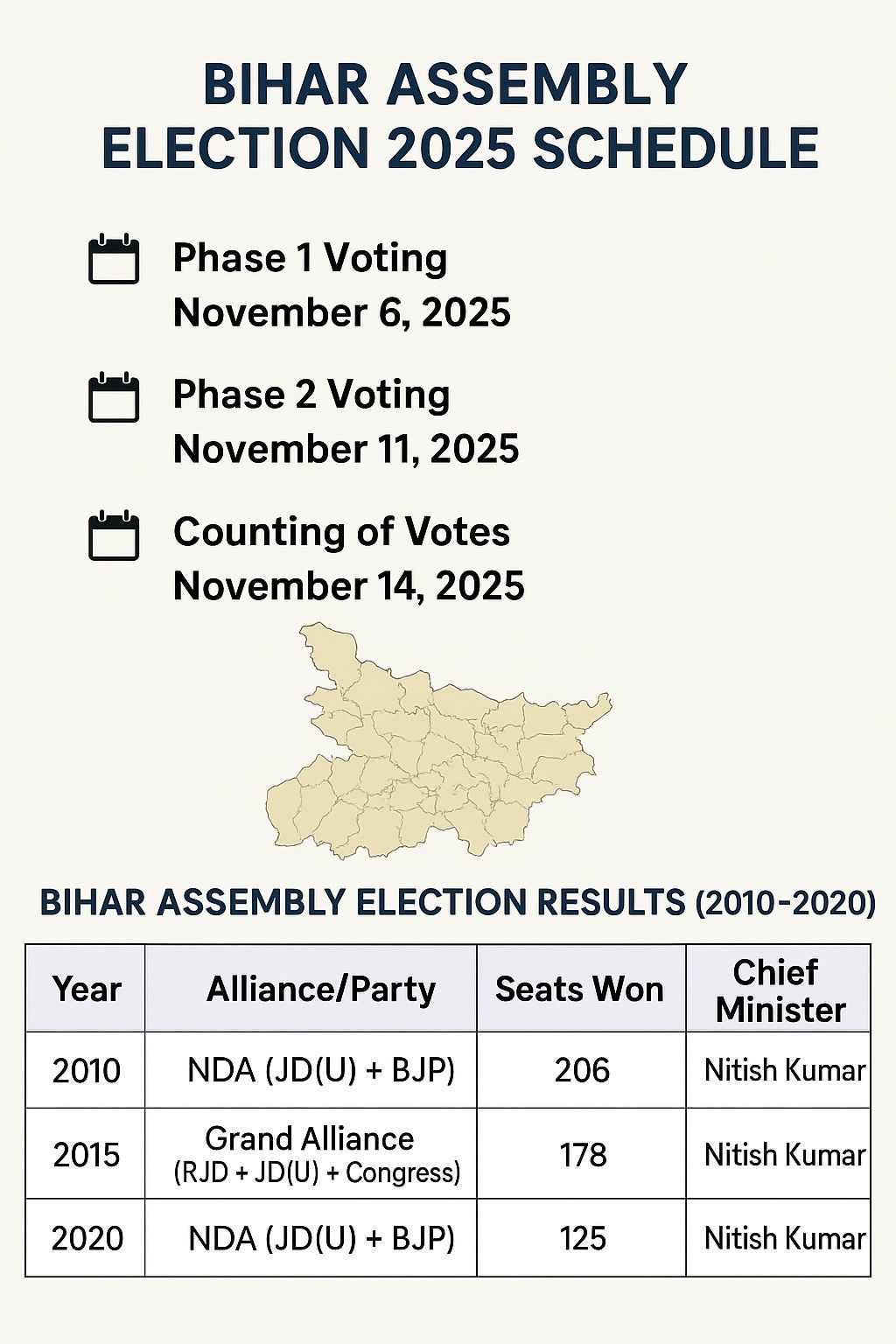
Voting will take place in two phases: November 6 and 11, and the results will be declared on November 14. The Election Commission has described this as the shortest state poll schedule in over 20 years, underscoring the importance of efficiency and order in the process.
This election will also mark the rollout of the Special Intensive Revision (SIR) — a long-pending “clean-up” of Bihar’s voter list after more than two decades. Chief Election Commissioner Gyanesh Kumar said the revision has “purified” the rolls, helping restore voter confidence and data integrity. However, opposition leaders have expressed apprehensions over the deletion of names and demanded greater transparency.
To ensure a smoother process, the Election Commission has launched 17 new initiatives aimed at modernizing polling and counting operations. These include webcasting from every booth, limiting the number of voters per station, creating secure zones for mobile deposits, and mandating that postal ballots be tallied before the final rounds of counting. At the poll announcement, the CEC appealed to citizens to “celebrate this festival of democracy”, likening the spirit of voting to Bihar’s beloved Chhath festival.
At a press briefing on the preparations of the Bihar polls, Gyanesh Kumar said, “We congratulate the voters of India. Thank you to everyone for the successful SIR process. I appeal to all the voters of Bihar to celebrate this festival of democracy with the same enthusiasm as you celebrate Chhath. Everyone should vote and ensure their participation.”
Political Equations, Campaign Themes
The contest once again pits the National Democratic Alliance (NDA) — led by Chief Minister Nitish Kumar’s JD(U) and the BJP — against the Mahagathbandhan (INDIA bloc) spearheaded by Tejashwi Yadav’s Rashtriya Janata Dal (RJD), alongside the Congress and Left parties. Though Tejashwi has been the alliance’s main campaigner, the opposition has refrained from naming an official chief ministerial face, a move many see as tactical ambiguity to manage coalition dynamics.
The NDA, on its part, has focused on stability and law-and-order issues, warning against a return to the “jungle raj” of the 1990s. Nitish Kumar’s administration has also stepped up public spending, unveiling projects worth tens of thousands of crores in a last-minute push to reinforce its development record. The ruling alliance is banking on welfare schemes, women’s empowerment programs, and improved infrastructure to appeal to voters seeking continuity.
The opposition, however, has mounted an aggressive challenge, accusing the NDA government of unemployment, corruption and misplaced priorities. Tejashwi has urged voters to “oust the failed government,” while Congress leaders have raised concerns that recent government announcements violate the spirit of a fair contest.
The 2020 Bihar Assembly elections took place in three phases — on October 28, November 3, and November 7, with the votes counted on November 10.
NDA secured a narrow victory, winning 125 seats in the 243-member assembly. The Mahagathbandhan, led by the RJD, put up a strong fight but finished slightly behind with 110 seats.
Following the outcome, Nitish Kumar was once again sworn in as chief minister, continuing his tenure at the helm of the NDA government.
Road Ahead
Over 7.4 crore voters are eligible to cast their ballots in this election, including nearly 14 lakh first-time voters and over 14,000 centenarians. With Bihar’s political loyalties historically shaped by caste, development and leadership trust, all major parties are working to strike the right balance between identity and governance.
As the campaign heats up, Bihar’s 2025 election is shaping into more than just a political contest — it’s a referendum on the state’s vision of progress, representation and change.