

New Delhi: As the political temperature rises ahead of the Bihar assembly election results day, the credibility of exit polls has become a major talking point.
The controversy began when RJD leader Tejashwi Yadav accused the agencies behind the exit polls of acting under pressure to create a “false narrative” in favour of NDA. He alleged that these polls were designed to influence public perception and intimidate officials, rather than reflect ground realities.
In the latest episode of Dialogus: Syah Safed hosted by Shanker Arnimesh, senior journalist Santosh Singh echoed concerns over the credibility of such polls, emphasizing that Bihar’s political landscape is too diverse and volatile to be captured by “mechanical sampling or speculative models”.
The debate, which dissected the claims and counterclaims around the controversial projections that show NDA winning by significant leads, also focused on the methodological lapses in how exit polls are conducted. Rakesh Ranjan, professor at Patna University, questioned the parameters used for data collection, pointing out that the sampling size and demographic representation often fail to capture the complex voter sentiments across Bihar’s rural and urban belts.
Adding to that, Shashi Kant Pandey, professor at Ambedkar University, Lucknow, reflected on how the methodology of exit polls has evolved but remains inconsistent. “The interpretation of voter behaviour has to go beyond numbers; it must consider the psychological and social contexts that drive voting patterns,” he observed.
Women Voters Rewrite Electoral Script
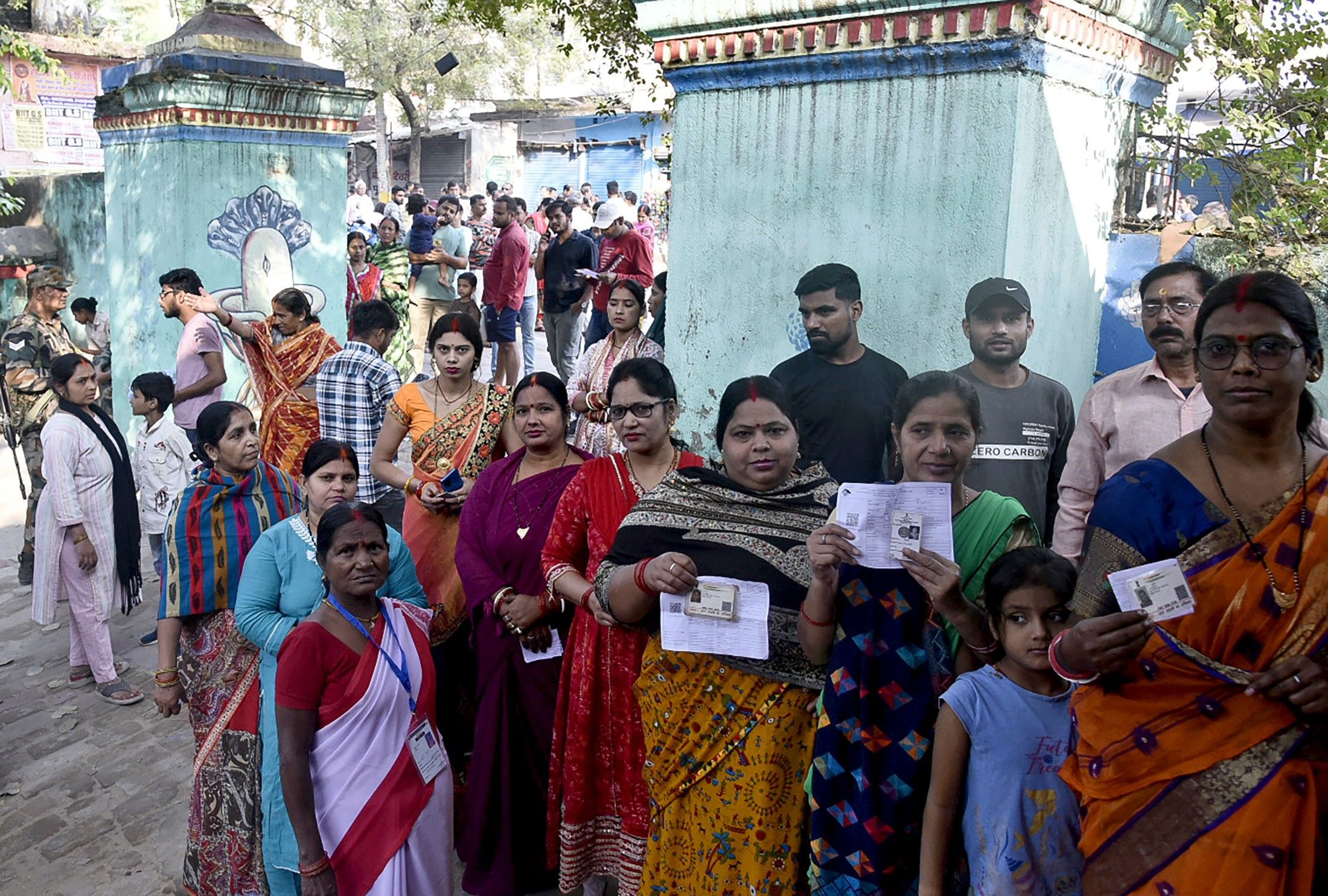
Noting the sharp increase in women voter turnout, which has risen by nearly 8% compared to the previous election, Anshu Naithani, senior journalist, highlighted this as one of the most decisive shifts in Bihar’s voting behaviour, noting that over four lakh more women participated this time.
This rise could potentially reshape traditional voting equations, with many women voters showing preference for welfare-driven governance, particularly under the Nitish Kumar administration, political analyst Amitabh Bhushan suggested.
Despite visible enthusiasm among young and unemployed voters, no strong anti-incumbency wave appears to be emerging. According to Santosh Singh, this might indicate that while Tejashwi Yadav’s youth connect is strong, NDA continues to benefit from stability and social welfare perceptions.
Legal & Ethical Questions
According to the exit polls, NDA is projected to win nearly 70% of the seats, a figure that several experts described as “statistically surprising”. Shashi Kant Pandey also raised concerns about the legality and transparency of private organizations’ involvement in such data collection.
Anshu Naithani criticized the opposition’s muted response throughout the polling phase, saying that “silence at crucial moments allows misinformation to thrive”.
While exit polls offer a snapshot of voter sentiment, the real verdict lies in the people’s mandate, which could still defy projections. With women and youth voters emerging as key influencers, Bihar’s 2025 elections are poised to challenge conventional wisdom — and perhaps, redefine its political future. All will be clear on the 14th.