

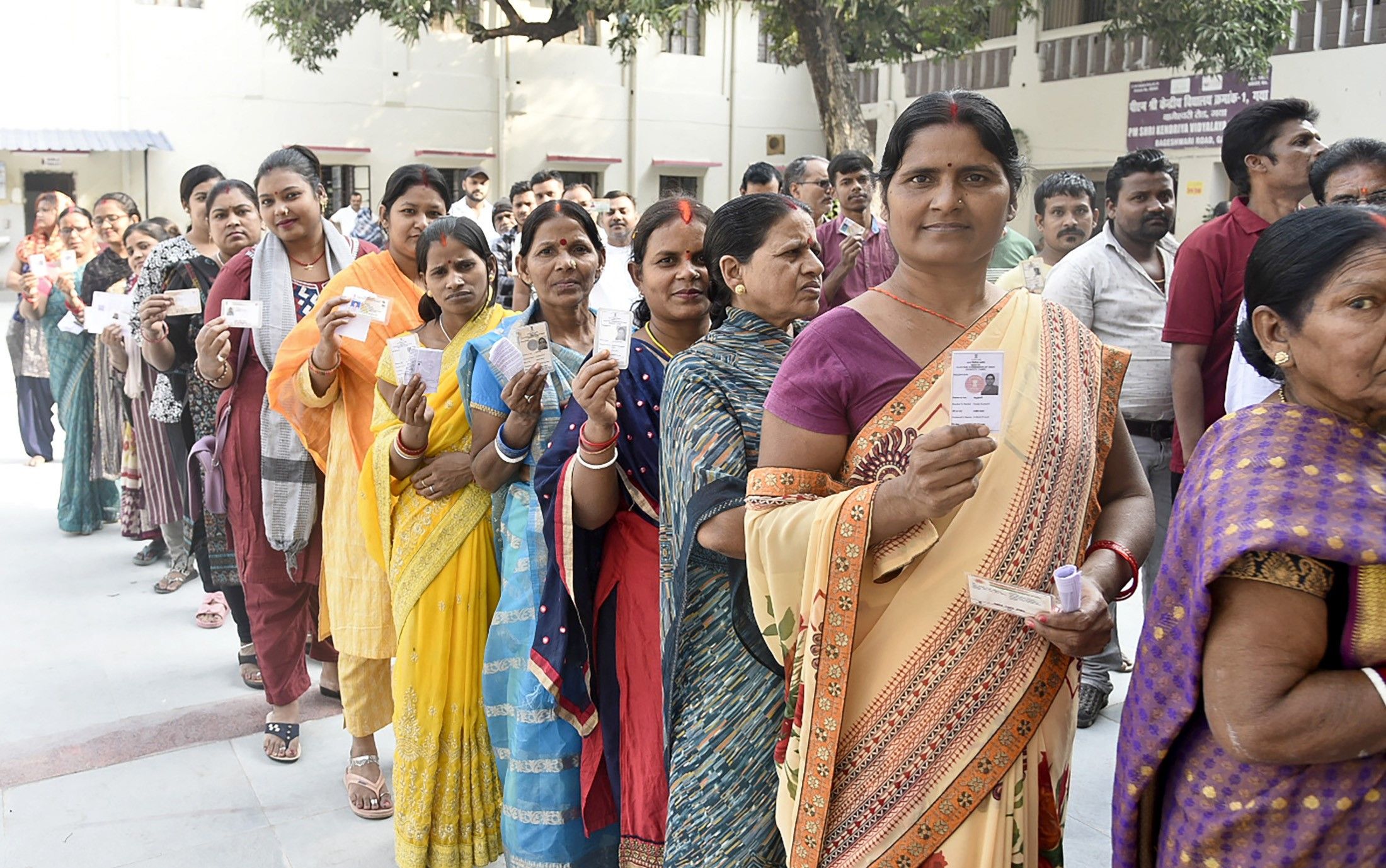
New Delhi: Bihar on Tuesday crossed a historic milestone in its democratic journey, recording the highest ever voter turnout since 1951 at 66.91% in the just-concluded phase-II of the assembly elections.
The two-phase polls, which saw unprecedented enthusiasm across regions, were marked by a remarkable surge in female voter participation. As in the first phase, women voters once again participated in greater numbers than men in this round as well, recording a turnout of 74.03% compared to 64.1% among male voters. Overall, voter participation reached 71.6% for women and 62.8% for men.
The second and final phase, covering 122 constituencies, recorded a provisional turnout of 68.79%, surpassing figures from previous elections. Districts such as Katihar (78.39%), Kishanganj (77.91%), and Purnea (75.87%) stood out for their overwhelming participation, while others like Paschim Champaran, Jamui, Araria and Gaya also reported voter engagement close to or above 70%.
In the earlier assembly elections, voter turnout during the second phase stood at 58.8% in 2020, which was slightly higher than 58.3% in 2015 and 53.8% in 2010.
Over 8.5 lakh polling staff, supported by 1.4 lakh polling agents and a team of over 300 observers, formed the backbone of the massive electoral exercise. The entire process was monitored through a real-time webcasting facility from the ECI control centre, to ensure transparency across all the 45,399 polling stations
The polls also saw international attention, with 16 delegates from six countries — South Africa, Indonesia, Thailand, the Philippines, Belgium and Colombia — attending as part of the International Election Visitors’ Programme (IEVP).
The contest itself has been intense, with the ruling NDA facing a spirited challenge from the Mahagathbandhan. The emergence of Prashant Kishor’s Jan Suraaj Party has added an unpredictable dimension to the race, with the potential to alter outcomes in closely-fought constituencies.
In the Seemanchal belt, Asaduddin Owaisi’s AIMIM focused on consolidating Muslim and Dalit votes, hoping to replicate its 2020 success. Smaller allies too have played their cards strategically — Jitan Ram Manjhi’s HAM defending its traditional strongholds, Mukesh Sahni’s VIP leveraging its EBC and Nishad base with the promise of a deputy chief minister’s post, and Upendra Kushwaha’s RLM contesting key seats with the potential to influence NDA’s prospects.
With results scheduled for November 14, all eyes are now on the final tally, as Bihar awaits to see whether the record-breaking participation — especially the powerful assertion of women voters — will translate into a political shift or reinforce the existing balance of power.