

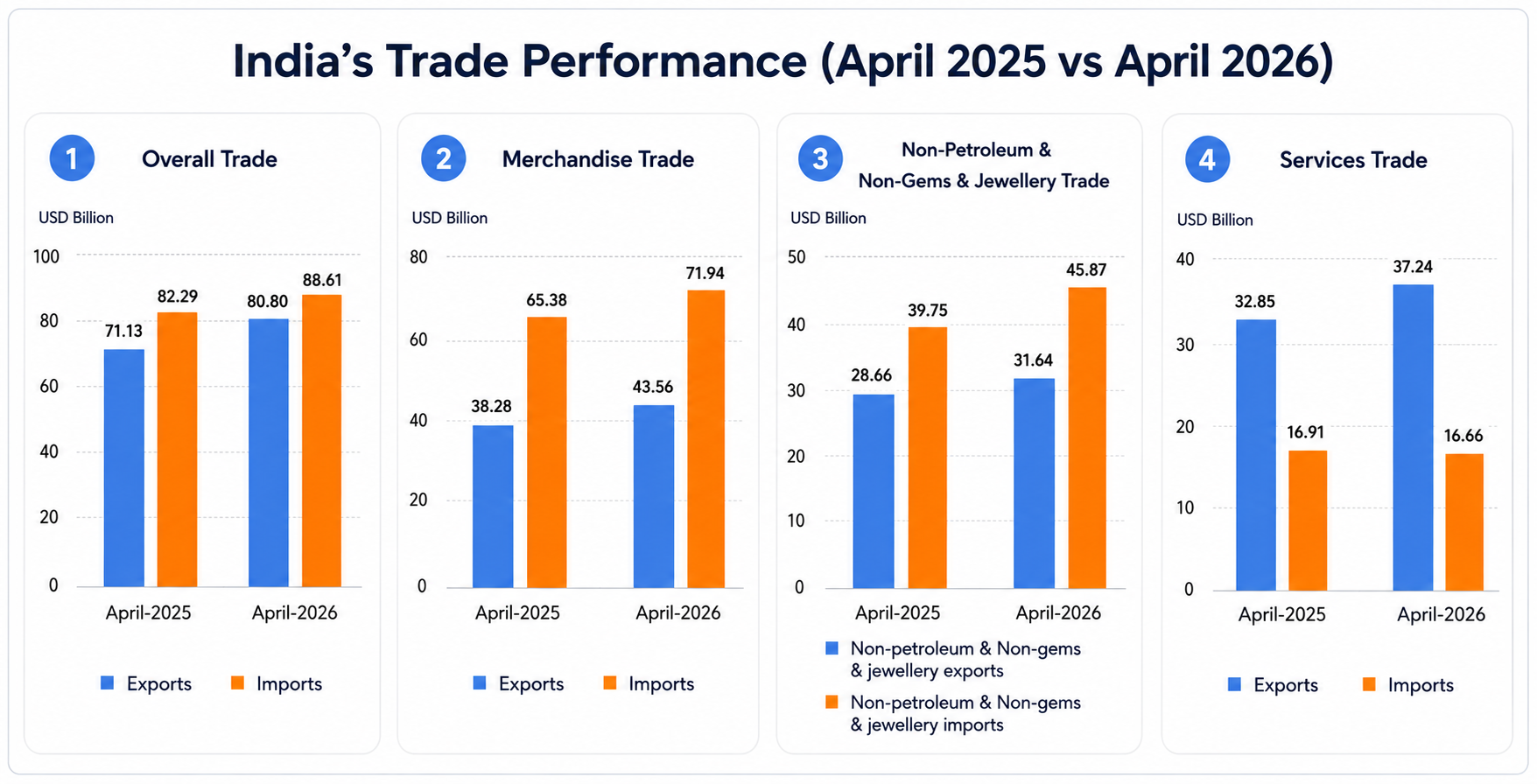
New Delhi: India’s merchandise exports rose 13.78% year-on-year to $43.56 billion in April, recording the strongest monthly outbound trade performance in more than four years and reinforcing the government’s push toward a $1 trillion export target for 2026-27.
Despite strong export growth, imports climbed 10% to a six-month high of $71.94 billion in April, widening the trade deficit to $28.38 billion from $20.67 billion in March, according to the data released by the Ministry of Commerce and Industry on Friday (May 15).
Commerce Secretary Rajesh Agrawal noted that India’s exports “remained resilient” despite geopolitical volatility, especially in West Asia. “The positive value growth may also have some contribution from the price because prices of many things are going up, so that may have some positive impact,” he told reporters.
The latest export surge comes as India rapidly expands its free trade agreement (FTA) network to secure deeper market access across major economies. On Thursday, Commerce and Industry Minister Piyush Goyal had said that India’s FTA network now covers more than two-thirds of global trade after the country signed nine trade agreements over the past three-and-a-half years, bringing 38 economies into closer trade engagement.
Five additional agreements are expected to become operational within the next 12 months, while India is negotiating fresh trade pacts with Chile, Maldives, the Gulf Cooperation Council (GCC), Canada, Eurasia, Mexico, Southern African Customs Union (SACU) and Mercosur. Agreements with Chile and the Maldives are expected to be concluded before the end of the year.
Earlier trade arrangements with Japan, South Korea and the Association of Southeast Asian Nations continue to remain central to India’s export diversification strategy.
Oil Fuels Trade
Petroleum products emerged as the biggest contributor to export growth during the month, with shipments rising 34.66% to $9.6 billion amid a sharp increase in crude oil prices.
Brent crude prices have risen nearly 12% since mid-March to $107.51 per barrel and had briefly touched $126.41 on April 30 as tensions escalated in West Asia.
Electronic goods exports rose 40.31% to $5.17 billion, while meat and dairy shipments expanded 48%. Engineering goods and pharmaceuticals also registered healthy growth of 8.76% and 7.12%, respectively.
Imports remained elevated despite a 10% decline in crude oil purchases to $18.7 billion. Gold imports jumped 81.69% to $5.62 billion, while silver imports surged 157.16% to $411 million, adding pressure on the external account.
The widening trade deficit underscores the impact of higher commodity prices and resilient domestic demand even as export momentum strengthens.
West Asia Impact
India’s trade flows with West Asia weakened sharply amid disruptions in maritime cargo movement linked to the ongoing US-Iran conflict.
Merchandise exports to the region fell 28% to $4.16 billion in April from $5.78 billion a year earlier, while imports declined 31.64% to $10.47 billion from $15.32 billion.
The conflict has disrupted shipping movement through the Strait of Hormuz, forcing exporters to increasingly rely on diversified trade destinations and alternative logistics channels.
India nevertheless recorded strong export growth in markets such as Singapore, Tanzania, Sri Lanka, Bangladesh, Hong Kong, Malaysia, Australia and Vietnam, reflecting the government’s emphasis on widening export destinations through trade agreements and market diversification.
FTAs Drive Ambition
India’s services exports continued to support the broader external sector, rising to an estimated $37.24 billion in April from $32.85 billion a year ago. Services imports moderated slightly to $16.66 billion.
The depreciating rupee has also begun aiding export competitiveness. The Indian currency has weakened more than 6% this year and closed at 95.86 against the US dollar on Friday.
Commenting on the currency movement, Agrawal said, “Till now it has been showing a positive trajectory, and I think the early signs from May also look at me being in positive.”
The government is simultaneously encouraging exporters to settle global trade transactions in rupees, although adoption remains limited. “The movement is still at a very nascent stage,” the secretary remarked.
India’s overall exports touched a record $863 billion in 2025-26, strengthening confidence within the commerce ministry that the $1 trillion export target is achievable through a combination of export promotion schemes, manufacturing growth and the operationalisation of new FTAs.
“New operational agreements will create opportunities for our exporters, which they are already working on to see how best we can leverage it. We are looking forward to the operationalisation of some of these FTAs in the next few months,” Agrawal said.