

New Delhi: India’s biopharma industry is at a turning point. Drug pipelines are expanding beyond traditional small-molecule medicines into biologics, biosimilars, cell and gene therapies, and precision cancer treatments. At the same time, companies face tighter regulatory scrutiny, rising costs and intense global competition.
In this environment, the EY report — EY Pharma’s New Architecture — argues that AI-powered platforms will fundamentally reshape how Indian companies discover, test and manufacture medicines. The report suggests that the change is not just technological but structural, affecting how data is used, how decisions are taken and how research connects with production.
“India stands at a pivotal point in this transformation. With its unique blend of scientific talent, digital depth and large-scale manufacturing capacity, India is the natural home for this integrated model. It is no longer just the ‘pharmacy of the world’, it’s becoming the world's laboratory and digital engine,” says Daniel Mathews, EY Global Life Sciences Leader.
For many years, drug development followed a step-by-step path. Scientists discovered a molecule, tested it in laboratories, moved it into clinical trials and only later prepared for large-scale manufacturing. Different teams often worked in isolation, and information did not always flow smoothly between stages.
That model worked reasonably well for simpler drugs but struggles with today’s more complex therapies. According to the EY report, modern medicines require earlier coordination, faster decisions and better visibility of risks — areas where AI can make a significant difference.
In research, AI is already changing how new medicines are identified. Instead of physically testing thousands of compounds, computer systems can analyze vast amounts of chemical and biological data to predict how a potential drug might behave. These tools can estimate how well a molecule might work, whether it could cause side effects and which patients may benefit most. By narrowing down options before laboratory testing begins, researchers save time and money and improve the chances of success in later stages.
AI tools are also helping scientists review large volumes of medical literature and past trial data much more quickly. Rather than replacing researchers, these systems act as assistants, helping teams identify promising ideas and avoid repeating earlier work. For Indian firms seeking to move beyond generics into innovative products, this boost in efficiency is crucial.
The impact of AI extends into clinical trials. Traditionally, trials were designed using fixed plans and cautious assumptions. Today, AI-based simulation tools can test different trial designs on computers before enrolling patients. These simulations use historical data and disease patterns to predict recruitment challenges, dropout rates and likely outcomes. This allows companies to design smarter, more efficient studies.
During trials, AI systems can monitor incoming data almost in real time. They can flag unusual safety signals, missing information or operational problems early, reducing costly delays. In a country as large and diverse as India, where trial sites can vary in performance, such digital oversight improves consistency and builds regulatory confidence.
Manufacturing is another area where AI is bringing change. Modern biologic drugs are highly sensitive to small changes in temperature, raw materials or production conditions. Traditional batch manufacturing methods, which rely heavily on manual checks, are often not precise enough. AI-enabled systems use sensors and data analytics to monitor production continuously. If something begins to drift from expected standards, the system can alert operators or automatically adjust settings.
These tools also help predict equipment breakdowns before they occur, reducing downtime. For India’s large manufacturing base — long known for generics and vaccines — upgrading to digitally integrated facilities presents both a challenge and an opportunity. While investments are required, AI-driven production can deliver higher quality, faster turnaround times and stronger compliance with global standards.
Supply chains are also becoming more complex, especially for advanced therapies that depend on specialized materials. AI can help companies forecast demand, assess supplier risks and plan alternative sourcing strategies. This makes supply resilience part of early development planning rather than an afterthought.
However, technology alone will not be enough. The transformation described in the report requires new skills and stronger collaboration. AI in drug development demands expertise that combines biology, engineering and data science. Indian companies will need to invest in training and build teams that can translate computer-generated insights into practical decisions.
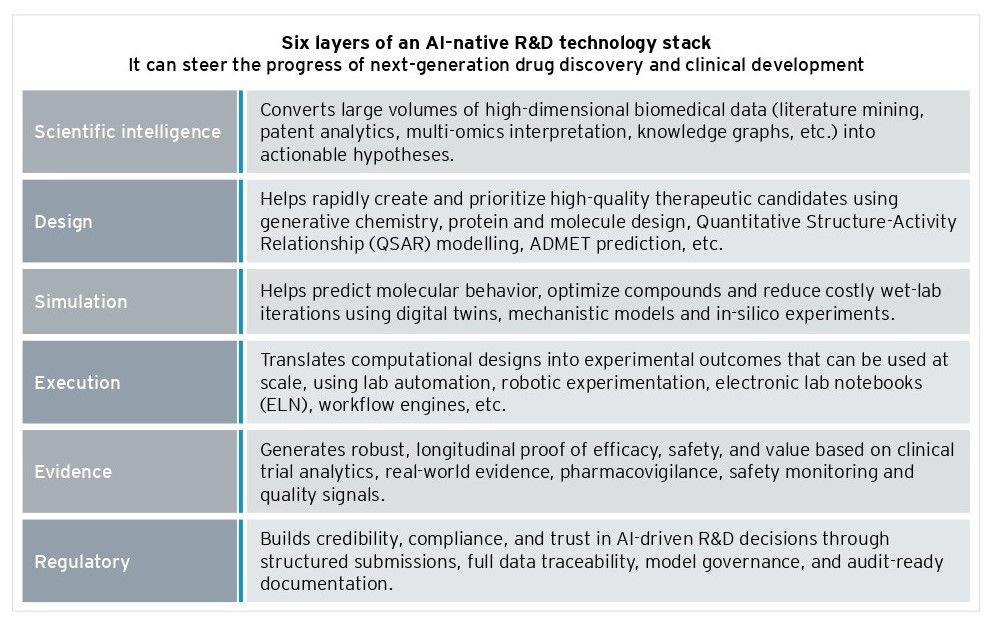
Regulators, too, must adapt. As AI tools influence trial design and manufacturing control, clear guidelines on data integrity, transparency and validation will be essential. Close cooperation between industry and regulators can ensure that innovation moves forward without compromising patient safety.
India has important advantages in this shift. It combines large-scale pharmaceutical manufacturing, growing biotech capabilities and strong digital talent. With the right investments and policy support, these strengths can be integrated into platform-based models that support both innovation and efficiency.
The future of biopharma will depend not only on scientific breakthroughs but also on the systems that turn discoveries into reliable medicines. AI-powered platforms can shorten development timelines, improve trial quality, strengthen manufacturing and make supply chains more resilient.
“For India, this (AI-powered) transition represents both a pivotal moment and a generational opportunity. The country’s pharmaceutical sector is globally recognized for its manufacturing excellence and cost efficiency, providing a robust foundation for a shift toward higher-value innovation. Indian companies are increasingly investing in proprietary biologics, new modality platforms and digital R&D capabilities, leveraging strengths in engineering, data science and scalable production. Future growth will be characterized not just by volume, but by the ability to build platforms, intellectual property and resilient innovation ecosystems,” says Suresh Subramanian Partner, National Life Sciences Leader,EY Parthenon.
“The Union Budget 2026 reinforces this direction through the Biopharma Strategy for Healthcare Advancement through Knowledge, Technology and Innovation (SHAKTI) initiative, an Rs 10,000 crore, five-year program aimed at positioning India as a global biopharma manufacturing hub,” he adds.
For Indian companies, embracing AI deeply within their operations could redefine their global role. Instead of being known primarily as a supplier of affordable generics, India has the potential to emerge as a hub for advanced biopharma innovation. If implemented thoughtfully, AI integration can help manage growing scientific complexity while delivering medicines faster and more reliably to patients.
(Cover photo by Toon Lambrechts on Unsplash)